Showing posts with label award. Show all posts

Wednesday, July 8, 2015

Review: The Family Romanov by Candace Fleming

The Family Romanov--Candace Fleming
January 2014 by Schwartz & Wade
304 pages--Goodreads

From the acclaimed author of Amelia Lost and The Lincolns comes a heartrending narrative nonfiction page-turner. When Russia’s last tsar, Nicholas II, inherited the throne in 1894, he was unprepared to do so. With their four daughters (including Anastasia) and only son, a hemophiliac, Nicholas and his reclusive wife, Alexandra, buried their heads in the sand, living a life of opulence as World War I raged outside their door and political unrest grew into the Russian Revolution.

Deftly maneuvering between the lives of the Romanovs and the plight of Russia’s peasants and urban workers—and their eventual uprising—Fleming offers up a fascinating portrait, complete with inserts featuring period photographs and compelling primary-source material that brings it all to life.


This was a really interesting read.  I was surprised by some of the things I learned, like that the Romanovs were not all killed the very night of the revolution as Bolsheviks stormed the imperial palace.  Granted, all of my previous knowledge about the Romanovs came from the movie Anastasia, so it's not like I was any sort of expert on the family or that time period or anything at all about Russia.  But it still surprised me.  We (I) internalize probably far too much of the faux history presented in fictional tales.  

The Family Romanov:  Murder, Rebellion, and the Fall of Imperial Russia (great title by the way, I love long titles) is more than just a biography of Nicholas Romanov.  It is more even than a biography of him and his family.  This book covers the the legacy of the Romanovs, Nicholas and his family, his poor decisions as a ruler, the Russian aristocracy, the Russian peasantry, the development of the Bolsheviks, Lenin, civil unrest, the revolution, the early attempts at democracy, the transition to communism, the reality of communist Russia not living up to Lenin's ideals, the rise of Stalin, the execution of the royal family, conspiracy theories about the potential escape of some of the royal children, and the discovery of the Romanovs' bodies years later.  Not bad for a children's nonfiction. 

Fleming takes this ambitious scope and presents a narrative that is both interesting and easy to follow.  We really get to know Nicholas and the other Romanovs and we sympathize with them as people.  But we also see how their awful decisions and their oppression of the people led to civil unrest and eventually revolution.

I listened to this on audiobook (which was great for the pronunciations I never would have gotten on my own), so I missed out on all the great photographs in the physical copy.  I've heard they're amazing, so I'll have to drop in at the library and flip through a copy so I can see them.

Friday, June 27, 2014

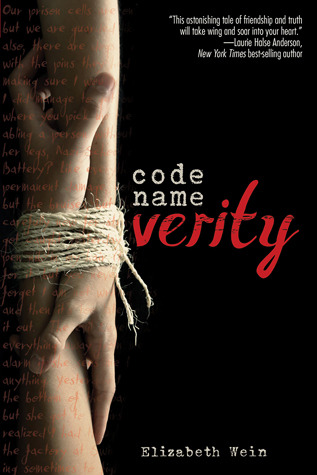
Review: Code Name Verity by Elizabeth Wein

Code Name Verity by Elizabeth Wein
May 2012 by Hyperion Books
343 pages--Goodreads

Oct. 11th, 1943-A British spy plane crashes in Nazi-occupied France. Its pilot and passenger are best friends. One of the girls has a chance at survival. The other has lost the game before it's barely begun.

When "Verity" is arrested by the Gestapo, she's sure she doesn't stand a chance. As a secret agent captured in enemy territory, she's living a spy's worst nightmare. Her Nazi interrogators give her a simple choice: reveal her mission or face a grisly execution.

As she intricately weaves her confession, Verity uncovers her past, how she became friends with the pilot Maddie, and why she left Maddie in the wrecked fuselage of their plane. On each new scrap of paper, Verity battles for her life, confronting her views on courage, failure and her desperate hope to make it home. But will trading her secrets be enough to save her from the enemy?


There was so much hype surrounding this book.  It won a Printz honor.  Many people raved about it and gave it 5-star reviews.  It was on all the recommendation lists for a little while.  And it wasn't bad; I actually quite liked it.  But it is slow.  Very slow.  The ending is fantastic, but you have to be willing to push through the first half of the novel to get there.  I read Code Name Verity using the audiobook, which worked out quite well.  The narration was excellent and it kept me going through the less-engaging first half of the novel.

I loved how well we got to know Julie and Maddie.  This book is sometimes pitched as a spy novel, which is just misleading.  No Bond or Borne here.  This is a book about the friendship between two young women, albeit in rather dangerous circumstances, but the events of WWII take a distant back seat to the women's friendship.  And I honestly don't remember the last time I read a young adult (not middle grade or children's) novel that celebrated love between friends with absolutely no romance whatsoever getting in the way.  Though it was slow, I do appreciate the development of their relationship.

Without being gratuitous, this book is honest in its descriptions of torture, interrogation, and execution.  But with its level of violence and some strong language, it is not a book for younger readers.

This next paragraph is spoilery, so feel free to skip it.  
I can't think of the last time an author has pulled off an unreliable narrator so well.  As I read the second half of the book and realized what Julie had done, I had to keep flipping back to earlier in the novel to see how she had done it (I actually had both a physical copy in addition audiobook).  Suffice it to say, there were many "What the heck!?" moments.  And the best part is Wein tells us from the start that there would be an unreliable narrator.  She says in the first few pages that sabotage is integral to the mission of a captured combatant.  It was sort of like Michael Cane's bookend statements in The Prestige about how you look for the secret but you won't find it because you want to be fooled.  

Code Name Verity is a well-written novel with excellent characters.  It's not as fast or exciting as the hype or description implies, but if you can put in the investment, it is worth it.

Monday, January 20, 2014

Review: The Evolution of Calpurnia Tate by Jacqueline Kelly

The Evolution of Calpurnia Tate--Jacqueline Kelly
May 2009 by Henry Holt
338 pages--Goodreads

Calpurnia Virginia Tate is eleven years old in 1899 when she wonders why the yellow grasshoppers in her Texas backyard are so much bigger than the green ones.With a little help from her notoriously cantankerous grandfather, an avid naturalist, she figures out that the green grasshoppers are easier to see against the yellow grass, so they are eaten before they can get any larger.

As Callie explores the natural world around her, she develops a close relationship with her grandfather, navigates the dangers of living with six brothers, and comes up against just what it means to be a girl at the turn of the century.

Debut author Jacqueline Kelly deftly brings Callie and her family to life, capturing a year of growing up with unique sensitivity and a wry wit.


The Evolution of Calpurnia Tate is a highly enjoyable read with a gorgeous cover (I love silhouettes and scroll-work; this cover has both).  Made up of vignettes about one summer and fall, Callie's story is reminiscent of Anne of Green Gables and Little House on the Prairie with some Darwinian science thrown in.  I love Callie's adventures as a young naturalist, roaming the riverbed, collecting bugs and other scientific samples.  I especially love the relationship between her and her grandfather.

Callie's voice is distinct from the very start.  The writing in general is strong, but particularly in Callie's narrative voice.  She's a memorable character, and I love her spunk and determination.  Her observations about the world and people are hilarious, especially when three of her brothers have crushes on the same friend at the same time and Callie gets sick of being the middleman.  The brothers themselves are great.  I love Travis and his kittens and his unfortunate attachment to the family turkeys.

This novel presents a great coming of age story.  I completely understand Callie's desire to do something more than the life that was chosen for her, how she feels trapped by the societal and familial expectations that don't match up with her dreams.  This conflict is left mostly unresolved, and while I can understand why (time constraints--it would take years for Callie to work this out and this story only covers six months.) the ending feels just a bit incomplete.  I want some sort of reconciliation between Callie and her mother.

I wish this book had been around when I was younger.  Callie, Anne, Laura, and I would have been the best of friends despite differences in time, location, and fictionality.  There's just a bit of mild language (which I note only so I remember not to recommend the book to my ultra-ultra-sensitive students).  The Evolution of Calpurnia Tate is a well-written and thoroughly enjoyable book.  

Sunday, August 25, 2013

Review: Sold by Patricia McCormick

Sold--Patricia McCormick
September 2006 by Disney Hyperion
263 pages--Goodreads

Lakshmi is a thirteen-year-old girl who lives with her family in a small hut on a mountain in Nepal. Though she is desperately poor, her life is full of simple pleasures, like playing hopscotch with her best friend from school, and having her mother brush her hair by the light of an oil lamp. But when the harsh Himalayan monsoons wash away all that remains of the family’s crops, Lakshmi’s stepfather says she must leave home and take a job to support her family.

He introduces her to a glamorous stranger who tells her she will find her a job as a maid in the city. Glad to be able to help, Lakshmi journeys to India and arrives at “Happiness House” full of hope. But she soon learns the unthinkable truth: she has been sold into prostitution.

An old woman named Mumtaz rules the brothel with cruelty and cunning. She tells Lakshmi that she is trapped there until she can pay off her family’s debt—then cheats Lakshmi of her meager earnings so that she can never leave.

Lakshmi’s life becomes a nightmare from which she cannot escape. Still, she lives by her mother’s words— Simply to endure is to triumph—and gradually, she forms friendships with the other girls that enable her to survive in this terrifying new world. Then the day comes when she must make a decision—will she risk everything for a chance to reclaim her life?

Written in spare and evocative vignettes, this powerful novel renders a world that is as unimaginable as it is real, and a girl who not only survives but triumphs.


Sold is an unexpected gem.  Kudos to McCormick for managing to take on such a difficult subject as sex trafficking in a realistic way without making me feel uber depressed.  We see everything that happens to Lakshmi without it becoming gratuitous.  We see the victimization, the drugging, the violence, the disease, the crushing social stigmas, the hopelessness, and the hope.  
This book is real.  I come away from this book feeling like I know Laksmi's home life.  I know her life in Calcutta.  I know the other girls in the brothel.  The whole book just feels real.

I couldn't even bring myself to hate Mumtaz.  She's definitely the villain, but she's not demonized.  I wish McCormick had given her a back story.  I imagine she herself was sold when she was young and is just as trapped in this life as the other girls.


I cannot express how much I love the scenes with Monica.  I love her character.  I love how sharp she is on the outside to protect the teddy-bear-holding child on the inside.  I love her conversation with Lakshmi about their reasons for staying at the brothel.  Ignoring the fact that they cannot leave, they cling to the last shred of dignity this life leaves them.  Monica proclaims she is paying her daughter's school fees and Lakshmi tells of the tin roof she will buy for her family.  This life has torn everything from them, but they hold some small pride in order to survive.  I hate but recognize the reality that Monica is forced to return to the brothel when her family casts her out.  Prostitution is the only life society has left for her.  And when she leaves the brothel because she has contracted AIDS, we never hear about her again because we can never know what happened to this girl who slipped through the cracks of an unjust world.


Even though Sold is a short novel, it is just the right length for the story it tells.  The audio book is excellent, but now that I realize the book is written in verse, I wish I had read it in print. This is a beautiful novel.  It is a realistic portrayal of a horrible life that is still hopeful and appropriate for young adult readers.  Though, it's probably too much for most middle graders.

Tuesday, July 23, 2013

Review: Dodger by Terry Pratchett

Dodger--Terry Pratchett
September 2012 by Harper Collins
360 pages--Goodreads

A storm. Rain-lashed city streets. A flash of lightning. A scruffy lad sees a girl leap desperately from a horse-drawn carriage in a vain attempt to escape her captors. Can the lad stand by and let her be caught again? Of course not, because he's...Dodger.

Seventeen-year-old Dodger may be a street urchin, but he gleans a living from London's sewers, and he knows a jewel when he sees one. He's not about to let anything happen to the unknown girl--not even if her fate impacts some of the most powerful people in England.

From Dodger's encounter with the mad barber Sweeney Todd to his meetings with the great writer Charles Dickens and the calculating politician Benjamin Disraeli, history and fantasy intertwine in a breathtaking account of adventure and mystery.


This book is a lot of fun.  Dodger is a hilarious swindler who would take offense at being called a thief; he just finds things that have been misplaced, or would have been misplaced soon anyways.  But he's good-hearted and skilled at what he does.

I love Terry Pratchett's style of narration.  Something about the straight-faced, understated, tongue in cheek humor just captivated me from the very beginning of the novel.  Maybe it's the word play, things like Dodger learning how to be a successful urchin by learning how to urch or a man giving Dodger a cursory glance with a good deal of curse in it.  It's not a style that works for everyone, but it works perfectly for me.  It's just funny.  I loved each time Mr. Dickens stole a title or line for his future books from Dodger.

Dodger is historical fiction in the same way that Leviathan is historical fiction.  Pratchett calls it historical fantasy.  Is it entirely plausible that all this stuff in this book (multiple assassination attempts, several heroics, being raised from rags to riches, etc) happens in just week?  No. But who cares?  This is the sort of book that throws plausibility out the window and says "wouldn't it be cool if.." Pratchett fudges dates and places to make it work out so all his historical figures can come together.  If you can accept that, the book is fun.  Otherwise, the craziness will bug you.  

My only question is why didn't we get more of the Outlander?  That was a serious let down.  It could have been so cool to have a *SPOILER* lady assassin after Dodger for most of the book.  Instead, Pratchett doesn't build up nearly enough tension and throws the Outlander in at the very tail end of the book with no explanation or development.  Most of the villains are like that too, more boogy men than fleshed out threats.

I will definitely have to give some of Pratchett's other books a try.  I really liked Dodger, but it's a book I'd hesitate to recommend.  I can't even pin down exactly what it was that made me like it, so I don't know what to identify in other readers that would make them like it.  It's an interesting read.

Wednesday, July 17, 2013

Review: They Called Themselves the K.K.K. by Susan Campbell Bartoletti

They Called Themselves the K.K.K: The Birth of an American Terrorist Group--Susan Campbell Bartoletti
August 2010 by Houghten Mifflin Books for Children
172 pages--Goodreads

"Boys, let us get up a club."

With those words, six restless young men raided the linens at a friend’s mansion in 1866. They pulled white sheets over their heads, hopped on horses, and cavorted through the streets of Pulaski, Tennessee. Soon, the six friends named their club the Ku Klux Klan and began patterning their initiations after fraternity rites, with passwords and mysterious handshakes. All too quickly, this club would grow into the self-proclaimed “Invisible Empire,” with secret dens spread across the South. On their brutal raids, the nightriders would claim to be ghosts of Confederate soldiers and would use psychological and physical terror against former slaves who dared to vote, own land, attend school, or worship as they pleased.

This is the story of how a secret terrorist group took root in America’s democracy. Filled with chilling and vivid personal accounts unearthed from oral histories, congressional documents, and other primary sources, this is a book to read and remember.


This is a very interesting and compelling read.  They Called Themselves the K.K.K. does a wonderful job of contextualizing the Klan within the Reconstruction.  I appreciate that Bartoletti uses this book to really try to understand the Klansmen, their reasons, and their motivations.  Rather than just condemning the acts of the Klan, which we already know are wrong, the book explores why a person would be driven to join a hate group and do monstrous things.  This is what I like best about this book and this is exactly where Superman Versus the Ku Klux Klan falls very, very flat.  I read non-fiction to understand, not to rehash oversimplified good-bad dichotomies.  

On that note, I love the quote by W.E.B. Du Bois about Klansmen: "These human beings at heart are desperately afraid of something.  Of What?  Of many things, but usually of losing their jobs, being declassed, degraded, or actually disgraced; of losing their hopes, their savings, their plans for their children; of the actual pangs of hunger, of dirt, of crime."   I think fear is a big part of what drives prejudice.

This book focuses on the early development of the Klan during Reconstruction.  I expected it to spend more time on the Jim Crow Era and the Civil Rights movement.  It's still good, and I will definitely be able to use Chapter 6 about Klan violence against sharecroppers during my Roll of Thunder unit. 

The audiobook for They Called Themselves is excellent, but somethings just don't work well in that format, specifically the timeline.  The physical book is a good balance of text, white space, insets, and  pictures, though the dialects might be difficult to understand in print.  The source material occasionally uses offensive language or images, but it is handled tastefully.  Bartoletti doesn't censor the history.

The source notes are definitely worth a look, especially the bit about Bartoletti's visit to a modern day Klan meeting.  It's creepy.  The Klan still uses the same rhetoric and fans the flames of the same fears about people who are different.  Children are still learning this close-minded life view, and not just in Klan families.  These same arguments are  prevalent in today's politics, though in a diluted form.  That's why meaningful interaction with people who are different from you is important.  

All in all, They Called Themselves the K.K.K. is a well researched, engaging, well crafted narrative and excellent non-fiction text.

Thursday, July 4, 2013

Review: Bomb by Steve Sheinkin

Bomb:  The Race to Build--and Steal--the World's Most Dangerous Weapon--Steve Sheinkin
September 2012 by Flash Point
266 pages--Goodreads

In December of 1938, a chemist in a German laboratory made a shocking discovery: When placed next to radioactive material, a Uranium atom split in two. That simple discovery launched a scientific race that spanned 3 continents. In Great Britain and the United States, Soviet spies worked their way into the scientific community; in Norway, a commando force slipped behind enemy lines to attack German heavy-water manufacturing; and deep in the desert, one brilliant group of scientists was hidden away at a remote site at Los Alamos. This is the story of the plotting, the risk-taking, the deceit, and genius that created the world's most formidable weapon. This is the story of the atomic bomb.


This is one of those books that has won so many awards that you wonder if it can ever live up to it's reputation.  Bomb does.  Beginning with an FBI take down of a Soviet spy, this book is engrossing.  Science.  Spies (willing and reluctant).  A world war.  More spies.  It's a book that both teens and adults can enjoy. 

Sheinkin does an excellent job of interweaving primary sources with exposition.  With firsthand accounts from scientists, spies, pilots, politicians, and survivors, the entire book is interesting.  Unlike some nonfiction texts, Bomb makes history accessible.  You don't need much background in the history or science to understand and enjoy the book.  Sheinkin also gives us a sound understanding of the context of the decision to use the bomb.  He makes us understand why Truman felt justified in using the bombs on Japan, but he still acknowledging the horror of what happened.  He neither excuses nor condemns.  He just lays out what happened and lets us draw our own conclusions.  

The ending is positively chilling.  "The making of the atomic bomb is one of history's most amazing examples of teamwork and genius and poise under pressure.  But it's also the story of how humans created a weapon capable of wiping our species off the planet.  It's a story with no end in sight.  And, like it or not, you're in it."

My only question is, where were the Germans in all of this?  I know the focus of the book is America vs Soviet Union, but come on.  There's no way they weren't spying on the Americans.  Yes, it creates tension to not know how close the Germans were to completing the bomb while the Americans faced set back after set back, but still.   

Bomb is no dull history text book.  It is an interesting and engaging text worth every award it has received.   I haven't been so engaged in a nonfiction text in ages.  Both the topic and the writing style are excellent.  

Tuesday, June 4, 2013

Review: Airborn by Kenneth Oppel

Airborn--Kenneth Oppel
May 2004 by Harper Collins
544 pages--Goodreads

Matt Cruse is a cabin boy on the Aurora, a huge airship that sails hundreds of feet above the ocean, ferrying wealthy passengers from city to city. It is the life Matt's always wanted; convinced he's lighter than air, he imagines himself as buoyant as the hydrium gas that powers his ship. One night he meets a dying balloonist who speaks of beautiful creatures drifting through the skies. It is only after Matt meets the balloonist's granddaughter that he realizes that the man's ravings may, in fact, have been true, and that the creatures are completely real and utterly mysterious.

In a swashbuckling adventure reminiscent of Jules Verne and Robert Louis Stevenson, Kenneth Oppel, author of the best-selling Silverwingtrilogy, creates an imagined world in which the air is populated by transcontinental voyagers, pirates, and beings never before dreamed of by the humans who sail the skies.


From the first sentence, I was glued to the page, err, to the ear phones...since it was an audiobook.  That idiom doesn't really translate.  Anywho, it pulled me in right from the start, and I don't know that I can actually nail down what exactly it was that pulled me in.  Maybe it's just the spirit of the adventure.  There's something terribly compelling about swashbuckling, sailing novels, and I especially love air ships.  Airborn is like Leviathan but without the geopolitical stuff.  Just sailing.  Flying.  Exploring.  Soaring.

And excellent characters.  Matt is one of those genuine, root-for-able, hardworking, underdog characters.  He's not a terribly deep character, but I did appreciate the angle with him dealing with his father's death.  Kate is annoyingly short sighted and irresponsible, but her rigid determination is part of why I like her.  In general, the characters are not particularly deep or dynamic.  Airborn is a bit gimicky in the same way Dark Life is with one life-threatening situation and escape after another.  But you know what?  I didn't care this time.  I just got caught up in the adventure.

The audiobook is excellent.  It's a full cast recording with excellent choices for each of the voice actors.  It's definitely worth it if you're looking for something to listen to.

After reading This Dark Endeavor, I was worried that Airborn would just be okay, but it was great.  I couldn't put it down, even when I was supposed to be reading books to plan for next year's curriculum.  It's a thick book, but you can whip through it quickly.

And also SKY PIRATES!!! What else do you need?

Friday, May 10, 2013

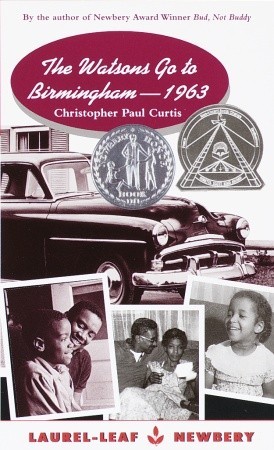
Review: The Watsons Go to Birmingham--1963 by Christopher Paul Curtis

The Watsons Go to Birmingham--1963--
Christopher Paul Curtis
1995 by Laurel-Leaf
210 pages

Enter the hilarious world of ten-year-old Kenny and his family, the Weird Watsons of Flint, Michigan. There's Momma, Dad, little sister Joetta, Kenny, and Byron, Kenny's older brother, who, at thirteen, is an "official juvenile delinquent."

When Momma and Dad decide it's time for a visit to Grandma, Dad comes home with the amazing Ultra-Glide, and the Watsons set out on a trip like no other. Heading South, they're going to Birmingham, Alabama, and toward one of the darkest moments in America's history.


In fourth grade teacher, my teacher read Bud Not Buddy aloud to our class, and I did not like it.  I was in my fantasy-only phase, and a story about a boy searching for his father during the depression didn't interest me at all.  Reading The Watsons Go to Birmingham--1963 makes me realize I should probably go back and give Bud a second chance.   

The Watsons is excellent.  It doesn't have an overarching plot; it's more a series of vignettes about Kenny and his family.  Most Civil Rights Movement books are entirely about racism and persecution and the need for equality and the injustices, but this book didn't go into all that until the very end.  It was kind of nice to just see what life was like in the 60's for an average family.  Kenny's antics prove that it wasn't all that much different from life today.

I like Kenny's voice.  He habitually exaggerates his adventures and his descriptions, making an entertaining read.  He reuses phrases like "talking a mile a minute" or "you might as well have him up to a tree and said ready, aim fire."  This could be seen as annoying, but coming from Kenny,I liked it.  His repetitions are a sort of familiar refrain throughout the novel.

The audiobook is excellent.  It's narrated by LeVar Burton, so the whole book is basicaly an extended episode of Reading Rainbow.  Nostalgia!  And Burton's narration matches well with Kenny's exuberant storytelling.

The last couple of episodes are unexpected heavy, given the light tone of the rest of the book, but they make up my favorite part of the novel.  I love Curtis's exploration of something like post traumatic stress disorder as Kenny tries to make sense of the horrible things he saw.  Kenny's not quite a naive narrator, but because of his youth or his shock, he can't comprehend what happened.  It's a really interesting last couple of chapters.  But fear not; we don't end on a despairing note.  We even sort of almost actually like Byron by the end.

The Watson's Go to Birmingham--1963 is a satisfying and thought provoking read that I liked much more than I expected.

Wednesday, April 10, 2013

Mini Review: One Crazy Summer by Rita Williams-Garcia

One Crazy Summer--Rita Williams-Garcia
January 2010 by Amistad
218 pages--Goodreads

In the summer of 1968, after travelling from Brooklyn to Oakland, California, to spend a month with the mother they barely know, eleven-year-old Delphine and her two younger sisters arrive to a cold welcome as they discover that their mother, a dedicated poet and printer, is resentful of the intrusion of their visit and wants them to attend a nearby Black Panther summer camp.


This was a decent read, but it just kind of throws you into the middle of the Black Panthers without any explanation whatsoever.  As most of the middle graders reading this book won't know much about the Black Panthers going into the book, the will probably be lost.  I know books aren't meant to be history lessons, but a bit more background information would have been nice.

The relationship between the sisters is realistic sweet.  However, I think this is one of those books that adults like but kids find a hard time relating to.

Sunday, April 7, 2013

Review: Rules by Cynthia Lord

Rules--Cynthia Lord
April 2006 by Scholastic Press
208 pages--Goodreads

A heartfelt and witty debut about feeling different and finding acceptance--beyond the rules.

Twelve-year-old Catherine just wants a normal life. Which is near impossible when you have a brother with autism and a family that revolves around his disability. She's spent years trying to teach David the rules-from "a peach is not a funny-looking apple" to "keep your pants on in public"-in order to stop his embarrassing behaviors. But the summer Catherine meets Jason, a paraplegic boy, and Kristi, the next-door friend she's always wished for, it's her own shocking behavior that turns everything upside down and forces her to ask: What is normal?


Rules is a poignant (Who decided that word should have a g?  It should be poinient) read that draws you in.  I LOVE the relationship between Catherine and David.  It is touching and sweet, and it is the most accurate representation of that feeling of they're messing things up for me and everyone's staring at me and I hate this but I can't be mad at you because it's not your fault and I know you're trying, but still...  The representation of Catherine's relationship with her parents is great too.  

Lord has an autistic child, so I'm going to assume the representation of autism is accurate to at least her own experience.  And Rules won the Schneider Family Book Award, which is kind of the Newbery for books describing the experience of a child or adolescent with disabilities.  It also won a Newbery Honor.

The book is a little bit dated with details like the VCR tapes that Catherine has to keep winding when the tape pulls out of the cassette.  I remember that, but readers more than five years younger than me probably won't.

Wanting to be accepted is a universal desire, not just limited to those with a disability or those who have a family member with a disability.  Rules captures that longing excellently It is short.  It is sweet.  It is a tearjerker.  I read it in a single day.  It is a great read.

Sunday, March 10, 2013

Review: Monster by Walter Dean Myers

Monster--Walter Dean Myers
April 1999 by Amistad
288 pages--Goodreads

FADE IN: INTERIOR: Early morning in CELL BLOCK D, MANHATTAN DETENTION CENTER.

Steve (Voice-Over)Sometimes I feel like I have walked into the middle of a movie. Maybe I can make my own movie. The film will be the story of my life. No, not my life, but of this experience. I'll call it what the lady prosecutor called me ... Monster.


This is one of those novels that has won so many awards and is a staple in so many Adolescent lit classes that you wonder if the actual book can live up to its reputation.  Monster does.  I sped through the book in just a couple of days and had only three pages to go when one of my classes began and I had to spend the whole class dying to know what happened.  

Steve is on trial for murder.  Witnesses say he was the lookout for some other guys who robbed a convenience store and shot the owner.  The book is a screenplay, written by Steve, about the trial.  I liked the screenplay format.  It makes the book a quick read, and all that white space makes the book look accessible.  Some readers see this as a ploy or gimmick, but I don't.  I see it as a way for Steve to work through what was happening to him.

However, partly because of the format, we don't get to know Steven well.  The novel only centers around the actual trial, not his life before.  And despite being in his head the whole time, Steven is still a mystery to us at the end of the novel.  He is an interesting character and I would have liked more background information about him and his family.  I realize that this kind of goes against the point of the book (to determine Steve's guilt or innocence just with the limited evidence we get), but still.

I like how the book addresses the criminal justice system and the preconceived notions we have about the accused.  We forget that in the eyes of the law, a defendant is innocent until the prosecution proves otherwise.  This book also made me realize the difference between "innocent" and "not guilty."  Maybe a particular person did commit a crime, but if there is no evidence to prove guilt, the law cannot touch them.  In that light, I love how Myers leaves Steve's innocence or guilt ambiguous.  I won't spoil the court verdict, but we really don't know whether Steve participated in the theft.  Is he evading responsibility for his actions or being rightly served by justice?  

This book also forces us to look at, in a very small degree, the violence that goes on in prisons.  We tend to ignore the fate of inmates because we don't have to see them and subconsciously we think, "They broke the law, so they deserve what they get."  But even criminals don't deserve to be assaulted and beat up on a regular basis.  The novel deals with some heavy, mature subjects, but it is actually pretty light on swearing, which surprised me.

This book made me think about a lot of things. I liked it, and I think it is a book that would resonate with a lot of teens.

Monday, January 21, 2013

Review: American Born Chinese by Gene Luen Yang

American Born Chinese--Gene Luen Yang
September 2006 by First Second
240--Goodreads

A tour-de-force by rising indy comics star Gene Yang, American Born Chinese tells the story of three apparently unrelated characters: Jin Wang, who moves to a new neighborhood with his family only to discover that he’s the only Chinese-American student at his new school; the powerful Monkey King, subject of one of the oldest and greatest Chinese fables; and Chin-Kee, a personification of the ultimate negative Chinese stereotype, who is ruining his cousin Danny’s life with his yearly visits. Their lives and stories come together with an unexpected twist in this action-packed modern fable. American Born Chinese is an amazing ride, all the way up to the astonishing climax.


This was my second try with graphic novels, and this time it turned out quite well.  Balancing the themes of identity, isolation, assimilation, and friendship, Yang's graphic novel is split between three seemingly unrelated stories that come together in the end.  


What I loved most about the book was that this is not a story just for Chinese Americans or even just for recent immigrants.  Danny's and Jin's and even the Monkey King's stories are relate-to-able to anyone who has ever felt like they didn't fit in, which is pretty much everyone.  The whole point of the book is to be what you are, but that theme is not presented like a preachy self-confidence lesson.  The novel recognizes how hard it is to be yourself when yourself doesn't fit in.  It acknowledges that some people are and will always be jerks.  It captures awkward and sometimes rocky teenage friendships in such a way that we can all see something reflected from ourselves.

Yang's illustration style is a bit more comic-book-like than I am used to.  The characters are drawn with rounded edges, and the whole book uses a bright color palate.  However, the illustrations are deep in their simplicity.  They say a lot with few or no words.  

A few minor complaints.  I was annoyed by the body humor (fart jokes and the like), but the book is about teenage boys.  You can't teach Jr. High kids a lesson on onomatopoeia without "fart" and "burp" causing giggles.  Also, I think the Monkey King's reversal was too swift; we aren't prepared for his complete change in his personality.  I can see why it happened, given the ending, but I would have liked a bit more development in his change.

This book can be enjoyed on many different levels.  Some readers will pick up American Born Chines expecting a light, easy read, and I think they'll be surprised at how deep it is.  I liked it.  I can see why it won the Printz.

Friday, November 23, 2012

Review: Roll of Thunder, Hear My Cry by Mildred D. Taylor

Roll of Thunder, Hear My Cry--Mildred D. Taylor
1976 by Puffin
276 pages--Goodreads

Ever since it won the 1977 Newbery Medal, Roll of Thunder, Hear My Cry has engaged and affected millions of readers everywhere. Set in a small town in Mississippi at the height of the Depression, this powerful, moving novel deals with issues of prejudice, courage, and self-respect. It is the story of one family's struggle to maintain their integrity, pride, and independence in the face of racism and social injustice. It is also the story of Cassie Logan, an independent girl who discovers over the course of an important year why having land of their own is so crucial to her family. The racial tension and harrowing events experienced by young Cassie, her family, and her neighbors cause Cassie to grow up and discover the reality of her environment.


I first read Roll of Thunder in 7th grade and I despised it.  I hated it with the fiery passion of a thousand suns.  Okay, maybe that's an overstatement, but I thought it was dead boring.  I liked reading fantasy and that was about it.  I knew little about the Depression or segregation.  I didn't like historical fiction much and the story of a black family in the South didn't interest me at all.  I just didn't have the context to appreciate it.  I may not be giving my 7th grade teacher enough credit.  He may well have contextualized the novel, but I don't remember anything other than just reading the book.  Reading it now knowing much more about the Jim Crow era and what it meant to be black in the South during the depression, knowing about not just Martin Luther King Jr but Emmett Till and lynch mobs, having more context I appreciated the story much more.  It's still a slow moving novel, but it is very good.

I got a lot of To Kill a Mockingbird vibes while reading this, but Roll of Thunder is a more immediate story.  As much as I like Scout and Atticus, they are not part of the black community.  All they risk is scorn; the Logans risk losing everything.  Their danger is ever-present and real.  Mockingbird has a wider focus and as such, loses some intensity while Roll of Thunder is tightly focused.

The characterization is great.  The lines of good and bad are not drawn down racial lines.  It's not super in-depth since it is a children's book, but there is some complexity in the characters.  Mr. Jamison is an honest, decent white lawyer.  Jeremy likes the Logans despite the racism in his family.  Many of the black families want to support the Logan's boycott, but they also need to survive.  TJ has been wronged by the system but is not absolved of personal responsibility in his bad choices.  Uncle Hammer's anger is justified, but his violent reactions are not.

I really appreciated the relationship between Mama and Cassie.  How do you raise a black child and teach her to have self respect, but also teach her that white folk won't see her as worth anything and she'll have to act a certain way to survive?  How do you decide how much to tell your child about the brutality going on around her when you know she sees some of it but may not understand everything?  How do you balance the need to protect your child with the need to let her grow up?

The book did a wonderful job of portraying racism through the eyes of a child.  How does a nine year old even process that she is despised because of the color of her skin?  Does she really understand what it means that the night men are riding?  Does she understand that her family could not just lose the land, but her father could be beaten or tarred or lynched?

The novel uses n word occasionally, and I can see this bothering some readers.  I don't particularly like the word's use, but I think it is justified in this story.  Taylor says in the introduction to the novel that history is not politically correct, that racism it is not polite; it is full of pain.  She does not sugar coat things or shy away from the truth.  She is tasteful about her use of the word, but you will want to take that into consideration in recommending the book to young readers.

The book loses points because while it is excellent now, it didn't appeal to me at all as a kid and I think many of my classmates agreed with me.  I feel like some Newbery winners are amazingly written from the perspective of adults, but kids don't like or appreciate them.  And if kids don't like the book, what's the point?

LinkWithin

Related Posts Plugin for WordPress, Blogger...