Showing posts with label multicultural. Show all posts

Monday, March 9, 2015

Review: A Path Appears by Nicholas D. Kristof and Sheryl WuDunn

A Path Appears: Transforming Lives, Creating OpportunityA Path Appears--Nicholas D. Kristof and Sheryl WuDunn
September 2014 by Knopf
400 pages--Goodreads

An essential, galvanizing narrative about making a difference here and abroad—a road map to becoming the most effective global citizens we can be.

In their number one New York Times best seller Half the Sky, husband-and-wife team Nicholas D. Kristof and Sheryl WuDunn brought to light struggles faced by women and girls around the globe, and showcased individuals and institu­tions working to address oppression and expand opportunity. A Path Appears is even more ambi­tious in scale: nothing less than a sweeping tap­estry of people who are making the world a better place and a guide to the ways that we can do the same—whether with a donation of $5 or $5 mil­lion, with our time, by capitalizing on our skills as individuals, or by using the resources of our businesses.

With scrupulous research and on-the-ground reporting, the authors assay the art and science of giving, identify successful local and global initia­tives, and share astonishing stories from the front lines of social progress. We see the compelling, in­spiring truth of how real people have changed the world, upending the idea that one person can’t make a difference.

We meet people like Dr. Gary Slutkin, who devel­oped his landmark Cure Violence program to combat inner-city conflicts in the United States by applying principles of epidemiology; Lester Strong, who left a career as a high-powered television anchor to run an organization bringing in older Americans to tu­tor students in public schools across the country; MIT development economist Esther Duflo, whose pioneering studies of aid effectiveness have revealed new truths about, among other things, the power of hope; and Jessica Posner and Kennedy Odede, who are transforming Kenya’s most notorious slum by ex­panding educational opportunities for girls.

A Path Appears offers practical, results-driven advice on how best each of us can give and reveals the lasting benefits we gain in return. Kristof and WuDunn know better than most how many urgent challenges communities around the world face to­day. Here they offer a timely beacon of hope for our collective future.


This book is ambitious.  I don't know that I've seen such a wide scope in a single book before.  In general, A Path Appears is about increasing opportunity, both domestically and internationally.  More specifically, it covers education, crime, poverty, malnutrition, gang violence, addiction, sex trafficking, early childhood intervention, prenatal care, family planning, agriculture, mentoring, literacy, charity, business, advocacy, human psychology, metrics, investments, marketing, and pretty much everything else under the sun that can be linked to aid work.  Kristof and WuDunn take a strategic, research based approach to determining the efficacy of aid groups and evaluating which groups make the most impact per dollar.

The book is peppered with suggestions for how you can get involved in making a difference.  If you take anything from this book it is the idea that ordinary people, not just millionaires, can make a significant difference in the world by making smart aid decisions.  Pick a cause, and the book probably describes a group that addresses that cause.

I was disappointed that the book didn't spend more time on sex trafficking or domestic violence. The accompanying PBS documentary dedicated an episode each to those two issues, and they are super important.  Sex trafficking in particular doesn't get the kind of attention it needs.  Looking at that decision from further back however, it makes a bit of sense.  A documentary on sex trafficking will pull in more attention and funding than one on micro nutrients and efficacy metrics.  And a chunk of people who watch the documentary will go off and immediately start reading the book (me), so I suppose it was an effective marketing strategy.

This book is important, yes, but it is also compelling.  Kristof and WuDunn are excellent story tellers.  They make you care about each and every one of the people they highlight and the many dozens of causes those people support.  They manage to capture the magnitude of these problems without making you feel helpless.  Rather leaving you drowning in a sea of unfillable need, they empower you with tools to do good.  A Path Appears is a must read for anyone who wants to make a positive difference in the world, whether in your own neighborhood or on the other side of the world.  And if you haven't read their earlier book, Half the Sky, do that right now.

Tuesday, August 5, 2014

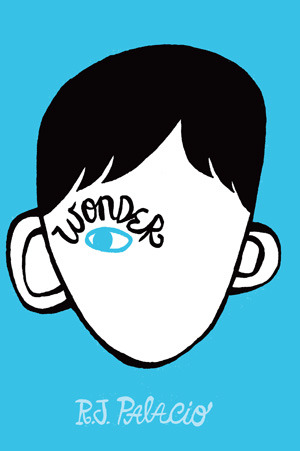
Review: Wonder by R.J. Palacio

Wonder--R.J. Palacio
February 2012 by Knopf
315 pages--Goodreads

August (Auggie) Pullman was born with a facial deformity that prevented him from going to a mainstream school—until now. He's about to start 5th grade at Beecher Prep, and if you've ever been the new kid then you know how hard that can be. The thing is Auggie's just an ordinary kid, with an extraordinary face. But can he convince his new classmates that he's just like them, despite appearances?


Wonder is a beautiful story.  I stayed up way to late in order to finish it.  I'm really not sure how late I was up.  It is both funny and tear jerking.

Palacio makes excellent use of multiple points of view, highlighting the different experiences of each of the characters.  The multiple POVs make it very clear that there are always more than two sides to every story.  The transitions between POVs is well paced, never so frequent that the different voices become confusing or overwhelming.  POV switches are generally 70 or so pages apart and always at the right place plot-wise.

Side note, I know this book focus on the kids' experiences, but I would have loved a few chapters from Mom or Dad's perspective.  

The characters and their interactions with each other are authentic.  Middle school kids saying stupid things (both the dorky-awkward-dumb stuff and the varying degrees of intentionally hurtful stuff).  Friendships change because people change and life moves on.  I love that every character has the potential for good and bad.  The kids at school are jerks who alienate August because he's different.  But the same kids come to his rescue later on and become his friends.  Jack reacts authentically to August's unignorable differences.  He didn't want to be friends with the freak, then got to know him and became friends, but then wanted to separate himself from August to preserve his reputation.

I especially loved Via and her conflicting feelings about wanting to be there to support her brother and not wanting to always and only be known as August's sister and wanting to get attention from her parents but feeling selfish for doing so because that would take attention away from August.  Via's narrative would pair well with Rules.  

One of the best but most heartbreaking parts of the novel were the little comments from August that prove how much he was hurt by other people's reactions despite being "used" to them.  He notices when people don't look him in the eye or start even just a tiny bit when they first see him.  He's so matter of fact about it because he tries to hide the hurt, even to himself.  

The only problem I had with the novel was the ending.  I watched this TED talk the same day I read the book, and that definitely colored my reading of the novel.  (Spoilers ahead.  Ye be warned).  I wanted August's victory to be complete in just becoming an accepted and normal part of the community.  Instead, he became the exact sort of inspiration porn Stella Young talks about (seriously, go watch the TED talk).  I can see both sides of the issue.  We don't want to objectify or pedestalize people, but we also should be inspired by the people around us.  Wonder wasn't written in a vacuum.  I'm curious how I would feel about the ending in a reread of the book, and I'd love to have a class discussion tying the book and TED talk together.

Wonder is a great middle grade story, but it very enjoyable for older readers too.  It has surprising depth.  I feel like Wonder is a story that would grow well with rereading, like all the best books.  

P.S. for my own teachery notes--The book has really short chapters (generally 1-3 pages), making super accessible for even reluctant readers.

Friday, October 18, 2013

Review: Mississippi Trial, 1955 by Chris Crowe

Mississippi Trial, 1955--Chris Crowe
May 2002 by Dial
240 pages--Goodreads

At first Hiram is excited to visit his hometown in Mississippi. But soon after he arrives, he crosses paths with Emmett Till, a black teenager from Chicago who is also visiting for the summer, and Hiram sees firsthand how the local whites mistreat blacks who refuse to "know their place." When Emmett's tortured dead body is found floating in a river, Hiram is determined to find out who could do such a thing. But what will it cost him to know?


I learned about the Emmett Till trial just a couple of years ago and it surprises me that this isn't included in our general education about the Civil Rights Movement.  I think it's something that needs to be discussed in our conversations about race and equality and injustice.  I think Mississippi Trial, 1955 does a good job of framing the trial and the events leading up to it, but it misses the mark on a couple of other things.

What bugged me most was that Hirum pulls a 180 about halfway through the book for no apparent reason.  First he hates his dad and can't see eye to eye with him on anything.  Then, poof.  He sees his dad's side of things and becomes too forward thinking for his time period and his previous actions.  This turn around should have been preceded by a number of small things that made Hirum question his belief system before he made his full transition rather than happening in one fell swoop.  

As the title indicates, this book focuses on the trial rather than on Emmett Till himself.  I'm not sure if I liked that or not.  It did highlight the fact that while most Mississippians did not kill Emmett, they did support the system that promoted the behavior and thinking that allowed the murder to happen.  But I would have liked to know Emmett more as a person.

I really like that this book confronts the fact that good, normal people are capable of doing horrible things.  Not many of us are willing to face that fact.  We like to think of evil as something that exists outside of us.  But I firmly believe that there are very few full-on monsters out there, just a lot of partial ones.  Mississippi Trial makes us face the partial monsters within all of us.

Sunday, August 25, 2013

Review: Sold by Patricia McCormick

Sold--Patricia McCormick
September 2006 by Disney Hyperion
263 pages--Goodreads

Lakshmi is a thirteen-year-old girl who lives with her family in a small hut on a mountain in Nepal. Though she is desperately poor, her life is full of simple pleasures, like playing hopscotch with her best friend from school, and having her mother brush her hair by the light of an oil lamp. But when the harsh Himalayan monsoons wash away all that remains of the family’s crops, Lakshmi’s stepfather says she must leave home and take a job to support her family.

He introduces her to a glamorous stranger who tells her she will find her a job as a maid in the city. Glad to be able to help, Lakshmi journeys to India and arrives at “Happiness House” full of hope. But she soon learns the unthinkable truth: she has been sold into prostitution.

An old woman named Mumtaz rules the brothel with cruelty and cunning. She tells Lakshmi that she is trapped there until she can pay off her family’s debt—then cheats Lakshmi of her meager earnings so that she can never leave.

Lakshmi’s life becomes a nightmare from which she cannot escape. Still, she lives by her mother’s words— Simply to endure is to triumph—and gradually, she forms friendships with the other girls that enable her to survive in this terrifying new world. Then the day comes when she must make a decision—will she risk everything for a chance to reclaim her life?

Written in spare and evocative vignettes, this powerful novel renders a world that is as unimaginable as it is real, and a girl who not only survives but triumphs.


Sold is an unexpected gem.  Kudos to McCormick for managing to take on such a difficult subject as sex trafficking in a realistic way without making me feel uber depressed.  We see everything that happens to Lakshmi without it becoming gratuitous.  We see the victimization, the drugging, the violence, the disease, the crushing social stigmas, the hopelessness, and the hope.  
This book is real.  I come away from this book feeling like I know Laksmi's home life.  I know her life in Calcutta.  I know the other girls in the brothel.  The whole book just feels real.

I couldn't even bring myself to hate Mumtaz.  She's definitely the villain, but she's not demonized.  I wish McCormick had given her a back story.  I imagine she herself was sold when she was young and is just as trapped in this life as the other girls.


I cannot express how much I love the scenes with Monica.  I love her character.  I love how sharp she is on the outside to protect the teddy-bear-holding child on the inside.  I love her conversation with Lakshmi about their reasons for staying at the brothel.  Ignoring the fact that they cannot leave, they cling to the last shred of dignity this life leaves them.  Monica proclaims she is paying her daughter's school fees and Lakshmi tells of the tin roof she will buy for her family.  This life has torn everything from them, but they hold some small pride in order to survive.  I hate but recognize the reality that Monica is forced to return to the brothel when her family casts her out.  Prostitution is the only life society has left for her.  And when she leaves the brothel because she has contracted AIDS, we never hear about her again because we can never know what happened to this girl who slipped through the cracks of an unjust world.


Even though Sold is a short novel, it is just the right length for the story it tells.  The audio book is excellent, but now that I realize the book is written in verse, I wish I had read it in print. This is a beautiful novel.  It is a realistic portrayal of a horrible life that is still hopeful and appropriate for young adult readers.  Though, it's probably too much for most middle graders.

Wednesday, July 17, 2013

Review: They Called Themselves the K.K.K. by Susan Campbell Bartoletti

They Called Themselves the K.K.K: The Birth of an American Terrorist Group--Susan Campbell Bartoletti
August 2010 by Houghten Mifflin Books for Children
172 pages--Goodreads

"Boys, let us get up a club."

With those words, six restless young men raided the linens at a friend’s mansion in 1866. They pulled white sheets over their heads, hopped on horses, and cavorted through the streets of Pulaski, Tennessee. Soon, the six friends named their club the Ku Klux Klan and began patterning their initiations after fraternity rites, with passwords and mysterious handshakes. All too quickly, this club would grow into the self-proclaimed “Invisible Empire,” with secret dens spread across the South. On their brutal raids, the nightriders would claim to be ghosts of Confederate soldiers and would use psychological and physical terror against former slaves who dared to vote, own land, attend school, or worship as they pleased.

This is the story of how a secret terrorist group took root in America’s democracy. Filled with chilling and vivid personal accounts unearthed from oral histories, congressional documents, and other primary sources, this is a book to read and remember.


This is a very interesting and compelling read.  They Called Themselves the K.K.K. does a wonderful job of contextualizing the Klan within the Reconstruction.  I appreciate that Bartoletti uses this book to really try to understand the Klansmen, their reasons, and their motivations.  Rather than just condemning the acts of the Klan, which we already know are wrong, the book explores why a person would be driven to join a hate group and do monstrous things.  This is what I like best about this book and this is exactly where Superman Versus the Ku Klux Klan falls very, very flat.  I read non-fiction to understand, not to rehash oversimplified good-bad dichotomies.  

On that note, I love the quote by W.E.B. Du Bois about Klansmen: "These human beings at heart are desperately afraid of something.  Of What?  Of many things, but usually of losing their jobs, being declassed, degraded, or actually disgraced; of losing their hopes, their savings, their plans for their children; of the actual pangs of hunger, of dirt, of crime."   I think fear is a big part of what drives prejudice.

This book focuses on the early development of the Klan during Reconstruction.  I expected it to spend more time on the Jim Crow Era and the Civil Rights movement.  It's still good, and I will definitely be able to use Chapter 6 about Klan violence against sharecroppers during my Roll of Thunder unit. 

The audiobook for They Called Themselves is excellent, but somethings just don't work well in that format, specifically the timeline.  The physical book is a good balance of text, white space, insets, and  pictures, though the dialects might be difficult to understand in print.  The source material occasionally uses offensive language or images, but it is handled tastefully.  Bartoletti doesn't censor the history.

The source notes are definitely worth a look, especially the bit about Bartoletti's visit to a modern day Klan meeting.  It's creepy.  The Klan still uses the same rhetoric and fans the flames of the same fears about people who are different.  Children are still learning this close-minded life view, and not just in Klan families.  These same arguments are  prevalent in today's politics, though in a diluted form.  That's why meaningful interaction with people who are different from you is important.  

All in all, They Called Themselves the K.K.K. is a well researched, engaging, well crafted narrative and excellent non-fiction text.

Friday, May 10, 2013

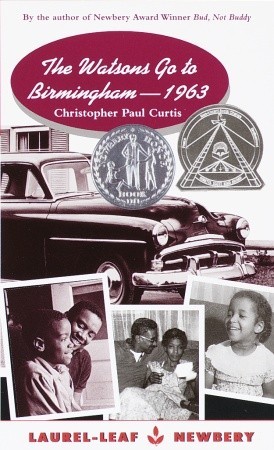
Review: The Watsons Go to Birmingham--1963 by Christopher Paul Curtis

The Watsons Go to Birmingham--1963--
Christopher Paul Curtis
1995 by Laurel-Leaf
210 pages

Enter the hilarious world of ten-year-old Kenny and his family, the Weird Watsons of Flint, Michigan. There's Momma, Dad, little sister Joetta, Kenny, and Byron, Kenny's older brother, who, at thirteen, is an "official juvenile delinquent."

When Momma and Dad decide it's time for a visit to Grandma, Dad comes home with the amazing Ultra-Glide, and the Watsons set out on a trip like no other. Heading South, they're going to Birmingham, Alabama, and toward one of the darkest moments in America's history.


In fourth grade teacher, my teacher read Bud Not Buddy aloud to our class, and I did not like it.  I was in my fantasy-only phase, and a story about a boy searching for his father during the depression didn't interest me at all.  Reading The Watsons Go to Birmingham--1963 makes me realize I should probably go back and give Bud a second chance.   

The Watsons is excellent.  It doesn't have an overarching plot; it's more a series of vignettes about Kenny and his family.  Most Civil Rights Movement books are entirely about racism and persecution and the need for equality and the injustices, but this book didn't go into all that until the very end.  It was kind of nice to just see what life was like in the 60's for an average family.  Kenny's antics prove that it wasn't all that much different from life today.

I like Kenny's voice.  He habitually exaggerates his adventures and his descriptions, making an entertaining read.  He reuses phrases like "talking a mile a minute" or "you might as well have him up to a tree and said ready, aim fire."  This could be seen as annoying, but coming from Kenny,I liked it.  His repetitions are a sort of familiar refrain throughout the novel.

The audiobook is excellent.  It's narrated by LeVar Burton, so the whole book is basicaly an extended episode of Reading Rainbow.  Nostalgia!  And Burton's narration matches well with Kenny's exuberant storytelling.

The last couple of episodes are unexpected heavy, given the light tone of the rest of the book, but they make up my favorite part of the novel.  I love Curtis's exploration of something like post traumatic stress disorder as Kenny tries to make sense of the horrible things he saw.  Kenny's not quite a naive narrator, but because of his youth or his shock, he can't comprehend what happened.  It's a really interesting last couple of chapters.  But fear not; we don't end on a despairing note.  We even sort of almost actually like Byron by the end.

The Watson's Go to Birmingham--1963 is a satisfying and thought provoking read that I liked much more than I expected.

Wednesday, April 10, 2013

Mini Review: One Crazy Summer by Rita Williams-Garcia

One Crazy Summer--Rita Williams-Garcia
January 2010 by Amistad
218 pages--Goodreads

In the summer of 1968, after travelling from Brooklyn to Oakland, California, to spend a month with the mother they barely know, eleven-year-old Delphine and her two younger sisters arrive to a cold welcome as they discover that their mother, a dedicated poet and printer, is resentful of the intrusion of their visit and wants them to attend a nearby Black Panther summer camp.


This was a decent read, but it just kind of throws you into the middle of the Black Panthers without any explanation whatsoever.  As most of the middle graders reading this book won't know much about the Black Panthers going into the book, the will probably be lost.  I know books aren't meant to be history lessons, but a bit more background information would have been nice.

The relationship between the sisters is realistic sweet.  However, I think this is one of those books that adults like but kids find a hard time relating to.

Sunday, March 10, 2013

Review: Monster by Walter Dean Myers

Monster--Walter Dean Myers
April 1999 by Amistad
288 pages--Goodreads

FADE IN: INTERIOR: Early morning in CELL BLOCK D, MANHATTAN DETENTION CENTER.

Steve (Voice-Over)Sometimes I feel like I have walked into the middle of a movie. Maybe I can make my own movie. The film will be the story of my life. No, not my life, but of this experience. I'll call it what the lady prosecutor called me ... Monster.


This is one of those novels that has won so many awards and is a staple in so many Adolescent lit classes that you wonder if the actual book can live up to its reputation.  Monster does.  I sped through the book in just a couple of days and had only three pages to go when one of my classes began and I had to spend the whole class dying to know what happened.  

Steve is on trial for murder.  Witnesses say he was the lookout for some other guys who robbed a convenience store and shot the owner.  The book is a screenplay, written by Steve, about the trial.  I liked the screenplay format.  It makes the book a quick read, and all that white space makes the book look accessible.  Some readers see this as a ploy or gimmick, but I don't.  I see it as a way for Steve to work through what was happening to him.

However, partly because of the format, we don't get to know Steven well.  The novel only centers around the actual trial, not his life before.  And despite being in his head the whole time, Steven is still a mystery to us at the end of the novel.  He is an interesting character and I would have liked more background information about him and his family.  I realize that this kind of goes against the point of the book (to determine Steve's guilt or innocence just with the limited evidence we get), but still.

I like how the book addresses the criminal justice system and the preconceived notions we have about the accused.  We forget that in the eyes of the law, a defendant is innocent until the prosecution proves otherwise.  This book also made me realize the difference between "innocent" and "not guilty."  Maybe a particular person did commit a crime, but if there is no evidence to prove guilt, the law cannot touch them.  In that light, I love how Myers leaves Steve's innocence or guilt ambiguous.  I won't spoil the court verdict, but we really don't know whether Steve participated in the theft.  Is he evading responsibility for his actions or being rightly served by justice?  

This book also forces us to look at, in a very small degree, the violence that goes on in prisons.  We tend to ignore the fate of inmates because we don't have to see them and subconsciously we think, "They broke the law, so they deserve what they get."  But even criminals don't deserve to be assaulted and beat up on a regular basis.  The novel deals with some heavy, mature subjects, but it is actually pretty light on swearing, which surprised me.

This book made me think about a lot of things. I liked it, and I think it is a book that would resonate with a lot of teens.

Friday, February 15, 2013

Review: And Still We Rise by Miles Corwin

And Still We Rise:  The Trials and Triumphs of Twelve Gifted Inner-City Students--Miles Corwin
April 2000 by William Morrow
418 pages--Goodreads

Bestselling author of The Killing Season and veteran Los Angeles Times reporter Miles Corwin spent a school year with twelve high school seniors -- South-Central kids who qualified for a gifted program because of their exceptional IQs and test scores. Sitting alongside them in classrooms where bullets were known to rip through windows, Corwin chronicled their amazing odyssey as they faced the greatest challenges of their academic lives. And Still We Rise is an unforgettable story of transcending obstacles that would dash the hopes of any but the most exceptional spirits.


Many books and movies about education are meant to be warm fuzzy feel good stories.  And Still We Rise is not one of those stories.  Corwin doesn't sugar coat anything.  He is realistic.  Some of these students don't make it.  The teachers are not saviors.  I actually really disliked the main teacher.  Granted, she's teaching in a harsh environment, but she lets her own issues with the administration and parents bleed out into her classroom at the expense of her teaching.  The book covers the course of an entire school year, focusing on one student at a time.  Each student is distinct and their story engaging.  We get involved with their stories and it kills us when one of them doesn't make it. 

This book gave me a lot of things to think about as a teacher:  expansion of the canon, ways to teach, understanding where my students are coming from, not making assumptions based on a student's appearance, keeping my personal life personal, and continuing on even after making mistakes.

I appreciate that Corwin explores the complexity of the affirmative action.  He is in no way unbiased, but he does back up his position with a lot of evidence.  Is it fair and will it serve America as a whole if we exclude a chunk of the population from college because they didn't have the opportunity for a top-notch K-12 education, or because they had to work 40+ hours a week to make ends meet in addition to going to school so they never had time to study for the SAT when going to college could give them the chance to pull themselves and their families out of poverty?  At the same time, the kid with a better SAT score legitimately knows more, and has better skills, (I'll ignore for now the issue of how accurate SAT is at measuring college readiness).  Should we punish that kid for being dealt a better hand?  Affirmative action is a imperfect solution to a very unbalanced set of starting circumstances.  I don't have an answer, but I appreciate the exploration.

The narrative is occasionally scattered, as if Corwin couldn't remember what he had already said and so went back and repeated himself.  This may have been done to clarify, but as the same wordage is used again and again, it just feels repetitive.  There is also some strong language.  I feel like it is authentic to the inner city kids Corwin writes about, but it will bother some readers.

And Still We Rise is not a boring read, though it is at times a downer.  It presents complicated issues that don't have any clear, much less easy solutions while keeping readers engaged with the human side of those issues.

Monday, January 21, 2013

Review: American Born Chinese by Gene Luen Yang

American Born Chinese--Gene Luen Yang
September 2006 by First Second
240--Goodreads

A tour-de-force by rising indy comics star Gene Yang, American Born Chinese tells the story of three apparently unrelated characters: Jin Wang, who moves to a new neighborhood with his family only to discover that he’s the only Chinese-American student at his new school; the powerful Monkey King, subject of one of the oldest and greatest Chinese fables; and Chin-Kee, a personification of the ultimate negative Chinese stereotype, who is ruining his cousin Danny’s life with his yearly visits. Their lives and stories come together with an unexpected twist in this action-packed modern fable. American Born Chinese is an amazing ride, all the way up to the astonishing climax.


This was my second try with graphic novels, and this time it turned out quite well.  Balancing the themes of identity, isolation, assimilation, and friendship, Yang's graphic novel is split between three seemingly unrelated stories that come together in the end.  


What I loved most about the book was that this is not a story just for Chinese Americans or even just for recent immigrants.  Danny's and Jin's and even the Monkey King's stories are relate-to-able to anyone who has ever felt like they didn't fit in, which is pretty much everyone.  The whole point of the book is to be what you are, but that theme is not presented like a preachy self-confidence lesson.  The novel recognizes how hard it is to be yourself when yourself doesn't fit in.  It acknowledges that some people are and will always be jerks.  It captures awkward and sometimes rocky teenage friendships in such a way that we can all see something reflected from ourselves.

Yang's illustration style is a bit more comic-book-like than I am used to.  The characters are drawn with rounded edges, and the whole book uses a bright color palate.  However, the illustrations are deep in their simplicity.  They say a lot with few or no words.  

A few minor complaints.  I was annoyed by the body humor (fart jokes and the like), but the book is about teenage boys.  You can't teach Jr. High kids a lesson on onomatopoeia without "fart" and "burp" causing giggles.  Also, I think the Monkey King's reversal was too swift; we aren't prepared for his complete change in his personality.  I can see why it happened, given the ending, but I would have liked a bit more development in his change.

This book can be enjoyed on many different levels.  Some readers will pick up American Born Chines expecting a light, easy read, and I think they'll be surprised at how deep it is.  I liked it.  I can see why it won the Printz.

Friday, November 23, 2012

Review: Roll of Thunder, Hear My Cry by Mildred D. Taylor

Roll of Thunder, Hear My Cry--Mildred D. Taylor
1976 by Puffin
276 pages--Goodreads

Ever since it won the 1977 Newbery Medal, Roll of Thunder, Hear My Cry has engaged and affected millions of readers everywhere. Set in a small town in Mississippi at the height of the Depression, this powerful, moving novel deals with issues of prejudice, courage, and self-respect. It is the story of one family's struggle to maintain their integrity, pride, and independence in the face of racism and social injustice. It is also the story of Cassie Logan, an independent girl who discovers over the course of an important year why having land of their own is so crucial to her family. The racial tension and harrowing events experienced by young Cassie, her family, and her neighbors cause Cassie to grow up and discover the reality of her environment.


I first read Roll of Thunder in 7th grade and I despised it.  I hated it with the fiery passion of a thousand suns.  Okay, maybe that's an overstatement, but I thought it was dead boring.  I liked reading fantasy and that was about it.  I knew little about the Depression or segregation.  I didn't like historical fiction much and the story of a black family in the South didn't interest me at all.  I just didn't have the context to appreciate it.  I may not be giving my 7th grade teacher enough credit.  He may well have contextualized the novel, but I don't remember anything other than just reading the book.  Reading it now knowing much more about the Jim Crow era and what it meant to be black in the South during the depression, knowing about not just Martin Luther King Jr but Emmett Till and lynch mobs, having more context I appreciated the story much more.  It's still a slow moving novel, but it is very good.

I got a lot of To Kill a Mockingbird vibes while reading this, but Roll of Thunder is a more immediate story.  As much as I like Scout and Atticus, they are not part of the black community.  All they risk is scorn; the Logans risk losing everything.  Their danger is ever-present and real.  Mockingbird has a wider focus and as such, loses some intensity while Roll of Thunder is tightly focused.

The characterization is great.  The lines of good and bad are not drawn down racial lines.  It's not super in-depth since it is a children's book, but there is some complexity in the characters.  Mr. Jamison is an honest, decent white lawyer.  Jeremy likes the Logans despite the racism in his family.  Many of the black families want to support the Logan's boycott, but they also need to survive.  TJ has been wronged by the system but is not absolved of personal responsibility in his bad choices.  Uncle Hammer's anger is justified, but his violent reactions are not.

I really appreciated the relationship between Mama and Cassie.  How do you raise a black child and teach her to have self respect, but also teach her that white folk won't see her as worth anything and she'll have to act a certain way to survive?  How do you decide how much to tell your child about the brutality going on around her when you know she sees some of it but may not understand everything?  How do you balance the need to protect your child with the need to let her grow up?

The book did a wonderful job of portraying racism through the eyes of a child.  How does a nine year old even process that she is despised because of the color of her skin?  Does she really understand what it means that the night men are riding?  Does she understand that her family could not just lose the land, but her father could be beaten or tarred or lynched?

The novel uses n word occasionally, and I can see this bothering some readers.  I don't particularly like the word's use, but I think it is justified in this story.  Taylor says in the introduction to the novel that history is not politically correct, that racism it is not polite; it is full of pain.  She does not sugar coat things or shy away from the truth.  She is tasteful about her use of the word, but you will want to take that into consideration in recommending the book to young readers.

The book loses points because while it is excellent now, it didn't appeal to me at all as a kid and I think many of my classmates agreed with me.  I feel like some Newbery winners are amazingly written from the perspective of adults, but kids don't like or appreciate them.  And if kids don't like the book, what's the point?

LinkWithin

Related Posts Plugin for WordPress, Blogger...