Showing posts with label historical. Show all posts

Friday, June 27, 2014

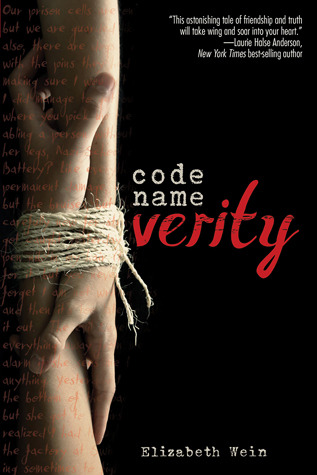
Review: Code Name Verity by Elizabeth Wein

Code Name Verity by Elizabeth Wein
May 2012 by Hyperion Books
343 pages--Goodreads

Oct. 11th, 1943-A British spy plane crashes in Nazi-occupied France. Its pilot and passenger are best friends. One of the girls has a chance at survival. The other has lost the game before it's barely begun.

When "Verity" is arrested by the Gestapo, she's sure she doesn't stand a chance. As a secret agent captured in enemy territory, she's living a spy's worst nightmare. Her Nazi interrogators give her a simple choice: reveal her mission or face a grisly execution.

As she intricately weaves her confession, Verity uncovers her past, how she became friends with the pilot Maddie, and why she left Maddie in the wrecked fuselage of their plane. On each new scrap of paper, Verity battles for her life, confronting her views on courage, failure and her desperate hope to make it home. But will trading her secrets be enough to save her from the enemy?


There was so much hype surrounding this book.  It won a Printz honor.  Many people raved about it and gave it 5-star reviews.  It was on all the recommendation lists for a little while.  And it wasn't bad; I actually quite liked it.  But it is slow.  Very slow.  The ending is fantastic, but you have to be willing to push through the first half of the novel to get there.  I read Code Name Verity using the audiobook, which worked out quite well.  The narration was excellent and it kept me going through the less-engaging first half of the novel.

I loved how well we got to know Julie and Maddie.  This book is sometimes pitched as a spy novel, which is just misleading.  No Bond or Borne here.  This is a book about the friendship between two young women, albeit in rather dangerous circumstances, but the events of WWII take a distant back seat to the women's friendship.  And I honestly don't remember the last time I read a young adult (not middle grade or children's) novel that celebrated love between friends with absolutely no romance whatsoever getting in the way.  Though it was slow, I do appreciate the development of their relationship.

Without being gratuitous, this book is honest in its descriptions of torture, interrogation, and execution.  But with its level of violence and some strong language, it is not a book for younger readers.

This next paragraph is spoilery, so feel free to skip it.  
I can't think of the last time an author has pulled off an unreliable narrator so well.  As I read the second half of the book and realized what Julie had done, I had to keep flipping back to earlier in the novel to see how she had done it (I actually had both a physical copy in addition audiobook).  Suffice it to say, there were many "What the heck!?" moments.  And the best part is Wein tells us from the start that there would be an unreliable narrator.  She says in the first few pages that sabotage is integral to the mission of a captured combatant.  It was sort of like Michael Cane's bookend statements in The Prestige about how you look for the secret but you won't find it because you want to be fooled.  

Code Name Verity is a well-written novel with excellent characters.  It's not as fast or exciting as the hype or description implies, but if you can put in the investment, it is worth it.

Monday, January 20, 2014

Review: The Evolution of Calpurnia Tate by Jacqueline Kelly

The Evolution of Calpurnia Tate--Jacqueline Kelly
May 2009 by Henry Holt
338 pages--Goodreads

Calpurnia Virginia Tate is eleven years old in 1899 when she wonders why the yellow grasshoppers in her Texas backyard are so much bigger than the green ones.With a little help from her notoriously cantankerous grandfather, an avid naturalist, she figures out that the green grasshoppers are easier to see against the yellow grass, so they are eaten before they can get any larger.

As Callie explores the natural world around her, she develops a close relationship with her grandfather, navigates the dangers of living with six brothers, and comes up against just what it means to be a girl at the turn of the century.

Debut author Jacqueline Kelly deftly brings Callie and her family to life, capturing a year of growing up with unique sensitivity and a wry wit.


The Evolution of Calpurnia Tate is a highly enjoyable read with a gorgeous cover (I love silhouettes and scroll-work; this cover has both).  Made up of vignettes about one summer and fall, Callie's story is reminiscent of Anne of Green Gables and Little House on the Prairie with some Darwinian science thrown in.  I love Callie's adventures as a young naturalist, roaming the riverbed, collecting bugs and other scientific samples.  I especially love the relationship between her and her grandfather.

Callie's voice is distinct from the very start.  The writing in general is strong, but particularly in Callie's narrative voice.  She's a memorable character, and I love her spunk and determination.  Her observations about the world and people are hilarious, especially when three of her brothers have crushes on the same friend at the same time and Callie gets sick of being the middleman.  The brothers themselves are great.  I love Travis and his kittens and his unfortunate attachment to the family turkeys.

This novel presents a great coming of age story.  I completely understand Callie's desire to do something more than the life that was chosen for her, how she feels trapped by the societal and familial expectations that don't match up with her dreams.  This conflict is left mostly unresolved, and while I can understand why (time constraints--it would take years for Callie to work this out and this story only covers six months.) the ending feels just a bit incomplete.  I want some sort of reconciliation between Callie and her mother.

I wish this book had been around when I was younger.  Callie, Anne, Laura, and I would have been the best of friends despite differences in time, location, and fictionality.  There's just a bit of mild language (which I note only so I remember not to recommend the book to my ultra-ultra-sensitive students).  The Evolution of Calpurnia Tate is a well-written and thoroughly enjoyable book.  

Wednesday, January 1, 2014

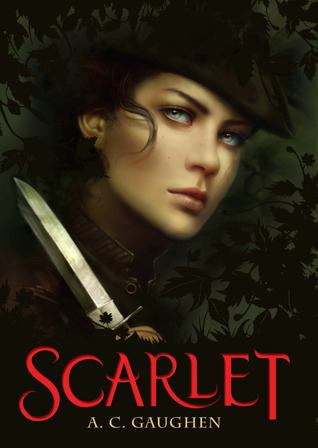
Review: Scarlet by A. C. Gaughen

Scarlet--A. C. Gaughen
February 2012 by Walker Children's
292 pages--Goodreads

Posing as one of Robin Hood’s thieves to avoid the wrath of the evil Thief Taker Lord Gisbourne, Scarlet has kept her identity secret from all of Nottinghamshire. Only the Hood and his band know the truth: the agile thief posing as a whip of a boy is actually a fearless young woman with a secret past. Helping the people of Nottingham outwit the corrupt Sheriff of Nottingham could cost Scarlet her life as Gisbourne closes in.

It’s only her fierce loyalty to Robin—whose quick smiles and sharp temper have the rare power to unsettle her—that keeps Scarlet going and makes this fight worth dying for.


Aaarg!!  This book was such a disappointment.  I wanted Scarlet to be an awesome adventure about the girl hiding in plain sight among the Merry Men.  I wanted to know where she came from and why she was hiding from Gisbourne and how she got so good at knife throwing and why she dressed up like a man and why she joined Robin's group and how she hid her identity from the world.  Basically I wanted an Alanna-esque character inserted into the Robin Hood mythology.

Of all the stories that didn't need a stupid, stupid love triangle!  This could have been such a good book with knife throwing and daring escapes and hangings.  But instead, we spent the whole book listening to Robin, John, and Scarlet angst about who would get together with whom, completely ignoring the more important and deadly things going on.  Yes, Alanna had a love triangle too, but the adventure and the fate of the kingdom always came first.  The external plot or internal non-romantic conflict in a novel will always be more interesting to me than romantic angst.

And the best part of the awful unnecessary romance:  Robin, who never said a word to John about sleeping around, calls Scarlet a "whore" for accepting a little comfort in a moment when she is scared and injured and in shock.  And his reason for doing this?  "Hurting you is the best way I know to punish myself."  What kind of messed up crap is that?!  That statement is so close to justification for domestic abuse, I can't believe it made the final cut into the novel.  We'll just log it away with Carosel's If-he loves-you-it-doesn't-hurt-when-he-hits-you message.

The slightly less annoying or unsettling problems in the novel include:

  • The trust timeline was unrealistic.  Scarlet had been working with Robin and company for almost two years before the book gets started, and she didn't trust them at all.  Then, once we finish the first few chapters, she suddenly trusts them.  Because reasons.
  • Robin needs to be an adult.  Otherwise, the myth loses a lot of its significance.  Robin has to be a man when he returns from the crusades to find his lands seized and his people starving.  You can't blame a mere boy for letting his people down, but Robin the man has to accept that responsibility.  If you're going to make Robin a teenager, you better have a very good reason for doing it, and angst is not a good enough reason.

Scarlet was so disappointing, and yet frustratingly addictive.  I couldn't stop reading, even though I didn't like it.  This book sullies the good name of Scarlet.  Go read a good Scarlet instead where Marissa Meyer proves that a romantic sub plot can enhance rather than completely derail the main plot.

Friday, October 18, 2013

Review: Mississippi Trial, 1955 by Chris Crowe

Mississippi Trial, 1955--Chris Crowe
May 2002 by Dial
240 pages--Goodreads

At first Hiram is excited to visit his hometown in Mississippi. But soon after he arrives, he crosses paths with Emmett Till, a black teenager from Chicago who is also visiting for the summer, and Hiram sees firsthand how the local whites mistreat blacks who refuse to "know their place." When Emmett's tortured dead body is found floating in a river, Hiram is determined to find out who could do such a thing. But what will it cost him to know?


I learned about the Emmett Till trial just a couple of years ago and it surprises me that this isn't included in our general education about the Civil Rights Movement.  I think it's something that needs to be discussed in our conversations about race and equality and injustice.  I think Mississippi Trial, 1955 does a good job of framing the trial and the events leading up to it, but it misses the mark on a couple of other things.

What bugged me most was that Hirum pulls a 180 about halfway through the book for no apparent reason.  First he hates his dad and can't see eye to eye with him on anything.  Then, poof.  He sees his dad's side of things and becomes too forward thinking for his time period and his previous actions.  This turn around should have been preceded by a number of small things that made Hirum question his belief system before he made his full transition rather than happening in one fell swoop.  

As the title indicates, this book focuses on the trial rather than on Emmett Till himself.  I'm not sure if I liked that or not.  It did highlight the fact that while most Mississippians did not kill Emmett, they did support the system that promoted the behavior and thinking that allowed the murder to happen.  But I would have liked to know Emmett more as a person.

I really like that this book confronts the fact that good, normal people are capable of doing horrible things.  Not many of us are willing to face that fact.  We like to think of evil as something that exists outside of us.  But I firmly believe that there are very few full-on monsters out there, just a lot of partial ones.  Mississippi Trial makes us face the partial monsters within all of us.

Sunday, September 1, 2013

Review: Okay for Now

Okay for Now--Gary D. Schmidt
August 2011 by Clarion Books
360 pages--Goodreads

As a fourteen-year-old who just moved to a new town, with no friends and a louse for an older brother, Doug Swieteck has all the stats stacked against him. So begins a coming-of-age masterwork full of equal parts comedy and tragedy from Newbery Honor winner Gary D. Schmidt. 

As Doug struggles to be more than the "skinny thug" that his teachers and the police think him to be, he finds an unlikely ally in Lil Spicer--a fiery young lady who "smelled like daisies would smell if they were growing in a big field under a clearing sky after a rain." In Lil, Doug finds the strength to endure an abusive father, the suspicions of a whole town, and the return of his oldest brother, forever scarred, from Vietnam. Together, they find a safe haven in the local library, inspiration in learning about the plates of John James Audubon's birds, and a hilarious adventure on a Broadway stage. 

In this stunning novel, Schmidt expertly weaves multiple themes of loss and recovery in a story teeming with distinctive, unusual characters and invaluable lessons about love, creativity, and survival.


It's rare that a book can make me cry and laugh on the same page.  I can't tell you how many times I gasped aloud or giggled or teared up (which was bad because I was driving and listening to the audiobook) while reading the book.  And there were actual tears coming down my face as I finished the book.  I put off lesson planning, I put off sleep just so I could finish this book.  It is beautiful.  Just as The Wednesday Wars ties in Shakespeare plays to Holling's life, Okay for Now weaves Audobon's bird paintings into Doug's.  The noble pelican, the terrified eye, the mother bird looking into the distance.  

As a character, Doug is real.  Doug's reactions are genuine, even annoying when he lashes out like a jerk or a thug.  That's how Doug would react.  He has parts of his father in him, mostly sayings and phrases that he has internalized.  Even if he breaks the cycle of abuse, he is still partly his father.  All the other characters are multidimensional too.  Schmidt humanizes almost every single one of them.  Even the bully brother and the bully gym teacher became real people with both light and dark inside them.

The abuse was handled, well, I can't say beautifully because it is not a beautiful thing, but artfully maybe.  It is never stated directly that Doug's father is abusive, is alcoholic, beats his family.  Everything is implied.  And I loved that.  When it happens in real life, abuse is never talked about, even though everyone knows.  Schmidt conveys that through his writing style.  

The title fits the book perfectly.  Will things get better for Doug?  Maybe not.  Maybe they will get much worse.  But for now he is okay.

Part adorkable (the puffins!), part heartbreaking, Okay for Now is a beautiful book that I will definitely come back to again.  Congratulations, Mr. Schmidt.  You have been added to my "I will read anything you publish" list.

Tuesday, August 27, 2013

Review: Dead Reckoning by Mercedes Lackey and Rosemary Edghill

Dead Reckoning--Mercedes Lackey and Rosemary Edghill
June 2012 by Bloomsbury USA Childrens
336 pages--Goodreads

Jett is a girl disguised as a boy, living as a gambler in the old West as she searches for her long-lost brother. Honoria Gibbons is a smart, self-sufficient young woman who also happens to be a fabulous inventor. Both young women travel the prairie alone – until they are brought together by a zombie invasion! As Jett and Honoria investigate, they soon learn that these zombies aren’t rising from the dead of their own accord … but who would want an undead army? And why?


A steampunk, wild west, zombie horror, gender bender adventure.  A book like this will either do really well or fail miserably.  Thankfully, Dead Reckoning did not fail.  It's nothing terribly serious, just a fun romp through all the genres.  It's not too gory, even for a zombie book.  No unnecessary romances.  Just sleuthing and sciencing and exploding, and escaping and actually very little gun slinging.  It is quick paced, easily read in just a day or two.

The characters are fun.  Jett is strong and lives her disguise.  She is always the gambling gunslinger outlaw.  Only every now and then does her femininity manifest, like when she fusses over her horse when he returns unharmed after a run in with zombies.  Gibbons is annoyingly committed to science and rationality even when the pursuit of science could get her killed, but that's what makes her fun.  White Fox, he actually isn't really fleshed out.  Side note complaint:  Why didn't Lackey and Edghill just make White Fox Native American?  I get the whole child-of-two-worlds-so-he-belongs-to-neither thing.  But seriously, why not just make him Native American?  Gibbons and Jett would have been fine with it.  Does the entire cast have to be white?  Don't start going off on whether it would be plausible or not; you have zombies, for crying out loud!  Plausibility no longer applies.

There is some major villain monologuing explaining just exactly how and why he accomplished his master scheme.  That could have been handled more skillfully.  And some loose strings are left hanging.  You inject Jett with a vial full of poison and we're not ever going to address that again?  That should have some effect on her even if it doesn't kill her.

Dead Reckoning is genre blending done well.  It's not the book for you if you're looking for a pure western or pure steampunk or a pure zombie horror, but it's a light combination of all three.  I see potential for sequels and would probably have to pick them up.

Tuesday, July 23, 2013

Review: Dodger by Terry Pratchett

Dodger--Terry Pratchett
September 2012 by Harper Collins
360 pages--Goodreads

A storm. Rain-lashed city streets. A flash of lightning. A scruffy lad sees a girl leap desperately from a horse-drawn carriage in a vain attempt to escape her captors. Can the lad stand by and let her be caught again? Of course not, because he's...Dodger.

Seventeen-year-old Dodger may be a street urchin, but he gleans a living from London's sewers, and he knows a jewel when he sees one. He's not about to let anything happen to the unknown girl--not even if her fate impacts some of the most powerful people in England.

From Dodger's encounter with the mad barber Sweeney Todd to his meetings with the great writer Charles Dickens and the calculating politician Benjamin Disraeli, history and fantasy intertwine in a breathtaking account of adventure and mystery.


This book is a lot of fun.  Dodger is a hilarious swindler who would take offense at being called a thief; he just finds things that have been misplaced, or would have been misplaced soon anyways.  But he's good-hearted and skilled at what he does.

I love Terry Pratchett's style of narration.  Something about the straight-faced, understated, tongue in cheek humor just captivated me from the very beginning of the novel.  Maybe it's the word play, things like Dodger learning how to be a successful urchin by learning how to urch or a man giving Dodger a cursory glance with a good deal of curse in it.  It's not a style that works for everyone, but it works perfectly for me.  It's just funny.  I loved each time Mr. Dickens stole a title or line for his future books from Dodger.

Dodger is historical fiction in the same way that Leviathan is historical fiction.  Pratchett calls it historical fantasy.  Is it entirely plausible that all this stuff in this book (multiple assassination attempts, several heroics, being raised from rags to riches, etc) happens in just week?  No. But who cares?  This is the sort of book that throws plausibility out the window and says "wouldn't it be cool if.." Pratchett fudges dates and places to make it work out so all his historical figures can come together.  If you can accept that, the book is fun.  Otherwise, the craziness will bug you.  

My only question is why didn't we get more of the Outlander?  That was a serious let down.  It could have been so cool to have a *SPOILER* lady assassin after Dodger for most of the book.  Instead, Pratchett doesn't build up nearly enough tension and throws the Outlander in at the very tail end of the book with no explanation or development.  Most of the villains are like that too, more boogy men than fleshed out threats.

I will definitely have to give some of Pratchett's other books a try.  I really liked Dodger, but it's a book I'd hesitate to recommend.  I can't even pin down exactly what it was that made me like it, so I don't know what to identify in other readers that would make them like it.  It's an interesting read.

Saturday, July 20, 2013

Review: Between Shades of Gray by Ruta Sepetys

Between Shades of Gray--Ruta Sepetys
March 2011 by Philomel Books
344 pages--Goodreads

Lina is just like any other fifteen-year-old Lithuanian girl in 1941. She paints, she draws, she gets crushes on boys. Until one night when Soviet officers barge into her home, tearing her family from the comfortable life they've known. Separated from her father, forced onto a crowded and dirty train car, Lina, her mother, and her young brother slowly make their way north, crossing the Arctic Circle, to a work camp in the coldest reaches of Siberia. Here they are forced, under Stalin's orders, to dig for beets and fight for their lives under the cruelest of conditions.

Lina finds solace in her art, meticulously--and at great risk--documenting events by drawing, hoping these messages will make their way to her father's prison camp to let him know they are still alive. It is a long and harrowing journey, spanning years and covering 6,500 miles, but it is through incredible strength, love, and hope that Lina ultimately survives.Between Shades of Gray is a novel that will steal your breath and capture your heart.


Excellent.  Just excellent.  Between Shades of Gray is not an "Oh my gosh; this is so awesome!!!" book  It's a slow burning, sticks with you, love it the more you think about it type of book.  It has a lingering beauty in the tone, subject matter, and writing style.  It is honest about the horrors Lina faces without being depressing.  It is a story of suffering and a story of hope.

The Holocaust features prominently in WWII novels, but I had never heard of these Soviet prison camps and the deported Baltic citizens.  Seriously, how do people not know about this?  I guess it shows the emptiness of our "never again" attitude toward the Holocaust and genocides in general.  I would love to use this book in connection with a unit on Anne Frank (too bad I'm not teaching 8th grade this year) and then connect it to other, more modern genocides.

Sepetys is very honest in her portrayal of the characters; they are not demons and martyrs, but flawed people just trying to survive their very harsh circumstances.  They are very real.  In that light, I like Kretzsky's character.  We like to demonize our antagonists, but really no one is just black or white in this book or in real life.  Kretzsky and Lina and everyone else is made of spectrum of goods and bads.  I wish we could have seen more from his character, but this book is Lina's story, not his. 

There is some mature content in the descriptions of the NKVD's brutality.  It is accurate without being gratuitous, and I appreciate that. 

Between Shades of Gray is an excellent, excellent historical fiction.  I will be sure to read it again.  And the cover is just so pretty.  This cover, not the eyelash one.

Monday, July 15, 2013

Review: Fallen Grace by Mary Hooper

Fallen Grace--Mary Hooper
June 2010 by Bloomsbury USA
320 pages--Goodreads

Grace Parkes has just had to do a terrible thing. Having given birth to an illegitimate child, she has travelled to the famed Brookwood Cemetery to place her small infant's body in a rich lady's coffin. Following the advice of a kindly midwife, this is the only way that Grace can think of to give something at least to the little baby who died at birth, and to avoid the ignominy of a pauper's grave. Distraught and weeping, Grace meets two people at the cemetery: Mrs Emmeline Unwin and Mr James Solent. These two characters will have a profound affect upon Grace's life. 

But Grace doesn't know that yet. For now, she has to suppress her grief and get on with the business of living: scraping together enough pennies selling watercress for rent and food; looking after her older sister, who is incapable of caring for herself; thwarting the manipulative and conscience-free Unwin family, who are as capable of running a lucrative funeral business as they are of defrauding a young woman of her fortune.

A stunning evocation of life in Victorian London, with vivid and accurate depictions, ranging from the deprivation that the truly poor suffered to the unthinking luxuries enjoyed by the rich: all bound up with a pacy and thrilling plot, as Grace races to unravel the fraud about to be perpetrated against her and her sister.


Fallen Grace an interesting, slow, thoroughly researched novel.  I like this time period and enjoyed learning more about it.  I hadn't realize how huge and crazy the cult of mourning was.  Thanks for that Victoria.  Hooper doesn't shy away from details about the Victorian poor. This book is dark and nitty gritty without being depressing.  There is some mature content, but it is handled well and not explicit or gratuitous.

I liked Grace, but she was just a bit to perfect.  She's one of those beautiful, angelically good women who have no real flaws; they're just trapped in bad circumstances.  The villains are also flat in their characterization.  They're not developed, they're just evil.  Evil.

There's a bit too much deus ex machina throughout the book.  All the characters are connected.  There are random coincidences all over the place.  Things wrap up just a bit too neatly at the end.  It's almost predictable without actually being predictable.  Maybe Hooper is trying to imitate Dickens since he does this all the time.  The narrative also jumps point of view suddenly and without indication.

Can I step aside from the book for a minute and just say that a woman is not fallen or ruined or tainted because she is raped.  I know Hooper was just projecting Victorian morals into the book because that's how the characters would have seen it, but it bugs me.  A lot.  And can we stop talking about pulling girls from the "temptation" of prostitution.  Prostitution is a horrible life that women didn't take up unless they felt they had no other options.

Despite a few complaints, I liked it.  Fallen Grace is a compelling read, though a slow one.

Thursday, June 13, 2013

Mini Review: The Lions of Little Rock by Kristin Levine

The Lions of Little Rock--Kristin Levine
January 2012 by Puffin
320 pages--Goodreads

As twelve-year-old Marlee starts middle school in 1958 Little Rock, it feels like her whole world is falling apart. Until she meets Liz, the new girl at school. Liz is everything Marlee wishes she could be: she's brave, brash and always knows the right thing to say. But when Liz leaves school without even a good-bye, the rumor is that Liz was caught passing for white. Marlee decides that doesn't matter. She just wants her friend back. And to stay friends, Marlee and Liz are even willing to take on segregation and the dangers their friendship could bring to both their families.


I liked the book.  We don't like to face the reality that narrow-minded racist attitudes are held by perfectly normal people.  Klan members were well standing members of society.  The South was not populated by monsters, but by normal people who did horrible things.  The Lions of Little Rock makes us face that reality.  And it goes even further than that by having Marlee's mom be a bit racist.  She's not shouting racial epithets or anything like that, but she's not comfortable with her daughters going to an integrated school.  So often, all the "good" characters in these historical novels are enlightened and see clearly through racism and bigotry.  This book is more real than that.  Life is complicated and people are made up of spectrums of grays.  

I also appreciated that the conflict was resolved realistically.  Levine didn't just wave a magic wand and make everything better.  Things end better than they started, but it's still messy, as it really would have been in history.  There are a couple uses of the N word throughout the book, which I was not expecting in a middle-grade novel, but I feel they are contextually justified.

All and all a good read, not terribly momentous.

Friday, May 10, 2013

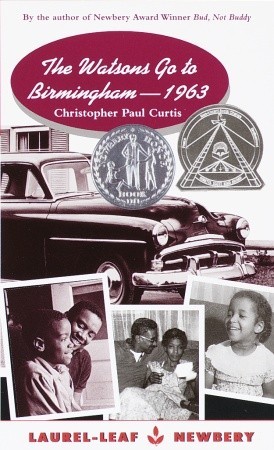
Review: The Watsons Go to Birmingham--1963 by Christopher Paul Curtis

The Watsons Go to Birmingham--1963--
Christopher Paul Curtis
1995 by Laurel-Leaf
210 pages

Enter the hilarious world of ten-year-old Kenny and his family, the Weird Watsons of Flint, Michigan. There's Momma, Dad, little sister Joetta, Kenny, and Byron, Kenny's older brother, who, at thirteen, is an "official juvenile delinquent."

When Momma and Dad decide it's time for a visit to Grandma, Dad comes home with the amazing Ultra-Glide, and the Watsons set out on a trip like no other. Heading South, they're going to Birmingham, Alabama, and toward one of the darkest moments in America's history.


In fourth grade teacher, my teacher read Bud Not Buddy aloud to our class, and I did not like it.  I was in my fantasy-only phase, and a story about a boy searching for his father during the depression didn't interest me at all.  Reading The Watsons Go to Birmingham--1963 makes me realize I should probably go back and give Bud a second chance.   

The Watsons is excellent.  It doesn't have an overarching plot; it's more a series of vignettes about Kenny and his family.  Most Civil Rights Movement books are entirely about racism and persecution and the need for equality and the injustices, but this book didn't go into all that until the very end.  It was kind of nice to just see what life was like in the 60's for an average family.  Kenny's antics prove that it wasn't all that much different from life today.

I like Kenny's voice.  He habitually exaggerates his adventures and his descriptions, making an entertaining read.  He reuses phrases like "talking a mile a minute" or "you might as well have him up to a tree and said ready, aim fire."  This could be seen as annoying, but coming from Kenny,I liked it.  His repetitions are a sort of familiar refrain throughout the novel.

The audiobook is excellent.  It's narrated by LeVar Burton, so the whole book is basicaly an extended episode of Reading Rainbow.  Nostalgia!  And Burton's narration matches well with Kenny's exuberant storytelling.

The last couple of episodes are unexpected heavy, given the light tone of the rest of the book, but they make up my favorite part of the novel.  I love Curtis's exploration of something like post traumatic stress disorder as Kenny tries to make sense of the horrible things he saw.  Kenny's not quite a naive narrator, but because of his youth or his shock, he can't comprehend what happened.  It's a really interesting last couple of chapters.  But fear not; we don't end on a despairing note.  We even sort of almost actually like Byron by the end.

The Watson's Go to Birmingham--1963 is a satisfying and thought provoking read that I liked much more than I expected.

Saturday, May 4, 2013

Review: Strands of Bronze and Gold by Jane Nickerson

Strands of Bronze and Gold--Jane Nickerson
March 2013 by Random House Children's Books
352 pages--Goodreads

The Bluebeard fairy tale retold. . . .

When seventeen-year-old Sophia Petheram’s beloved father dies, she receives an unexpected letter. An invitation—on fine ivory paper, in bold black handwriting—from the mysterious Monsieur Bernard de Cressac, her godfather. With no money and fewer options, Sophie accepts, leaving her humble childhood home for the astonishingly lavish Wyndriven Abbey, in the heart of Mississippi.

Sophie has always longed for a comfortable life, and she finds herself both attracted to and shocked by the charm and easy manners of her overgenerous guardian. But as she begins to piece together the mystery of his past, it’s as if, thread by thread, a silken net is tightening around her. And as she gathers stories and catches whispers of his former wives—all with hair as red as her own—in the forgotten corners of the abbey, Sophie knows she’s trapped in the passion and danger of de Cressac’s intoxicating world.


Glowing strands of romance, mystery, and suspense are woven into this breathtaking debut—a thrilling retelling of the “Bluebeard” fairy tale.


If you're not already familiar with this book or the Bluebeard fairytale, this review will be a bit spoilery.   The story is excellently creepy, but is even creepier if you don't know what to expect.  You have been warned; read on at your own peril.

Strands of Bronze and Gold is no horror or thriller novel.  It is a slow burn, but the gradual  reveal of Monsieur Bernard's true self is excellently written.  He's perfectly charming, then he makes us a bit uneasy, then a few things are out of place but mostly okay, then it's worse, then it's just wrong, but by then there's no escape and I'm sitting on the couch almost feeling nauseous about how bad things have gotten.  

Nickerson writes an abusive relationship very well.  From almost the first chapter almost every warning flag I'm aware of begins popping up.  Bernard isolates Sophia from her loved ones.  He makes her feel indebted to him.  He makes her financially dependent on him.  He lashes out and then apologizes.  He threatens to harm her family if she leaves.  She at first rationalizes his behavior then sees no way of escape.  The emotional, psychological, and eventually physical abuse is so well written, it is almost painful to read.  After finishing the novel, I was emotionally drained.  Abuse is not something I particularly enjoy reading about, but it needs to be talked about.  Bravo to Nickerson for such a good portrayal.  

One thing that did bug me about the abuse was at the end of the novel Sophie explains Bernard's abusive behavior by saying he must have been mentally unstable.  I agree that something has gone very wrong in the minds of abusers, but it can't always be excused by mental illness.  A lot of it, especially for Monsieur Bernard, is a culture of domination and absolute power.  Most abusers aren't born broken; they are raised to abuse.

I love how Nickerson wove slavery and the Southern setting into the fairy tale.  Bernard has had complete control over other people all his life.  He dehumanizes them to justify his treatment of them.  These behaviors and justifications then translate to his treatment of Sophie.  Make no mistake though, this is not a book about slavery.  It does not examine racism or racial privilege.  And that's okay with me.  I don't think every book involving a black character has to be a philosophical examining of all the sociocultural implications.  This is Sophie's and Bernard's story and no one else's.  

Nickerson does use a bit of deus ex machina to resolve the climax.  I know the devise is set up early on and alluded to several times throughout the novel, but it still feels like a too convenient and coincidental solution..

I can't say Strands of Bronze and Gold was a delight to read, because abuse is never enjoyable to read about.  But it was well written and an excellent novel.  A slow burning Southern gothic with painfully creepy undertones.  And the cover is shiny.  

Wednesday, April 10, 2013

Mini Review: One Crazy Summer by Rita Williams-Garcia

One Crazy Summer--Rita Williams-Garcia
January 2010 by Amistad
218 pages--Goodreads

In the summer of 1968, after travelling from Brooklyn to Oakland, California, to spend a month with the mother they barely know, eleven-year-old Delphine and her two younger sisters arrive to a cold welcome as they discover that their mother, a dedicated poet and printer, is resentful of the intrusion of their visit and wants them to attend a nearby Black Panther summer camp.


This was a decent read, but it just kind of throws you into the middle of the Black Panthers without any explanation whatsoever.  As most of the middle graders reading this book won't know much about the Black Panthers going into the book, the will probably be lost.  I know books aren't meant to be history lessons, but a bit more background information would have been nice.

The relationship between the sisters is realistic sweet.  However, I think this is one of those books that adults like but kids find a hard time relating to.

Saturday, February 23, 2013

Review: This Dark Endeavor by Kenneth Oppel

This Dark Endeavor--Kenneth Oppel
August 2011 by Simon & Schuster Books for Young Readers
298 pages--Goodreads

Victor and Konrad are the twin brothers Frankenstein. They are nearly inseparable. Growing up, their lives are filled with imaginary adventures...until the day their adventures turn all too real. They stumble upon The Dark Library, and secret books of alchemy and ancient remedies are discovered. Father forbids that they ever enter the room again, but this only piques Victor's curiosity more. When Konrad falls gravely ill, Victor is not be satisfied with the various doctors his parents have called in to help. He is drawn back to The Dark Library where he uncovers an ancient formula for the Elixir of Life. Elizabeth, Henry, and Victor immediately set out to find assistance in a man who was once known for his alchemical works to help create the formula.

Determination and the unthinkable outcome of losing his brother spur Victor on in the quest for the three ingredients that will save Konrads life. After scaling the highest trees in the Strumwald, diving into the deepest lake caves, and sacrificing one’s own body part, the three fearless friends risk their lives to save another.


This Dark Endeavor is a prologue to
Frankenstein, but you don't need to have read the original novel to enjoy this book.  I enjoyed the references here and there, such as a street named Wollstonecraft Alley (Wollstonecraft was Mary Shelly's maiden name), but they don't trip you up if you haven't read Frankenstein.  The novel does a good job of explaining Victor's drive to uncover the secrets of the human body.  He both desperately needs to save his brother's life and revels in the glory that each of his alchemical successes give him.

Victor is moody and passionate to the point of being obsessive.  He is self absorbed, over dramatic, short sighted, and compulsive.  This is accurate to his character in the original novel, but it makes him very difficult to connect with .  Don't get me wrong; he is well written. I just don't like dark, brooding, Heathcliff-like characters.  I like Henry and Konrad, but they don't get much screen time.  Elizabeth is very different in this adaptation.  In the original, she is merely an angelic but passive moral force and a strangulation victim.  In this story she is feisty and brave and stands up to Victor's nonsense, making her a much more interesting character.     

There is a love triangle, but at least it isn't one of those wiffley-waffley I-like-Boy-1-no-I-like-Boy-2 oh-I-can't-make-up-my-mind things that drive me crazy.  I still don't like that everyone is in love with Elizabeth, but at least there is no waffling back and forth.

The book has a lot of exciting escapes and daring dos, but I wasn't terribly interested in them.  I don't know if my dislike of Victor got in the way or if I just wasn't in the right mood.  However, most readers will be interested in strangely intelligent lynxes, crazy huge vulture attacks, flooding caves, amputation, and giant man eating fish.  I think it will pull in some who don't normally read.  

I wish the book had gone into more detail about the alchemy.  It's always present, but always behind a screen.  Somehow Polidori mixes up the elixir, but we don't get the step-by-step process, which I think would be interesting.  

It was fine, a decent read, but not one that compels me to continue with the series.  And I can't help but include the super chilling but spoilery ending paragraphs.  
I'd tried to save him, but I had not been smart enough, or diligent enough.
I covered my face with my hands.
And I mad an icy promise to myself.
I promised that I would see my brother again--even if it meant unlocking every secret law of this earth, to bring him back.

Friday, January 18, 2013

Review: Death Cloud by Andrew Lane

Death Cloud--Andrew Lane
June 2010 by Macmillan
313 pages--Goodreads

The year is 1868, and Sherlock Holmes is fourteen. His life is that of a perfectly ordinary army officer’s son: boarding school, good manners, a classical education – the backbone of the British Empire. But all that is about to change. With his father suddenly posted to India, and his mother mysteriously ‘unwell’, Sherlock is sent to stay with his eccentric uncle and aunt in their vast house in Hampshire. So begins a summer that leads Sherlock to uncover his first murder, a kidnap, corruption and a brilliantly sinister villain of exquisitely malign intent . . . 

The Death Cloud is the first in a series of novels in which the iconic detective is reimagined as a brilliant, troubled and engaging teenager – creating unputdownable detective adventures that remain true to the spirit of the original books.


This was a fun read.  I would have eaten it up in middle school.  It moves quickly with trouble following our main character around the whole time, so there are a lot of escape sequences.  The book starts off with a bang and an intriguing prologue.  Other reviewers have noted an Alex Rider vibe, and I would agree with them.  The teen characters in the novel and powerful.  It is expected that they can save the day, and they do.

I liked the focus on deduction to solve the mystery.  I don't like when a detective solves the case by pointing out an obscure fact that no one else could know:  this ash comes from a line of cigars sold exclusively in a particular shop in downtown Singapore; thus the murder is...   Holmes usually has a particular problem with this manner of mystery solving, but not in this version.  There is a bit of Scooby-Dooing (the villain goes on a rant and explains his secret plan to the hero) (thank you Misty for the term) near the end, but for the most part we follow along with Sherlock as he puts things together.

The villain is a half-baked, simplistic, and revengeful.  Holmes needs a Moriarty, not a bumbling crook.  Granted, Holmes isn't a mastermind yet, but still, I expected more out of the villain.  One other minor issue:  Mrs. Eglantine never goes anywhere.  Mycroft makes this big deal about her not being a friend to the Holmes family, and then she does nothing.  I can understand if Lane wants to wait until later in the series to have her be a super villain, but she needs to at least shoot Sherlock a dirty look at the end so we don't forget she exists.

This is the only YA series endorsed by the estate of Sir Arthur Conan Doyle, so it must be an accurate-enough-to-canon thing.  Lane writes a reasonably believable 14 or 15 year old Holmes.  He's more relate-to-able and less a sociopathic recluse than the adult Holmes, but that is necessary for a YA book.  Death Cloud is a great introduction for teens into the world of Sherlock Holmes.

Saturday, December 1, 2012

Review: A Curse Dark as Gold by Elizabeth Bunce

A Curse Dark as Gold--Elizabeth C Bunce
March 2008 by Arthur A. Levine Books
396 pages--Goodreads

Charlotte Miller has always scoffed at talk of a curse on her family's woolen mill, which holds her beloved small town together. But after her father's death, the bad luck piles up: departing workers, impossible debts, an overbearing uncle. Then a stranger named Jack Spinner offers a tempting proposition: He can turn straw into gold thread, for the small price of her mother's ring. As Charlotte is drawn deeper into her bargains with Spinner-and a romance with the local banker-she must unravel the truth of the curse on the mill and save the community she's always called home.


This was a slow, thoughtfully paced novel, but that worked well with reading it in twenty minute sessions as an audiobook.  The slowness will probably bother some readers, but I liked being given the time to absorb the whole situation and appreciate the story.  
The setting is developed thoroughly and accurately   Bunce did tons of research in writing the book.  But I didn't find myself caring much about the characters.  

I liked it as an adaptation of the Rumpelstiltskin fairytale.  Jack Spinner was an interesting character.  His development was satisfying and different from any other adaptation I've seen before.  He is the villain, but a sympathetic one.  I couldn't help but compare this novel to Suzanne Weyn's Crimson Thread, which is another Rumpelstiltskin retelling set in the Industrial Revolution, though a bit later on.  Crimson is definitely more lighthearted, and the Rumpelstiltskin character is not as compelling.  

Reading the relationship between Charlotte and Randall is painful.  You don't often see marital strife portrayed in these kind of books; it's usually just happily ever after.  Seeing a couple struggle would have been refreshing if it wasn't heart-wrenching,  but it fit their ridiculously quick courtship.  However, I didn't like how Bunce resolved this conflict.  SPOILER, He just comes back and everything's fine?  What?  And now he does magic?  And all their problems are just swept under the rug, unresolved.  I didn't like their period of distrustfulness  but it was compelling and interesting and real and deserved a better resolution than that.

For most of the novel the magic just didn't work for me.  Maybe if I had gone into it knowing it was a historical fantasy, I would have liked it better, but with the Industrial Revolution setting I was expecting historical fiction.  Even though Bunce set up the magic with all the the hexes and superstitions, the magic felt implausible.  I did like the eventual explanation of Jack Spinner and his origins.

The climax felt a bit sloppy and haphazard.  It was scattered and hard to tell exactly what was going on and who was there.  The conflict was resolved, but I felt almost as if something was missing.

The theme of what's in a name is very important.  The name Charlotte means strong or free, and she lives up to her name, almost to the point of stubbornly refusing any help ever, like she has to prove that she, a woman, can keep her mill running.  I can't say much without spoiling things, but Uncle Wheeler and Jack Spinner are worth paying attention to.  

On the whole, I liked it, but it wasn't fantastic.

Friday, November 23, 2012

Review: Roll of Thunder, Hear My Cry by Mildred D. Taylor

Roll of Thunder, Hear My Cry--Mildred D. Taylor
1976 by Puffin
276 pages--Goodreads

Ever since it won the 1977 Newbery Medal, Roll of Thunder, Hear My Cry has engaged and affected millions of readers everywhere. Set in a small town in Mississippi at the height of the Depression, this powerful, moving novel deals with issues of prejudice, courage, and self-respect. It is the story of one family's struggle to maintain their integrity, pride, and independence in the face of racism and social injustice. It is also the story of Cassie Logan, an independent girl who discovers over the course of an important year why having land of their own is so crucial to her family. The racial tension and harrowing events experienced by young Cassie, her family, and her neighbors cause Cassie to grow up and discover the reality of her environment.


I first read Roll of Thunder in 7th grade and I despised it.  I hated it with the fiery passion of a thousand suns.  Okay, maybe that's an overstatement, but I thought it was dead boring.  I liked reading fantasy and that was about it.  I knew little about the Depression or segregation.  I didn't like historical fiction much and the story of a black family in the South didn't interest me at all.  I just didn't have the context to appreciate it.  I may not be giving my 7th grade teacher enough credit.  He may well have contextualized the novel, but I don't remember anything other than just reading the book.  Reading it now knowing much more about the Jim Crow era and what it meant to be black in the South during the depression, knowing about not just Martin Luther King Jr but Emmett Till and lynch mobs, having more context I appreciated the story much more.  It's still a slow moving novel, but it is very good.

I got a lot of To Kill a Mockingbird vibes while reading this, but Roll of Thunder is a more immediate story.  As much as I like Scout and Atticus, they are not part of the black community.  All they risk is scorn; the Logans risk losing everything.  Their danger is ever-present and real.  Mockingbird has a wider focus and as such, loses some intensity while Roll of Thunder is tightly focused.

The characterization is great.  The lines of good and bad are not drawn down racial lines.  It's not super in-depth since it is a children's book, but there is some complexity in the characters.  Mr. Jamison is an honest, decent white lawyer.  Jeremy likes the Logans despite the racism in his family.  Many of the black families want to support the Logan's boycott, but they also need to survive.  TJ has been wronged by the system but is not absolved of personal responsibility in his bad choices.  Uncle Hammer's anger is justified, but his violent reactions are not.

I really appreciated the relationship between Mama and Cassie.  How do you raise a black child and teach her to have self respect, but also teach her that white folk won't see her as worth anything and she'll have to act a certain way to survive?  How do you decide how much to tell your child about the brutality going on around her when you know she sees some of it but may not understand everything?  How do you balance the need to protect your child with the need to let her grow up?

The book did a wonderful job of portraying racism through the eyes of a child.  How does a nine year old even process that she is despised because of the color of her skin?  Does she really understand what it means that the night men are riding?  Does she understand that her family could not just lose the land, but her father could be beaten or tarred or lynched?

The novel uses n word occasionally, and I can see this bothering some readers.  I don't particularly like the word's use, but I think it is justified in this story.  Taylor says in the introduction to the novel that history is not politically correct, that racism it is not polite; it is full of pain.  She does not sugar coat things or shy away from the truth.  She is tasteful about her use of the word, but you will want to take that into consideration in recommending the book to young readers.

The book loses points because while it is excellent now, it didn't appeal to me at all as a kid and I think many of my classmates agreed with me.  I feel like some Newbery winners are amazingly written from the perspective of adults, but kids don't like or appreciate them.  And if kids don't like the book, what's the point?

Sunday, October 21, 2012

Review: A Spy in the House by Y.S. Lee

A Spy in the House--Y.S. Lee
March 2010 by Candlewick
335 pages--Goodreads

Rescued from the gallows in 1850s London, young orphan (and thief) Mary Quinn is surprised to be offered a singular education, instruction in fine manners — and an unusual vocation. Miss Scrimshaw’s Academy for Girls is a cover for an all-female investigative unit called The Agency, and at seventeen, Mary is about to put her training to the test. Assuming the guise of a lady’s companion, she must infiltrate a rich merchant’s home in hopes of tracing his missing cargo ships. But the household is full of dangerous deceptions, and there is no one to trust — or is there? Packed with action and suspense, banter and romance, and evoking the gritty backstreets of Victorian London, this breezy mystery debuts a daring young detective who lives by her wits while uncovering secrets — including those of her own past.


This is an out and out good mystery.  I haven't read a pure mystery novel (as in, not just a mystery weaved into a larger plot a la Harry Potter) in a while.  It feels a bit dues ex-ish a couple of times when a clue just falls into Mary's hands, but that is part of the genre.  The mystery is well paced.  The reader gets enough information to put things together without figuring everything out way before the characters.  But, one of the biggest rules in mysteries is to never show a gun unless you plan on that gun going off later in the novel.  So why did Yee make such a big deal about the river and then never do anything with it?  This was just a minor qualm; it did not seriously detract from my enjoyment of the book.

I like the narration from two points of view.  That's hard to carry off in a novel, especially a mystery novel, but Lee does it well.

The novel spends a great deal of time on the societal position of women in the Victorian era.  This occasionally makes the book feel too feminist, to the point of being anti-men.  Now, I'm all for strong female leads who can take care of themselves, but we don't need to take cheap shots at the entire male gender either.  So often when women are encouraged to explore options and do something in their life that they find fulfilling (a good thing to encourage), marriage gets immediately dismissed as something that a woman shouldn't aspire to, which bugs me.  This aspect of the book just didn't jive with my personal philosophy, but aside from that Yee gives us a good look of the very very very limited options of Victorian women.  Upper class:  marriage or spinsterhood.  Lower class:  marriage and work, either on a farm or in a factory.  Prostitution:  open to women from all classes.  With no choices whatsoever, many women were unhappy or dissatisfied.

What it really necessary for Mary to find a book of porn while snooping?  What was the point?  It adds nothing to the plot except perhaps to emphasize the relative societal positions of men and women.  But I felt it was unnecessary.  It's brief and not graphic, to those of you worried about content, but not at all needed.

Neither spunky nor feisty is the right word word to describe Mary.  She's forceful, quick thinking, to the point, and most definitely not demure.  She is enjoyable at times and rubs me the wrong way at others; in the end I liked her. Was her mixed heritage supposed to be a surprise?  You can't introduce your main character as "Mary Lang" and not expect your readers to put it together that she's part Chinese or at least part Asian.  And honestly, the Irish and the Chinese do not look alike.  Lame cover story.

Yee has a few show don't tell issues.  We are simply told Mary's character in a list of eight or nine traits rather than putting her character together through her actions.  And we don't see anything of the month Mary spends training to be a secret agent.  However, in this case Lee likely wanted to speed us along to the main adventure without getting distracted on side plot, but I wanted to see some spy training.  

It's the kind of series I would have really gotten into as a kid, but now it's less appealing.  I liked the novel and it was hard to put down, but I didn't connect with the characters.  Good, but not fantastic.

LinkWithin

Related Posts Plugin for WordPress, Blogger...