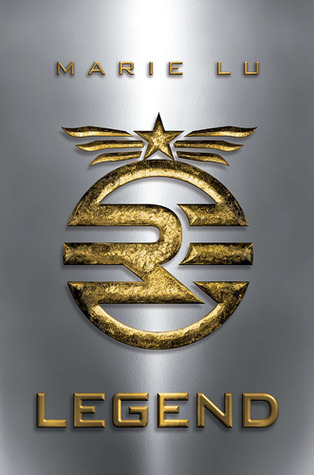
Legend--Marie Lu
November 2011 by Putnam Juvenile
320 pages--Goodreads
What was once the western United States is now home to the Republic, a nation perpetually at war with its neighbors. Born into an elite family in one of the Republic's wealthiest districts, fifteen-year-old June is a prodigy being groomed for success in the Republic's highest military circles. Born into the slums, fifteen-year-old Day is the country's most wanted criminal. But his motives may not be as malicious as they seem.
From very different worlds, June and Day have no reason to cross paths - until the day June's brother, Metias, is murdered and Day becomes the prime suspect. Caught in the ultimate game of cat and mouse, Day is in a race for his family's survival, while June seeks to avenge Metias's death. But in a shocking turn of events, the two uncover the truth of what has really brought them together, and the sinister lengths their country will go to keep its secrets.
Full of nonstop action, suspense, and romance, this novel is sure to move readers as much as it thrills.
A bunch of my students love this series, so I figured I'd check Legend out. Sadly, it was not as good as I had hoped it would be.
I think I've finally figured out why most of the dystopian novels published in the last few years disappoint me: they tend to use dystopia as a setting rather than as a social critique. When I read a dystopia, I want the novel to hold up a mirror to our own world, to show the dangerous potential of where we could go, or to exaggerate our society's flaws so we can more easily see how they are problematic. Books like Legend just use dystopia as a cool setting where the young heroes can be pitted against impossible odds. That's just not as compelling to me.
Additionally, the world building is too sparse. Even ignoring the lack of social commentary, the setting is vague. We never see how or why the Republic is a dystopia; we just have to take the synopsis's word that it is. I need to see how the government is repressive. What do they do that is so awful? Since no one knows about the plague cause, that isn't enough. What started the war between the Republic and the Colonies? What happened to the United States to cause it to break into factions? Why would people start revolting at Day's arrest? He's not a Robin Hood or a Mockingjay figure, and there's almost no evidence of repression, so the riot seems to exist solely to prick June's conscience. More detail about the world will probably be revealed later in the series, that's too late. You can surprise me later, but you must sell me on the world in the first book.
INSTALOVE. Seriously? A military girl working undercover and a rebel criminal living on the streets should both be much much much slower to trust and should not start making out with each other a day after they meet each other. I can accept descriptions of Day's gorgeous eyes and June's stunning beauty. I'll just roll my eyes and move on. But their relationship is way to serious given the time frame.
June and Day's personalities and voices are not distinct. Aside from their differing circumstances, either character could be narrating at any given time. If you are going to use two first-person narrators, their voices need to be clearly different from each other. As similar as the two characters are, they should not be identical.
Lu gets points for allowing Day to be vulnerable enough to cry, but those points are cancelled out by Day telling June, "Sorry. I couldn't help it," to explain why he kissed her. You'd better help it, Bucko. Even if you are not in control of your feelings, you are certainly in control of your actions. Words on even the hazy end of the victim-blaming spectrum are not romantic.
Despite all it's flaws, Legend is a decently enjoyable read. The mysteries, despite the bland world, are intriguing. The writing is fast-paced. The plot is exciting, and the book draws you in from the first line. Legend gets a low 3.
Showing posts with label dystopia. Show all posts
Sunday, January 12, 2014
Saturday, November 2, 2013
Review: Steelheart by Brandon Sanderson

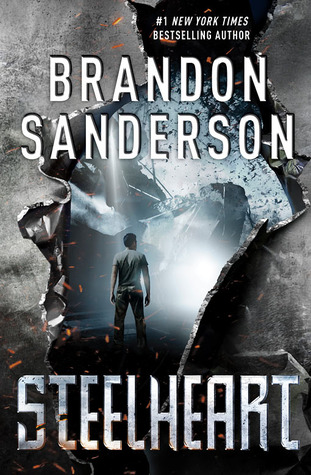
Steelheart--Brandon Sanderson
September 2013 by Delecorte
384 pages--Goodreads
There are no heroes.
Ten years ago, Calamity came. It was a burst in the sky that gave ordinary men and women extraordinary powers. The awed public started calling them Epics.
But Epics are no friend of man. With incredible gifts came the desire to rule. And to rule man you must crush his wills.
Nobody fights the Epics... nobody but the Reckoners. A shadowy group of ordinary humans, they spend their lives studying Epics, finding their weaknesses, and then assassinating them.
And David wants in. He wants Steelheart—the Epic who is said to be invincible. The Epic who killed David's father. For years, like the Reckoners, David's been studying, and planning—and he has something they need. Not an object, but an experience.
He's seen Steelheart bleed. And he wants revenge.
Steelheart is another book to add to Sanderson's already long list of great novels. I never thought I'd enjoy a superhero comic book in novel form so much. Some of the twists are predictable, but over all the story is still very good. Dan and I spent a long while after finishing the novel discussing how everything might work out in the next books. Steelheart is a very visual story, almost begging to be a movie. You can totally tell when during the action sequences we're supposed to switch to slow motion. And that was part of the fun of it.
The premise is intriguing: a world of super villains and a renegade bunch of humans trying to fight back. But these villains aren't as complex as Sanderson's usually are. It's too simplistic for all Epics to be inherently and completely evil from using their powers. There has to be at least one good Epic. But I trust he will develop the magic system later in the series. And hopefully he'll explain the physics-defying powers, like never ending bullets, somewhere along the way.
Character development is usually where Sanderson shines, but he had a couple of misses in this book. Cody is hilarious, David's horrible metaphors and similes are funny, and I really want to know more of Prof's back story. However, Megan is not very fleshed out. She's mostly a love interest. She has potential hidden in her history and the end plot twist, which Sanderson could explore in later books. But so far, she's kind of flat, just the hot fighter chick that the hero/audience to ogles at but who has no real personality. Hopefully, that will change.
Steelheart is an great beginning to a new series. My biggest complaint, beyond Megan, is the long wait until the sequel. And Nightweilder is SUCH a good name for a bad guy.
Wednesday, August 14, 2013
Review: Delirium by Lauren Oliver
Delirium--Lauren Oliver
February 2011 by HarperTeen
441 pages--Goodreads
Ninety-five days, and then I'll be safe. I wonder whether the procedure will hurt. I want to get it over with. It's hard to be patient. It's hard not to be afraid while I'm still uncured, though so far the deliria hasn't touched me yet. Still, I worry. They say that in the old days, love drove people to madness. The deadliest of all deadly things: It kills you both when you have it and when you don't.
I can't decide If I like the writing in Delirium or not. In some places it seems overly emotional to the point of being sappy, but in others it's quite skillful. I like Lena a lot as a narrator. Her mannerisms are just funny, but that could have just been the style the reader spoke in. Alex doesn't have any of his own drives or goals or even a personality. He's just there to fall in love with. The book contains more language than I'm comfortable with. And I kept waiting for someone to pop out and stab everyone in the back a la Uglies, but it never happened.
And I get the whole "resist the evil oppressive government to and with your last breath and never submit" thing, but I don't think conflating martyrdom and suicide is going to help our teen population at all.
But my biggest pet peeve is that Oliver completely misunderstood Romeo and Juliet. English Major Hulk Smash! Yes, Romeo and Juliet is a tragic love story, but it is NOT the greatest love story ever. It's a play about two twitterpated preteens who make horrible decisions and their families who also make horrible decisions. Come on! Romeo begins the play head over heels for Rosalind. That's why he goes to the Capulet party in the first place. When he sees Juliet, he forgets Rosalind ever existed. Given a few more days, he may have moved on to another girl. And Juliet was only 13. Do you know how many crushes I had when i was 13? A lot. Does not equal true love. This is not the play to base your romantic relationships on.
So, not an awful book, but not a great one either. Oliver got me more involved in the plot of Delirium than Roth did with Divergent, but I was still just so so in the end. I cared how the book ended, but I don't feel at all driven to finish the series. 2.5 stars.
February 2011 by HarperTeen
441 pages--Goodreads
Ninety-five days, and then I'll be safe. I wonder whether the procedure will hurt. I want to get it over with. It's hard to be patient. It's hard not to be afraid while I'm still uncured, though so far the deliria hasn't touched me yet. Still, I worry. They say that in the old days, love drove people to madness. The deadliest of all deadly things: It kills you both when you have it and when you don't.
I can't decide If I like the writing in Delirium or not. In some places it seems overly emotional to the point of being sappy, but in others it's quite skillful. I like Lena a lot as a narrator. Her mannerisms are just funny, but that could have just been the style the reader spoke in. Alex doesn't have any of his own drives or goals or even a personality. He's just there to fall in love with. The book contains more language than I'm comfortable with. And I kept waiting for someone to pop out and stab everyone in the back a la Uglies, but it never happened.
I wish I had known from the beginning that Delirium takes place in an alternate present. I thought it took place in the near future and there's no way our culture would accept such a drastic change (love being a dangerous disease) in so little time. It makes much more sense in an alternate present with its own culture. Oliver should have made that clearer.
Delirium doesn't quite make it as a dystopia for me. Dystopias need to explore the what if's and the how's and the how could we get there's of our present society extended to the extremes of the book's world. Delirium is too big a jump to be plausible. So while it is an interesting enough premise, it doesn't do what a dystopia is supposed to do. Matched did a better job of bridging that gap to a similar premise.
And I get the whole "resist the evil oppressive government to and with your last breath and never submit" thing, but I don't think conflating martyrdom and suicide is going to help our teen population at all.
But my biggest pet peeve is that Oliver completely misunderstood Romeo and Juliet. English Major Hulk Smash! Yes, Romeo and Juliet is a tragic love story, but it is NOT the greatest love story ever. It's a play about two twitterpated preteens who make horrible decisions and their families who also make horrible decisions. Come on! Romeo begins the play head over heels for Rosalind. That's why he goes to the Capulet party in the first place. When he sees Juliet, he forgets Rosalind ever existed. Given a few more days, he may have moved on to another girl. And Juliet was only 13. Do you know how many crushes I had when i was 13? A lot. Does not equal true love. This is not the play to base your romantic relationships on.
So, not an awful book, but not a great one either. Oliver got me more involved in the plot of Delirium than Roth did with Divergent, but I was still just so so in the end. I cared how the book ended, but I don't feel at all driven to finish the series. 2.5 stars.
Thursday, July 25, 2013
Review: Divergent by Veronica Roth
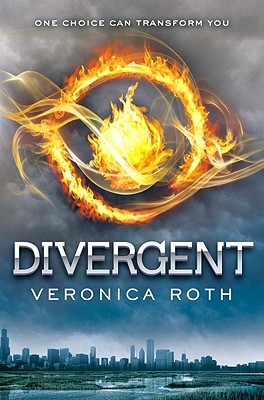
Divergent--Veronica Roth
April 2011 by Katherine Tegan Books
496 pages--Goodreads
In Beatrice Prior's dystopian Chicago, society is divided into five factions, each dedicated to the cultivation of a particular virtue—Candor (the honest), Abnegation (the selfless), Dauntless (the brave), Amity (the peaceful), and Erudite (the intelligent). On an appointed day of every year, all sixteen-year-olds must select the faction to which they will devote the rest of their lives. For Beatrice, the decision is between staying with her family and being who she really is—she can't have both. So she makes a choice that surprises everyone, including herself.
During the highly competitive initiation that follows, Beatrice renames herself Tris and struggles to determine who her friends really are—and where, exactly, a romance with a sometimes fascinating, sometimes infuriating boy fits into the life she's chosen. But Tris also has a secret, one she's kept hidden from everyone because she's been warned it can mean death. And as she discovers a growing conflict that threatens to unravel her seemingly perfect society, she also learns that her secret might help her save those she loves . . . or it might destroy her.
Divergent is one of those books that is action-packed and dramatic for the purpose of being action packed and dramatic. It all felt very empty. And SO IRRATIONAL. Garg! The world building is weak. The characters are flat and do irrational, unexplained things. They miss glaringly obvious plot "twists". And yet this book has wormed its way into so many people's 5-star list.
First, the world building: so many holes. I get that Roth has this really cool premise that she wants to try out, but the cardinal rule of dystopias is that they are supposed to be extensions of current society. They're supposed to explore the problems in our society. That means your dystopian world has to be at least semi-plausible; we have to believe that we could get there from here. But we get almost no explanation on how this post-civilization Chicago works. What made human society fall apart? War? Internal conflict? Tumblr? I seriously don't see the entire country breaking up because of personality traits. And what happened to the rest of the world? For that matter, what even happened to the rest of the country? What about people who lived in rural areas? What exists outside Chicago's boundaries? And while we're at it, how is everyone surviving in this city? Where is the food coming from? Where are the farmers? Where are the cows supplying hamburger meat?
Even the little world building we get doesn't make sense. Everything about Dauntless is messed up. They're supposed to be protecting the city, but no one patrols or guards or protects. The Dauntless just jump off buildings, shoot muffins off people's heads, and perform other acts of recklessness chalked up as bravery. And what the crap is up with Peter? I get that Roth is going for the whole "corruption within the factions" thing, but, just what? Stabbing your competition in the eye or tossing them over a cliff is a supreme act of cowardice, and he should have been banished. You can't trust someone who will eye stab you. It takes much more courage to admit to weaknesses than to pretend you don't have any, but the Dauntless are too focused on visible "bravery" and physical domination.
And why did all the transfers pick Dauntless in the first place. We get Tris's reasoning and a bit of Al's, but why on earth did Will and Christina transfer? This is never explained. They're just there because Tris needs a group to train with. Overall, the characters in this novel are not explored or fleshed out; they're just flat. Tris, in particular makes no sense. She's illogical. Or stupid. Allow me to demonstrate. Warning: spoilers.
April 2011 by Katherine Tegan Books
496 pages--Goodreads
In Beatrice Prior's dystopian Chicago, society is divided into five factions, each dedicated to the cultivation of a particular virtue—Candor (the honest), Abnegation (the selfless), Dauntless (the brave), Amity (the peaceful), and Erudite (the intelligent). On an appointed day of every year, all sixteen-year-olds must select the faction to which they will devote the rest of their lives. For Beatrice, the decision is between staying with her family and being who she really is—she can't have both. So she makes a choice that surprises everyone, including herself.
During the highly competitive initiation that follows, Beatrice renames herself Tris and struggles to determine who her friends really are—and where, exactly, a romance with a sometimes fascinating, sometimes infuriating boy fits into the life she's chosen. But Tris also has a secret, one she's kept hidden from everyone because she's been warned it can mean death. And as she discovers a growing conflict that threatens to unravel her seemingly perfect society, she also learns that her secret might help her save those she loves . . . or it might destroy her.
Divergent is one of those books that is action-packed and dramatic for the purpose of being action packed and dramatic. It all felt very empty. And SO IRRATIONAL. Garg! The world building is weak. The characters are flat and do irrational, unexplained things. They miss glaringly obvious plot "twists". And yet this book has wormed its way into so many people's 5-star list.
First, the world building: so many holes. I get that Roth has this really cool premise that she wants to try out, but the cardinal rule of dystopias is that they are supposed to be extensions of current society. They're supposed to explore the problems in our society. That means your dystopian world has to be at least semi-plausible; we have to believe that we could get there from here. But we get almost no explanation on how this post-civilization Chicago works. What made human society fall apart? War? Internal conflict? Tumblr? I seriously don't see the entire country breaking up because of personality traits. And what happened to the rest of the world? For that matter, what even happened to the rest of the country? What about people who lived in rural areas? What exists outside Chicago's boundaries? And while we're at it, how is everyone surviving in this city? Where is the food coming from? Where are the farmers? Where are the cows supplying hamburger meat?
Even the little world building we get doesn't make sense. Everything about Dauntless is messed up. They're supposed to be protecting the city, but no one patrols or guards or protects. The Dauntless just jump off buildings, shoot muffins off people's heads, and perform other acts of recklessness chalked up as bravery. And what the crap is up with Peter? I get that Roth is going for the whole "corruption within the factions" thing, but, just what? Stabbing your competition in the eye or tossing them over a cliff is a supreme act of cowardice, and he should have been banished. You can't trust someone who will eye stab you. It takes much more courage to admit to weaknesses than to pretend you don't have any, but the Dauntless are too focused on visible "bravery" and physical domination.
And why did all the transfers pick Dauntless in the first place. We get Tris's reasoning and a bit of Al's, but why on earth did Will and Christina transfer? This is never explained. They're just there because Tris needs a group to train with. Overall, the characters in this novel are not explored or fleshed out; they're just flat. Tris, in particular makes no sense. She's illogical. Or stupid. Allow me to demonstrate. Warning: spoilers.
- Hmm, Erudite wants to start a rebellion, but they need a way to control the Dauntless. They also have simulation serums that alter what the brain perceives. Oh, look. A new serum from Erudite. Don't worry; it's just a tracking serum that we're injecting ALL the Dauntless with. It couldn't possibly be a very convenient mind control serum.
- I need to destroy the computer controlling the dauntless-wide simulation. I could shoot the computer that's controlling the simulation. No, I'll instead hand the gun to the person who's trying to kill me. Don't worry, the power of love will save me.
- One of my brainwashed friends is trying to kill me. I could disable him by shooting him in the arm or leg. Nah, I think I'll shoot him in the head.
There is a lot, a lot of violence. If you don't like action flicks with guns and punching, Divergent is not your book. It certainly wasn't mine. But action lovers who don't care much about character development or plot progression will probably like it. It's kind of like The Maze Runner and summer blockbusters in that way.
I could not take the romance seriously. And that's all I have to say about that, so I'll rant about other things instead. Let's just conflate depression and cowardice, why don't we? As if we don't have enough problems in this country with how we handle mental illness. And while we're at it, let's just promote the idea that the best thing to do after being sexually assaulted is to not report it. Because reporting=cowardice apparently. Garg.
By the end of the book I got at least a bit invested in what would happen to some of the characters (Uriah, Will Christiana, all deserved larger parts). I was slightly curious about the plot, but it had ceased to make sense so I didn't care much. Divergent wasn't awful, but I'm not invested in the rest of the series.
Wednesday, April 10, 2013
Review: Son by Lois Lowry
Son--Lois Lowry
October 2012 by Houghton Mifflen Books for Children
393 pages--Goodreads
They called her Water Claire. When she washed up on their shore, no one knew that she came from a society where emotions and colors didn’t exist. That she had become a Vessel at age thirteen. That she had carried a Product at age fourteen. That it had been stolen from her body. Claire had a son. But what became of him she never knew. What was his name? Was he even alive? She was supposed to forget him, but that was impossible. Now Claire will stop at nothing to find her child, even if it means making an unimaginable sacrifice.
Son thrusts readers once again into the chilling world of the Newbery Medal winning book, The Giver, as well as Gathering Blue and Messengerwhere a new hero emerges. In this thrilling series finale, the startling and long-awaited conclusion to Lois Lowry’s epic tale culminates in a final clash between good and evil.
I have mixed reactions to Lowry's books. I love The Giver and have read it many times. Gathering Blue is okay, but nothing special. Messenger is flat out weird. And, unfortunately, so is Son.
Rather than being its own complete story, Son is more of a compilation of the other books in the series. I really enjoyed the first third of the novel. I liked learning more about the Community Claire and Jonas grew up in. I loved the bond Claire forms with Gabe. She does make some connections too easily (specifically that the pills kill feelings), but I was okay with it because I enjoyed the rest of the story. I thought the whole book would center around the Community and how it healed after Jonas left. Wrong. Claire actually escapes the community a day or two after Jonas, leaving me feeling cheated.
The second third was okay. It felt like an entirely different story than the first part of the novel, but it was okay. And then the third part of the novel. What? First of all, after being in Claire's head for the entire novel, we suddenly jump into Gabe's and then hop around between different characters. And the plot just gets weird. The ending is similar to Messenger's in that I finished the book with a "what the crap just happened?" feeling. Lowry keeps trying to go all existential with this series, but she doesn't set it up well. The spiritual stuff feels out of place in the world she created. Everything is fairly normal and then BOOM: battle between evil incarnate and the forces of good and love. And no, not a metaphorical fight between good and evil like Harry potter, but the actual embodiment of evil being destroyed by the actual power of love . . . I don't get it either.
Son was not what I was expecting. It just doesn't resonate like The Giver does. I suppose few things can live up to The Giver, but still.
October 2012 by Houghton Mifflen Books for Children
393 pages--Goodreads
They called her Water Claire. When she washed up on their shore, no one knew that she came from a society where emotions and colors didn’t exist. That she had become a Vessel at age thirteen. That she had carried a Product at age fourteen. That it had been stolen from her body. Claire had a son. But what became of him she never knew. What was his name? Was he even alive? She was supposed to forget him, but that was impossible. Now Claire will stop at nothing to find her child, even if it means making an unimaginable sacrifice.
Son thrusts readers once again into the chilling world of the Newbery Medal winning book, The Giver, as well as Gathering Blue and Messengerwhere a new hero emerges. In this thrilling series finale, the startling and long-awaited conclusion to Lois Lowry’s epic tale culminates in a final clash between good and evil.
I have mixed reactions to Lowry's books. I love The Giver and have read it many times. Gathering Blue is okay, but nothing special. Messenger is flat out weird. And, unfortunately, so is Son.
Rather than being its own complete story, Son is more of a compilation of the other books in the series. I really enjoyed the first third of the novel. I liked learning more about the Community Claire and Jonas grew up in. I loved the bond Claire forms with Gabe. She does make some connections too easily (specifically that the pills kill feelings), but I was okay with it because I enjoyed the rest of the story. I thought the whole book would center around the Community and how it healed after Jonas left. Wrong. Claire actually escapes the community a day or two after Jonas, leaving me feeling cheated.
The second third was okay. It felt like an entirely different story than the first part of the novel, but it was okay. And then the third part of the novel. What? First of all, after being in Claire's head for the entire novel, we suddenly jump into Gabe's and then hop around between different characters. And the plot just gets weird. The ending is similar to Messenger's in that I finished the book with a "what the crap just happened?" feeling. Lowry keeps trying to go all existential with this series, but she doesn't set it up well. The spiritual stuff feels out of place in the world she created. Everything is fairly normal and then BOOM: battle between evil incarnate and the forces of good and love. And no, not a metaphorical fight between good and evil like Harry potter, but the actual embodiment of evil being destroyed by the actual power of love . . . I don't get it either.
Son was not what I was expecting. It just doesn't resonate like The Giver does. I suppose few things can live up to The Giver, but still.
Friday, March 1, 2013
Review: Matched by Ally Condie
Matched--Ally Condie
November 2010 by Dutton Juvenile
369 pages--Goodreads
Cassia has always trusted the Society to make the right choices for her: what to read, what to watch, what to believe. So when Xander's face appears on-screen at her Matching ceremony, Cassia knows with complete certainty that he is her ideal mate... until she sees Ky Markham's face flash for an instant before the screen fades to black.
The Society tells her it's a glitch, a rare malfunction, and that she should focus on the happy life she's destined to lead with Xander. But Cassia can't stop thinking about Ky, and as they slowly fall in love, Cassia begins to doubt the Society's infallibility and is faced with an impossible choice: between Xander and Ky, between the only life she's known and a path that no one else has dared to follow.
Wow, that was good. I had kind of low expectations going in, but it was a hard book to put down. The synopsis above makes the book sound shallow, but I liked it, and I saw the the love triangle stuff as the impetus for Cassia to question the perfection of the Society. I am a bit annoyed, though, that a love triangle is the basis of the plot. Thankfully, it isn't as big of a trip up as I expected it to be. I don't like love triangles, especially when the girl waffles between two boys and she just can't decide who she likes better. Cassia spends the whole time being drawn to Ky and feeling guilty about hurting Xander, but she doesn't really waffle. So points there. By the way, no I will not pick a team. Teams are not the point; the Society and its absolute control is. I will not allow romance to get in the way of my dystopia. And since we all know how this is going to end, there is no point in bickering. Xander is the representation of the status quo; Ky represents choice. She can never choose Xander because that would prove that the Society is right, and we can't have that.
Condie does a good job of the building and describing a credible dystopia. We start out seeing the micromanaging control as strange but justified. Everything is safe this way. But then Condie leads us through a gradual reveal of the darker side of the Society. There's not much in the way of action, so don't expect a thrilling Hunger Games read-alike. But it is engaging through the interpersonal relationships and government induced issues.
I love Cassia's parents. So many YAs kill off the parents to get them out of the way. It is so nice to see good parents who love and support each other and care about their kids. I also like how their choices are flip sides of the same coin. Mother keeps the rules to protect the ones she loves; Father bends the rules to protect the ones he loves. They are an interesting and unexpected pair. I wish we could have seen more of Grandpa, but it is kind of important to get rid of him early on as his death is part of what spurs the change in Cassia.
I like the role "Do Not Go Gentle" and other poems play in Cassia's emerging rebellion. Yes, literature can change the world! I know it would be terribly boring to include in the book, but I'd be interested to see a list of the 100 songs, poems, history lessons, ect. Maybe as bonus material online or at the end of the book? I'm curious.
I will definitely read the next book. I hope Crossed includes more about the outer provinces and the countries the Society is fighting against as well as more turmoil within the Society. I also hope we learn why and how the Society came to be. The scary part of dystopias is not that such a world could exist; it's seeing our own society's potential to go down the same path.
Is it formulaic? A bit. There's definitely a lot of carry over from The Giver, but I don't think that kills the novel. Condie makes her world original enough to satisfy me. Besides, what's wrong with a deeper exploration of that type of world?
P.S. Google Chrome thinks "dystopia" should be "topiary".
November 2010 by Dutton Juvenile
369 pages--Goodreads
Cassia has always trusted the Society to make the right choices for her: what to read, what to watch, what to believe. So when Xander's face appears on-screen at her Matching ceremony, Cassia knows with complete certainty that he is her ideal mate... until she sees Ky Markham's face flash for an instant before the screen fades to black.
The Society tells her it's a glitch, a rare malfunction, and that she should focus on the happy life she's destined to lead with Xander. But Cassia can't stop thinking about Ky, and as they slowly fall in love, Cassia begins to doubt the Society's infallibility and is faced with an impossible choice: between Xander and Ky, between the only life she's known and a path that no one else has dared to follow.
Wow, that was good. I had kind of low expectations going in, but it was a hard book to put down. The synopsis above makes the book sound shallow, but I liked it, and I saw the the love triangle stuff as the impetus for Cassia to question the perfection of the Society. I am a bit annoyed, though, that a love triangle is the basis of the plot. Thankfully, it isn't as big of a trip up as I expected it to be. I don't like love triangles, especially when the girl waffles between two boys and she just can't decide who she likes better. Cassia spends the whole time being drawn to Ky and feeling guilty about hurting Xander, but she doesn't really waffle. So points there. By the way, no I will not pick a team. Teams are not the point; the Society and its absolute control is. I will not allow romance to get in the way of my dystopia. And since we all know how this is going to end, there is no point in bickering. Xander is the representation of the status quo; Ky represents choice. She can never choose Xander because that would prove that the Society is right, and we can't have that.
Condie does a good job of the building and describing a credible dystopia. We start out seeing the micromanaging control as strange but justified. Everything is safe this way. But then Condie leads us through a gradual reveal of the darker side of the Society. There's not much in the way of action, so don't expect a thrilling Hunger Games read-alike. But it is engaging through the interpersonal relationships and government induced issues.
I love Cassia's parents. So many YAs kill off the parents to get them out of the way. It is so nice to see good parents who love and support each other and care about their kids. I also like how their choices are flip sides of the same coin. Mother keeps the rules to protect the ones she loves; Father bends the rules to protect the ones he loves. They are an interesting and unexpected pair. I wish we could have seen more of Grandpa, but it is kind of important to get rid of him early on as his death is part of what spurs the change in Cassia.
I like the role "Do Not Go Gentle" and other poems play in Cassia's emerging rebellion. Yes, literature can change the world! I know it would be terribly boring to include in the book, but I'd be interested to see a list of the 100 songs, poems, history lessons, ect. Maybe as bonus material online or at the end of the book? I'm curious.
I will definitely read the next book. I hope Crossed includes more about the outer provinces and the countries the Society is fighting against as well as more turmoil within the Society. I also hope we learn why and how the Society came to be. The scary part of dystopias is not that such a world could exist; it's seeing our own society's potential to go down the same path.
Is it formulaic? A bit. There's definitely a lot of carry over from The Giver, but I don't think that kills the novel. Condie makes her world original enough to satisfy me. Besides, what's wrong with a deeper exploration of that type of world?
P.S. Google Chrome thinks "dystopia" should be "topiary".
Monday, February 11, 2013
Review: Unwind by Neal Shusterman
Unwind--Neal Shusterman
November 2007 by Simon & Schuster
335 pages--Goodreads
Connor, Risa, and Lev are running for their lives.
The Second Civil War was fought over reproductive rights. The chilling resolution: Life is inviolable from the moment of conception until age thirteen. Between the ages of thirteen and eighteen, however, parents can have their child "unwound," whereby all of the child's organs are transplanted into different donors, so life doesn't technically end. Connor is too difficult for his parents to control. Risa, a ward of the state is not enough to be kept alive. And Lev is a tithe, a child conceived and raised to be unwound. Together, they may have a chance to escape and to survive.
I have heard a ridiculous number of good things about Neal Shusterman and this series in particular. A friend was awesome enough to let me borrow it, so I finally got to read it. I may have built the book up too much in my mind, but I still liked it.
Unwind is written in first-person in present tense. I think this is the first book I've ever read in present tense. It was a little weird at first and took a while to get used to, but it gave an immediacy to the plot: we're right there with the characters instead of watching from the sidelines looking back like we usually do. And the unusual tense makes Shusterman's book stand apart.
The book is split between the point of view of three main characters. With as short as the book is, we don't have enough time to explore any of them as deeply as I would have liked since our attention is so split. Lev's story in particular needs more time and more development so we can understand why he changed; it's there, I just want more time to let it soak in. However, the multiple perspectives give us a wider view of the situation as a whole. We focus on the stories of individuals rather than the all of society, but we still get the big picture. I especially like that Shusterman doesn't turn any of his characters into monsters or saints. Each is complex, and even if we don't agree with their choices, we see where they're coming from.
I loved the Humphrey Dunfee urban legend that came up again and again throughout the novel. It tied things together in an unexpected but satisfying way. I'm still a bit annoyed at myself for not making the connection to Humpty Dumpty until now. How did I miss that?
The premise is not terribly plausible, but Shusterman makes it work, and by the end, we can see why society may have chosen to go down such a callous road. This book deals with some hard issues that can springboard into great discussions. What is the soul? Are you still alive if all your physical parts are? What does the sanctity of human life really mean? How much choice should an individual have over their own life? What should society do with with the people it doesn't want? Shusterman doesn't preach, doesn't tell you what to think. He just presents the story and lets us think it out for ourselves. There are no clear answers, but it is the thinking that matters. We cannot, as the novel's society does, just evade the responsibility of an unexpected baby or a troublesome teenager.
The book does contain some content that will be disturbing to some readers. It's not graphic, but Shusterman writes in such a way that your imagination fills in the blanks in a heebee jeebees kind of way. Aside from that, and perhaps because of it, it is a very compelling novel and a satisfying read.
P.S. Register to be an organ donor if you haven't done so already. You won't need your liver if you're dead, and someone else does.
November 2007 by Simon & Schuster
335 pages--Goodreads
Connor, Risa, and Lev are running for their lives.
The Second Civil War was fought over reproductive rights. The chilling resolution: Life is inviolable from the moment of conception until age thirteen. Between the ages of thirteen and eighteen, however, parents can have their child "unwound," whereby all of the child's organs are transplanted into different donors, so life doesn't technically end. Connor is too difficult for his parents to control. Risa, a ward of the state is not enough to be kept alive. And Lev is a tithe, a child conceived and raised to be unwound. Together, they may have a chance to escape and to survive.
I have heard a ridiculous number of good things about Neal Shusterman and this series in particular. A friend was awesome enough to let me borrow it, so I finally got to read it. I may have built the book up too much in my mind, but I still liked it.
Unwind is written in first-person in present tense. I think this is the first book I've ever read in present tense. It was a little weird at first and took a while to get used to, but it gave an immediacy to the plot: we're right there with the characters instead of watching from the sidelines looking back like we usually do. And the unusual tense makes Shusterman's book stand apart.
The book is split between the point of view of three main characters. With as short as the book is, we don't have enough time to explore any of them as deeply as I would have liked since our attention is so split. Lev's story in particular needs more time and more development so we can understand why he changed; it's there, I just want more time to let it soak in. However, the multiple perspectives give us a wider view of the situation as a whole. We focus on the stories of individuals rather than the all of society, but we still get the big picture. I especially like that Shusterman doesn't turn any of his characters into monsters or saints. Each is complex, and even if we don't agree with their choices, we see where they're coming from.
I loved the Humphrey Dunfee urban legend that came up again and again throughout the novel. It tied things together in an unexpected but satisfying way. I'm still a bit annoyed at myself for not making the connection to Humpty Dumpty until now. How did I miss that?
The premise is not terribly plausible, but Shusterman makes it work, and by the end, we can see why society may have chosen to go down such a callous road. This book deals with some hard issues that can springboard into great discussions. What is the soul? Are you still alive if all your physical parts are? What does the sanctity of human life really mean? How much choice should an individual have over their own life? What should society do with with the people it doesn't want? Shusterman doesn't preach, doesn't tell you what to think. He just presents the story and lets us think it out for ourselves. There are no clear answers, but it is the thinking that matters. We cannot, as the novel's society does, just evade the responsibility of an unexpected baby or a troublesome teenager.
The book does contain some content that will be disturbing to some readers. It's not graphic, but Shusterman writes in such a way that your imagination fills in the blanks in a heebee jeebees kind of way. Aside from that, and perhaps because of it, it is a very compelling novel and a satisfying read.
P.S. Register to be an organ donor if you haven't done so already. You won't need your liver if you're dead, and someone else does.
Friday, November 9, 2012
Review: Lord of the Flies by William Golding
Lord of the Flies--William Golding
Originally published in 1954
182 pages--Goodreads
William Golding's classic tale about a group of English schoolboys who are plane-wrecked on a deserted island is just as chilling and relevant today as when it was first published in 1954.
At first, the stranded boys cooperate, attempting to gather food, make shelters, and maintain signal fires. Overseeing their efforts are Ralph, "the boy with fair hair," and Piggy, Ralph's chubby, wisdom-dispensing sidekick whose thick spectacles come in handy for lighting fires. Although Ralph tries to impose order and delegate responsibility, there are many in their number who would rather swim, play, or hunt the island's wild pig population. Soon Ralph's rules are being ignored or challenged outright. His fiercest antagonist is Jack, the redheaded leader of the pig hunters, who manages to lure away many of the boys to join his band of painted savages. The situation deteriorates as the trappings of civilization continue to fall away, until Ralph discovers that instead of being hunters, he and Piggy have become the hunted: "He forgot his words, his hunger and thirst, and became fear; hopeless fear on flying feet." Golding's gripping novel explores the boundary between human reason and animal instinct, all on the brutal playing field of adolescent competition.
I'm not entirely sure how I missed reading this book in high school since it is so often on the required text list. Because it is a widely read book and it was published over 50 years ago, I will include spoilers. If that bothers you, beware.
Golding takes the Robinson Crusoe shipwrecked adventure story and turns it from a triumph to the human spirit to the decay of man's violent nature. Disturbing? Yes. It's about the descent into savagery; I don't think that could be properly conveyed without some element of the disturbing.
The slow breakdown of Golding's mini-society is excellently crafted. It is incredibly creepy because it is so believable. It's not just that the boys kill Simon in their primal dance, but that I can actually see this happening with a group of boys left all on their own. I can see things getting out of hand and going irrevocably too far. The book is a mirror to society, reflecting tendencies we see in people around us and in ourselves.
Golding meant for this to be an allegorical novel to analyze the breakdown from order to savagery. He is not subtle, but his portrayals rarely feels overhanded. Even though the characters have very specific and narrow roles (the intellectual, the savage, the leader, the prophet, the masses), they still have depth. They don't really have breadth, but within their roles they are deeply developed. I also liked the depiction of the ever present threat of the Beast--the fear of the unknown, the compelling drive to violence, the savagery in all of us, the label attached to the scapegoat to escape the fear of ourselves.
I really liked the ending sentence, where the officer turns away from the warlike boy savages to stare at his cruiser, the tool of the adult war that underscores the whole story. It's a reminder that the book doesn't just deal with the possible in society, but with problems we already have.
There is a strong connection to Lost. The Island brings out the best and the worst in people. The rule of law breaks down. There is a "prophet" in tune with the Island. And there are enough Beasts, smoke monsters, and Others to keep everyone on the edge. The Maze Runner spends less time on the collapse society but is another depiction of the cruelty people are capable of when they are desperate.
I didn't enjoy Lord of the Flies as much as I would have liked to. It made me think, but not as deeply as other books have. I wish I'd had the opportunity to study this in a class, because I would have taken more time and thought with it if I had read a physical copy instead of the audiobook. I'm glad I read it, but I won't feel the need to reread it for a while. This book has made it on to a lot of the "Best Books of the Century" lists, and I think it deserves its place. It is a rich text that provides a lot of food for discussion, both about Golding's literary craft and his commentary on society.
Originally published in 1954
182 pages--Goodreads
William Golding's classic tale about a group of English schoolboys who are plane-wrecked on a deserted island is just as chilling and relevant today as when it was first published in 1954.
At first, the stranded boys cooperate, attempting to gather food, make shelters, and maintain signal fires. Overseeing their efforts are Ralph, "the boy with fair hair," and Piggy, Ralph's chubby, wisdom-dispensing sidekick whose thick spectacles come in handy for lighting fires. Although Ralph tries to impose order and delegate responsibility, there are many in their number who would rather swim, play, or hunt the island's wild pig population. Soon Ralph's rules are being ignored or challenged outright. His fiercest antagonist is Jack, the redheaded leader of the pig hunters, who manages to lure away many of the boys to join his band of painted savages. The situation deteriorates as the trappings of civilization continue to fall away, until Ralph discovers that instead of being hunters, he and Piggy have become the hunted: "He forgot his words, his hunger and thirst, and became fear; hopeless fear on flying feet." Golding's gripping novel explores the boundary between human reason and animal instinct, all on the brutal playing field of adolescent competition.
I'm not entirely sure how I missed reading this book in high school since it is so often on the required text list. Because it is a widely read book and it was published over 50 years ago, I will include spoilers. If that bothers you, beware.
Golding takes the Robinson Crusoe shipwrecked adventure story and turns it from a triumph to the human spirit to the decay of man's violent nature. Disturbing? Yes. It's about the descent into savagery; I don't think that could be properly conveyed without some element of the disturbing.
The slow breakdown of Golding's mini-society is excellently crafted. It is incredibly creepy because it is so believable. It's not just that the boys kill Simon in their primal dance, but that I can actually see this happening with a group of boys left all on their own. I can see things getting out of hand and going irrevocably too far. The book is a mirror to society, reflecting tendencies we see in people around us and in ourselves.
Golding meant for this to be an allegorical novel to analyze the breakdown from order to savagery. He is not subtle, but his portrayals rarely feels overhanded. Even though the characters have very specific and narrow roles (the intellectual, the savage, the leader, the prophet, the masses), they still have depth. They don't really have breadth, but within their roles they are deeply developed. I also liked the depiction of the ever present threat of the Beast--the fear of the unknown, the compelling drive to violence, the savagery in all of us, the label attached to the scapegoat to escape the fear of ourselves.
I really liked the ending sentence, where the officer turns away from the warlike boy savages to stare at his cruiser, the tool of the adult war that underscores the whole story. It's a reminder that the book doesn't just deal with the possible in society, but with problems we already have.
There is a strong connection to Lost. The Island brings out the best and the worst in people. The rule of law breaks down. There is a "prophet" in tune with the Island. And there are enough Beasts, smoke monsters, and Others to keep everyone on the edge. The Maze Runner spends less time on the collapse society but is another depiction of the cruelty people are capable of when they are desperate.
I didn't enjoy Lord of the Flies as much as I would have liked to. It made me think, but not as deeply as other books have. I wish I'd had the opportunity to study this in a class, because I would have taken more time and thought with it if I had read a physical copy instead of the audiobook. I'm glad I read it, but I won't feel the need to reread it for a while. This book has made it on to a lot of the "Best Books of the Century" lists, and I think it deserves its place. It is a rich text that provides a lot of food for discussion, both about Golding's literary craft and his commentary on society.
Wednesday, September 26, 2012
Review: The Maze Runner by James Dashner
The Maze Runner -- James Dashner
October 2009 by Delacorte Books for Young Readers
374 pages Goodreads
When Thomas wakes up in the lift, the only thing he can remember is his first name. His memory is blank. But he’s not alone. When the lift’s doors open, Thomas finds himself surrounded by kids who welcome him to the Glade—a large, open expanse surrounded by stone walls.
Just like Thomas, the Gladers don’t know why or how they got to the Glade. All they know is that every morning the stone doors to the maze that surrounds them have opened. Every night they’ve closed tight. And every 30 days a new boy has been delivered in the lift.
Thomas was expected. But the next day, a girl is sent up—the first girl to ever arrive in the Glade. And more surprising yet is the message she delivers.
Thomas might be more important than he could ever guess. If only he could unlock the dark secrets buried within his mind.
October 2009 by Delacorte Books for Young Readers
374 pages Goodreads
When Thomas wakes up in the lift, the only thing he can remember is his first name. His memory is blank. But he’s not alone. When the lift’s doors open, Thomas finds himself surrounded by kids who welcome him to the Glade—a large, open expanse surrounded by stone walls.
Just like Thomas, the Gladers don’t know why or how they got to the Glade. All they know is that every morning the stone doors to the maze that surrounds them have opened. Every night they’ve closed tight. And every 30 days a new boy has been delivered in the lift.
Thomas was expected. But the next day, a girl is sent up—the first girl to ever arrive in the Glade. And more surprising yet is the message she delivers.
Thomas might be more important than he could ever guess. If only he could unlock the dark secrets buried within his mind.
With how popular as this book has been, I figured I needed to read it eventually, and when it showed up on the bargain books shelf at the bookstore for just a couple dollars I couldn't resist. Now I'm glad I only paid a few bucks for this because it was a bit lackluster. Not bad, just not terribly good either. I'm reading Lord of the Flies next and am interested to see how well the two compare. And by reading it next I mean probably some time after mid terms. In a month and a half. Or over Christmas break. I'll read it...soon.
Dashner throws us into his world very abruptly and we spend most of the novel trying to figure out what's going on. This bugged me a bit, though it was the effect Dashner was going for. I generally prefer a bit more explanation of the setting and good world building, even if there are a lot of unknowns. The rest of the series, from the Wikipedia summaries, seem to be a similar collection of scattered events that is supposed to be suspenseful
The excessive and escalating violence left a bad taste in my mouth. I'm not opposed to any violence ever, but the characters seemed to relish in it. At one point, a boy is banished from the safety of the Glade, tied up, and left to be eaten by Griever monster things. It's a disturbing scene, but some of the characters smile through it. I really don't like such callousness. These are just kids; they should be a bit more disturbed by their actions. I also made the mistake of finishing the book late at night and promply spent the next half hour trying to fall asleep while listening to the night noises of my house, trying to convince myself I was not about to get attacked. Thanks Dashner.
The characters use slang A LOT, to the point that it felt crude. "Klunk", "shuckface", "we're shucked", "shucking"--we know you're swearing. I don't think this would bother most readers, but it bugged me. Along with this, everyone is always yelling. Always. Spitting out death threats or lashing out at people (rationally or irrationally) or whatever. No one knows how to speak in a normally toned voice. Maybe I'm not giving the characters enough credit--it's a high stress situation--but anger overused loses its effect.
Also, there is extremely little character development. This is where a novel can really shine and yet where so many novels fall flat, taking the easy route of flat stereotypes.
Dashner throws us into his world very abruptly and we spend most of the novel trying to figure out what's going on. This bugged me a bit, though it was the effect Dashner was going for. I generally prefer a bit more explanation of the setting and good world building, even if there are a lot of unknowns. The rest of the series, from the Wikipedia summaries, seem to be a similar collection of scattered events that is supposed to be suspenseful
The excessive and escalating violence left a bad taste in my mouth. I'm not opposed to any violence ever, but the characters seemed to relish in it. At one point, a boy is banished from the safety of the Glade, tied up, and left to be eaten by Griever monster things. It's a disturbing scene, but some of the characters smile through it. I really don't like such callousness. These are just kids; they should be a bit more disturbed by their actions. I also made the mistake of finishing the book late at night and promply spent the next half hour trying to fall asleep while listening to the night noises of my house, trying to convince myself I was not about to get attacked. Thanks Dashner.
The characters use slang A LOT, to the point that it felt crude. "Klunk", "shuckface", "we're shucked", "shucking"--we know you're swearing. I don't think this would bother most readers, but it bugged me. Along with this, everyone is always yelling. Always. Spitting out death threats or lashing out at people (rationally or irrationally) or whatever. No one knows how to speak in a normally toned voice. Maybe I'm not giving the characters enough credit--it's a high stress situation--but anger overused loses its effect.
Also, there is extremely little character development. This is where a novel can really shine and yet where so many novels fall flat, taking the easy route of flat stereotypes.
My number one complaint is that the mystery of the novel is solved only through a dues ex machina bestowal of information. That's cheating. Yes, new information is usually needed to solve a mystery, but the characters didn't figure out anything on their own. Again, I don't know that this would bother a young adult audience, but I prefer the satisfaction of a well-developed, intricate plot that I can sort out along with the characters. I do like the plot twist at the very end of the book. Dashner has the potential to explore moral/ethical issues about government and science and experimentation a la The Island, but I can't help but think he won't live up to that potential.
I liked the book well enough when I was reading it, but after putting it down I had little desire to pick it up again. It was a decent book, but I don't feel terribly compelled to read the sequels. That's what Wikipedia is for.
Subscribe to:
Posts (Atom)