Showing posts with label post-apoc. Show all posts

Saturday, January 18, 2014

Review: Across a Star-Swept Sea by Diana Peterfreund

Across a Star-Swept Sea--Diana Peterfreund
October 2013 by Balzer +  Bray
464 pages--Goodreads

Centuries after wars nearly destroyed civilization, the two islands of New Pacifica stand alone, a terraformed paradise where even the Reduction—the devastating brain disorder that sparked the wars—is a distant memory. Yet on the isle of Galatea, an uprising against the ruling aristocrats has turned deadly. The revolutionaries’ weapon is a drug that damages their enemies’ brains, and the only hope is rescue by a mysterious spy known as the Wild Poppy.

On the neighboring island of Albion, no one suspects that the Wild Poppy is actually famously frivolous aristocrat Persis Blake. The teenager uses her shallow, socialite trappings to hide her true purpose: her gossipy flutternotes are encrypted plans, her pampered sea mink is genetically engineered for spying, and her well-publicized new romance with handsome Galatean medic Justen Helo… is her most dangerous mission ever.

Though Persis is falling for Justen, she can’t risk showing him her true self, especially once she learns he’s hiding far more than simply his disenchantment with his country’s revolution and his undeniable attraction to the silly socialite he’s pretending to love. His darkest secret could plunge both islands into a new dark age, and Persis realizes that when it comes to Justen Helo, she’s not only risking her heart, she’s risking the world she’s sworn to protect.

In this thrilling adventure inspired by The Scarlet Pimpernel, Diana Peterfreund creates an exquisitely rendered world where nothing is as it seems and two teens with very different pasts fight for a future only they dare to imagine.


I am so impressed by this novel.  After being a bit disappointed by For Darkness Shows the Stars, I was worried that Across a Star-Swept Sea would follow suit.  No worries!  It takes everything that For Darkness did right and builds on it.

First, the setting is perfect.  It's an excellent adaptation of the source material.  Peterfreund takes the class system of the first book and fits it to the framework of the French revolution.  The the reduction was cured a few centuries ago, but there is still class tension between the aristos and regs.  In Galatea those tensions erupt into a Reign of Terror with people being reduced rather than guillotined.  Fervor blinds the revolutionaries to the cruelty of their actions until they care only for revenge against the aristos and those who support them for all their crimes and their fathers' crimes and their fathers' fathers' crimes.  In Albion things are more stable, but those tensions still exist.  Some aristos are fair stewards; others are not.  And whispers of revolution from discontented regs threaten destabilize a regency government.

And the fact that Justen invented the reduction drug (albeit by accident) is a great adaptation of Marguerite's accidental betrayal in the original.  Basically, I just love good adaptations.  The ones that bring out the most important parts of the original and adapting those conflicts into a new setting.  The ones that stay true to the core of the characters while bringing out something new and interesting about them.

In that light, Persis is so annoying, and I mean that in the best possible way.  Her disguise requires her to act in a manner WAY below her intellect.  It drove me crazy how she had to hold back her complicated opinions about politics, gender relations, and social equality.  I hated every time Justen thought of her as a spoiled idiot.  It is so perfect for this story and the tension it needs.  I was a bit worried about this aspect of the adaptation--there is a big difference between a fop and a shallow socialite woman--but Peterfreund pulls it off masterfully, causing even Justen, the oh-so-enlightend, to question his gender assumption.

I know it wouldn't fit the story, but I wish we could see more of Persis' parents.  Dealing with an Alzheimer's-like condition would be both a fascinating, though tragic, plot line.  Persis, understandably, wants to ignore what was happening to her mother, but I want to see more exploration of that situation.

I only have a couple of complaints.  First, the multiple perspectives get a bit confusing at times.  For the story Peterfreund is telling, we do need to see from multiple characters' perspectives, but there isn't quite enough cuing as to when we switch perspectives.  I don't need a label slapped on each section, but it needs to be clear in the first sentence who's talking.  Sometimes it takes nearly a paragraph before we know who is narrating.

Second, I know most people were excited to see them again, but Elliot, Kai, and the rest of their group feel out of place in this story. There would have been better ways to lure the Poppy into a trap (for example, Remy getting captured) without pulling these characters in so late in the game.  And then the ending itself is just a bit too sudden.  Minor qualms, but still.

Across a Star-Swept Sea is excellent, both as its own story and as as a retelling of The Scarlet Pimpernel.  I need to go rewatch the movie now.  If you haven't read For Darkness, don't let that stop you from reading Across a Star-Swept Sea.  It's more of a companion novel than a sequel and can stand on its own.

Sunday, January 12, 2014

Review: Legend by Marie Lu

Legend--Marie Lu
November 2011 by Putnam Juvenile
320 pages--Goodreads

What was once the western United States is now home to the Republic, a nation perpetually at war with its neighbors. Born into an elite family in one of the Republic's wealthiest districts, fifteen-year-old June is a prodigy being groomed for success in the Republic's highest military circles. Born into the slums, fifteen-year-old Day is the country's most wanted criminal. But his motives may not be as malicious as they seem.

From very different worlds, June and Day have no reason to cross paths - until the day June's brother, Metias, is murdered and Day becomes the prime suspect. Caught in the ultimate game of cat and mouse, Day is in a race for his family's survival, while June seeks to avenge Metias's death. But in a shocking turn of events, the two uncover the truth of what has really brought them together, and the sinister lengths their country will go to keep its secrets.

Full of nonstop action, suspense, and romance, this novel is sure to move readers as much as it thrills. 


A bunch of my students love this series, so I figured I'd check Legend out.  Sadly, it was not as good as I had hoped it would be.  

I think I've finally figured out why most of the dystopian novels published in the last few years disappoint me:  they tend to use dystopia as a setting rather than as a social critique.  When I read a dystopia, I want the novel to hold up a mirror to our own world, to show the dangerous potential of where we could go, or to exaggerate our society's flaws so we can more easily see how they are problematic.  Books like Legend just use dystopia as a cool setting where the young heroes can be pitted against impossible odds.  That's just not as compelling to me.  

Additionally, the world building is too sparse.  Even ignoring the lack of social commentary, the setting is vague.  We never see how or why the Republic is a dystopia; we just have to take the synopsis's word that it is.  I need to see how the government is repressive.  What do they do that is so awful?  Since no one knows about the plague cause, that isn't enough.  What started the war between the Republic and the Colonies?  What happened to the United States to cause it to break  into factions?  Why would people start revolting at Day's arrest?  He's not a Robin Hood or a Mockingjay figure, and there's almost no evidence of repression, so the riot seems to exist solely to prick June's conscience.  More detail about the world will probably be revealed later in the series, that's too late.  You can surprise me later, but you must sell me on the world in the first book. 

INSTALOVE.  Seriously?  A military girl working undercover and a rebel criminal living on the streets should both be much much much slower to trust and should not start making out with each other a day after they meet each other.  I can accept descriptions of Day's gorgeous eyes and June's stunning beauty.  I'll just roll my eyes and move on.  But their relationship is way to serious given the time frame. 

June and Day's personalities and voices are not distinct.  Aside from their differing circumstances, either character could be narrating at any given time.  If you are going to use two first-person narrators, their voices need to be clearly different from each other.  As similar as the two characters are, they should not be identical. 

Lu gets points for allowing Day to be vulnerable enough to cry, but those points are cancelled out by Day telling June, "Sorry.  I couldn't help it," to explain why he kissed her.  You'd better help it, Bucko.  Even if you are not in control of your feelings, you are certainly in control of your actions.  Words on even the hazy end of the victim-blaming spectrum are not romantic.

Despite all it's flaws, Legend is a decently enjoyable read.  The mysteries, despite the bland world, are intriguing.  The writing is fast-paced.  The plot is exciting, and the book draws you in from the first line.  Legend gets a low 3.

Saturday, November 2, 2013

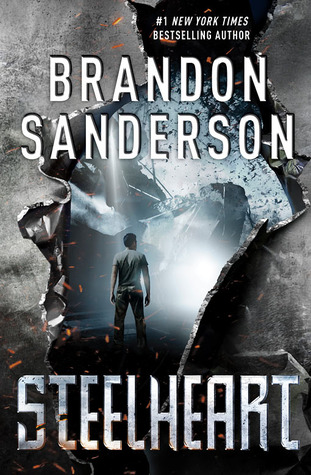
Review: Steelheart by Brandon Sanderson


Steelheart--Brandon Sanderson
September 2013 by Delecorte
384 pages--Goodreads

There are no heroes.

Ten years ago, Calamity came. It was a burst in the sky that gave ordinary men and women extraordinary powers. The awed public started calling them Epics.

But Epics are no friend of man. With incredible gifts came the desire to rule. And to rule man you must crush his wills.

Nobody fights the Epics... nobody but the Reckoners. A shadowy group of ordinary humans, they spend their lives studying Epics, finding their weaknesses, and then assassinating them.

And David wants in. He wants Steelheart—the Epic who is said to be invincible. The Epic who killed David's father. For years, like the Reckoners, David's been studying, and planning—and he has something they need. Not an object, but an experience.

He's seen Steelheart bleed. And he wants revenge.


Steelheart is another book to add to Sanderson's already long list of great novels. I never thought I'd enjoy a superhero comic book in novel form so much.  Some of the twists are predictable, but over all the story is still very good.  Dan and I spent a long while after finishing the novel discussing how everything might work out in the next books.  Steelheart is a very visual story, almost begging to be a movie.  You can totally tell when during the action sequences we're supposed to switch to slow motion.  And that was part of the fun of it.

The premise is intriguing:  a world of super villains and a renegade bunch of humans trying to fight back.  But these villains aren't as complex as Sanderson's usually are.  It's too simplistic for all Epics to be inherently and completely evil from using their powers.  There has to be at least one good Epic.  But I trust he will develop the magic system later in the series.  And hopefully he'll explain the physics-defying powers, like never ending bullets, somewhere along the way.

Character development is usually where Sanderson shines, but he had a couple of misses in this book.  Cody is hilarious, David's horrible metaphors and similes are funny, and I really want to know more of Prof's back story.  However, Megan is not very fleshed out.  She's mostly a love interest.  She has potential hidden in her history and the end plot twist, which Sanderson could explore in later books.  But so far, she's kind of flat, just the hot fighter chick that the hero/audience to ogles at but who has no real personality.  Hopefully, that will change.

Steelheart is an great beginning to a new series.  My biggest complaint, beyond Megan, is the long wait until the sequel.  And Nightweilder is SUCH a good name for a bad guy.

Thursday, July 25, 2013

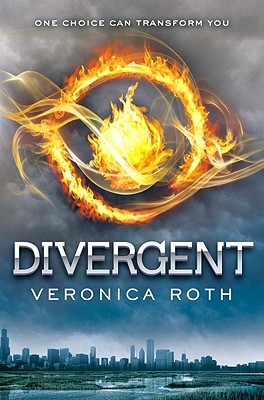
Review: Divergent by Veronica Roth

Divergent--Veronica Roth
April 2011 by Katherine Tegan Books
496 pages--Goodreads

In Beatrice Prior's dystopian Chicago, society is divided into five factions, each dedicated to the cultivation of a particular virtue—Candor (the honest), Abnegation (the selfless), Dauntless (the brave), Amity (the peaceful), and Erudite (the intelligent). On an appointed day of every year, all sixteen-year-olds must select the faction to which they will devote the rest of their lives. For Beatrice, the decision is between staying with her family and being who she really is—she can't have both. So she makes a choice that surprises everyone, including herself.

During the highly competitive initiation that follows, Beatrice renames herself Tris and struggles to determine who her friends really are—and where, exactly, a romance with a sometimes fascinating, sometimes infuriating boy fits into the life she's chosen. But Tris also has a secret, one she's kept hidden from everyone because she's been warned it can mean death. And as she discovers a growing conflict that threatens to unravel her seemingly perfect society, she also learns that her secret might help her save those she loves . . . or it might destroy her.


Divergent is one of those books that is action-packed and dramatic for the purpose of being action packed and dramatic.  It all felt very empty.  And SO IRRATIONAL.  Garg!  The world building is weak.  The characters are flat and do irrational, unexplained things.  They miss glaringly obvious plot "twists".  And yet this book has wormed its way into so many people's 5-star list.

First, the world building:  so many holes.  I get that Roth has this really cool premise that she wants to try out, but the cardinal rule of dystopias is that they are supposed to be extensions of current society.  They're supposed to explore the problems in our society.  That means your dystopian world has to be at least semi-plausible; we have to believe that we could get there from here.  But we get almost no explanation on how this post-civilization Chicago works.  What made human society fall apart?  War?  Internal conflict?  Tumblr?  I seriously don't see the entire country breaking up because of personality traits.  And what happened to the rest of the world?  For that matter, what even happened to the rest of the country?  What about people who lived in rural areas?  What exists outside Chicago's boundaries?  And while we're at it, how is everyone surviving in this city?  Where is the food coming from? Where are the farmers?  Where are the cows supplying hamburger meat?

Even the little world building we get doesn't make sense.  Everything about Dauntless is messed up.  They're supposed to be protecting the city, but no one patrols or guards or protects.  The Dauntless just jump off buildings, shoot muffins off people's heads, and perform other acts of recklessness chalked up as bravery.  And what the crap is up with Peter?  I get that Roth is going for the whole "corruption within the factions" thing, but, just what?  Stabbing your competition in the eye or tossing them over a cliff is a supreme act of cowardice, and he should have been banished.  You can't trust someone who will eye stab you.  It takes much more courage to admit to weaknesses than to pretend you don't have any, but the Dauntless are too focused on visible "bravery" and physical domination.

And why did all the transfers pick Dauntless in the first place.  We get Tris's reasoning and a bit of Al's, but why on earth did Will and Christina transfer?  This is never explained.  They're just there because Tris needs a group to train with.  Overall, the characters in this novel are not explored or fleshed out; they're just flat.  Tris, in particular makes no sense.  She's illogical.  Or stupid.  Allow me to demonstrate.  Warning:  spoilers.

  • Hmm, Erudite wants to start a rebellion, but they need a way to control the Dauntless.  They also have simulation serums that alter what the brain perceives.   Oh, look.  A new serum from Erudite.  Don't worry; it's just a tracking serum that we're injecting ALL the Dauntless with.  It couldn't possibly be a very convenient mind control serum.
  • I need to destroy the computer controlling the dauntless-wide simulation.  I could shoot the computer that's controlling the simulation.  No, I'll instead hand the gun to the person who's trying to kill me.  Don't worry, the power of love will save me.
  • One of my brainwashed friends is trying to kill me.  I could disable him by shooting him in the arm or leg.  Nah, I think I'll shoot him in the head.

There is a lot, a lot of violence.  If you don't like action flicks with guns and punching, Divergent is not your book.  It certainly wasn't mine.  But action lovers who don't care much about character development or plot progression will probably like it.  It's kind of like The Maze Runner and summer blockbusters in that way.

I could not take the romance seriously.  And that's all I have to say about that, so I'll rant about other things instead.  Let's just conflate depression and cowardice, why don't we?  As if we don't have enough problems in this country with how we handle mental illness.  And while we're at it, let's just promote the idea that the best thing to do after being sexually assaulted is to not report it.  Because reporting=cowardice apparently.  Garg. 

By the end of the book I got at least a bit invested in what would happen to some of the characters (Uriah, Will Christiana,  all deserved larger parts).  I was slightly curious about the plot, but it had ceased to make sense so I didn't care much.  Divergent wasn't awful, but I'm not invested in the rest of the series.  

Saturday, July 13, 2013

Review: For Darkness Shows the Stars by Diana Peterfreund

For Darkness Shows the Stars--Diana Peterfreund
June 2012 Balzer + Bray
402 pages--Goodreads

It's been several generations since a genetic experiment gone wrong caused the Reduction, decimating humanity and giving rise to a Luddite nobility who outlawed most technology.

Elliot North has always known her place in this world. Four years ago Elliot refused to run away with her childhood sweetheart, the servant Kai, choosing duty to her family's estate over love. Since then the world has changed: a new class of Post-Reductionists is jumpstarting the wheel of progress, and Elliot's estate is foundering, forcing her to rent land to the mysterious Cloud Fleet, a group of shipbuilders that includes renowned explorer Captain Malakai Wentforth--an almost unrecognizable Kai. And while Elliot wonders if this could be their second chance, Kai seems determined to show Elliot exactly what she gave up when she let him go.

But Elliot soon discovers her old friend carries a secret--one that could change their society . . . or bring it to its knees. And again, she's faced with a choice: cling to what she's been raised to believe, or cast her lot with the only boy she's ever loved, even if she's lost him forever.


Inspired by Jane Austen's Persuasion, For Darkness Shows the Stars is a breathtaking romance about opening your mind to the future and your heart to the one person you know can break it.


For Darkness Shows the Stars does a good job of both drawing on Persuasion while also standing as its own story.  The problem was I wouldn't let it be it's own story.  I could not stop comparing For Darkness to Persuasion and finding all the places it fell short.  I just couldn't let things go, and that kept me from enjoying the book as much as I could have.


The romance was neither tense nor tragic.  Seriously, Elliot.  Kai left when you were 14.  I had four concurrent crushes when I was 14 and none of those ever came close to panning out.  Move on.  I do like that Peterfreund built up their relationship as close childhood friends.  Then as adults Elliot and Kai talk to each other all the time, killing all the tension that is supposed to be there.  Anne and Wentworth never know what the other is thinking.  That's what makes the letter so satisfying: they finally, FINALLY express what we've been hoping they felt this whole time.  That tension just isn't there in For Darkness, even with Elliot and Kai's melodramatic fights.  

The letter itself was a disappointment   Nothing will ever be as swoon-worthy as Austen's original, and since Peterfreund hadn't been using Austenesque language, it would have been out of place to cut and paste it in.  But the rewritten letter is just so bland in comparison.  It honestly felt like a Sparknotes version of the original, and it was so much less than what I knew it could be.

I am impressed with how well Peterfreund translated Regency England's social structure to her post-apocalyptic world.  The classes are broken out just as rigidly and unsurmountably.  The Posts (rising middle class) are the new unknown middle ground threat.  The Reduced are just how the aristocracy and gentry would have viewed the peasant class, people who need to be watched over because they're not capable of caring for themselves.  Peterfreund also does an excellent job of making it clear why Elliot had to stay.  We can get a bit over-romantic while reading Persuasion and become convinced that Anne and Wentworth could have been happy as we overlook the fact that a war had just begun and he had no prospects and could have very easily died and left Anne a penniless widow cut off forever from her family.  It was the right choice for her to stay.  With Elliot we realize it would have been selfish of her to leave.  Had she left, the estate would have fallen apart from ill management and hundreds of people would have suffered.  

Peterfreund took a huge risk in reworking such beloved source material as Austen's Persuasion, and that risk didn't quite pan out for me, which is partly my own fault.  By the end of the novel I had finally allowed For Darkness to be its own novel and started to enjoy it more.  For Darkness Shows the Stars is not Persuasion by any measure, but it is good.  

Side note:  There was far too little of the Crofts/Innovations.  The Crofts are my absolute favorite Austen couple ever.  We see less of them in the movies, but in the books they are adorable.  The Innovations hardly spend two scenes together.  We see a lot of Felicia, and that's good, but I missed the Sophie going along with the Admiral's crazy driving and always sailing with him and the Admiral talking about how much he loved his wife, how he is used to having a woman (his wife) on his arm, and asking why all women can't be named Sophie. 

Sigh.  I should just go and reread Persuasion.

Friday, January 25, 2013

Review: The Adoration of Jenna Fox by Mary E. Pearson

The Adoration of Jenna Fox--Mary E. Pearson
April 2008 by Henry Holt and Co.
266 pages--Goodreads

Who is Jenna Fox? Seventeen-year-old Jenna has been told that is her name. She has just awoken from a coma, they tell her, and she is still recovering from a terrible accident in which she was involved a year ago. But what happened before that? Jenna doesn't remember her life. Or does she? And are the memories really hers?

This fascinating novel represents a stunning new direction for acclaimed author Mary Pearson. Set in a near future America, it takes readers on an unforgettable journey through questions of bio-medical ethics and the nature of humanity. Mary Pearson's vividly drawn characters and masterful writing soar to a new level of sophistication.


I really enjoyed this book.  From the intriguing beginning all through the book it was well paced.  I was engrossed by Jenna's story and could not put the book down.  It was compelling in the same way as the episode of Stark Trek: Next Generation in which there is a trial to determine whether or not Data is alive.  Some plot elements were easy to guess, but I was reasonably able to put aside my guesses and just go with the flow of Jenna's slow re-discovery of her life and her world.  The book is in first person and Jenna's voice is distinct, but not something every reader will like.  She spends a lot of time musing semi-poetically about things. I think that quality is appropriate for this book, but it will bug some readers and it took me a while to get used to.


Adoration is set in the near future.  The science is foreign enough to be futuristic, but plausible enough to be believable for a story set 50ish years from now.  While the book has some science fiction elements, it doesn't rely too heavily on them, making it great for readers who don't normally go for hard sci-fi (like me).

There is so much room for discussion with this book.  I would love to use it in a classroom of 9th or 10th graders.  What does it mean to be human?  What does it mean to be alive?  What is thought or consciousness?  How far will parents go to save their child?  How far should science be allowed to go?  Should it be limited at all?  Can you ethically save someone when there is hardly enough to be considered human?  Can you ethically not save them if you have the power to do so?  These questions don't have clear right or wrong answers, but they are important to consider.  Pearson writes in such a way that she brings these topics up for discussion without trying to force the "right" answer down on your throat.

Jenna's character is erratic at times.  She is perfectly fine one minute and the next she is angry and yelling at people with no transition in between.  It feels at times as if she has two separate personalities.  This may be Pearson's attempt to show Jenna straining against the restraints of her parents, but it feels unnatural.  Also, Jenna's relationship with Ethan is too rushed.  Total and complete trust comes into play after they have known each other for just a couple of weeks.

There is a sequel, for those who are interested, but for me the story is complete as a stand-alone.  Even the epilogue doesn't need to be there; it throws off the flavor of the rest of the book.  Adoration is definitely a slower, more ponderous book, but it makes you confront difficult issues in a satisfying way.  

There is some strongish language in a few places.

Friday, October 26, 2012

Review: Rip Tide by Kat Falls

Rip Tide--Kat Falls
May 2011 by Simon & Schuster Children's Books
320 pages--Goodreads

Ty has always known that the ocean is a dangerous place. Every time he swims beyond the borders of his family's subsea farm, he's prepared to face all manner of aquatic predators-sharks, squid, killer whales . . .

What Ty isn't prepared to find in the deep is an entire township chained to a sunken submarine, its inhabitants condemned to an icy underwater grave. It's only the first clue to a mystery that has claimed hundreds of lives and stands to claim two more -- lives very precious to Ty and his Topsider ally, Gemma.

Now in a desperate race against the clock, Ty and Gemma find themselves in conflict with outlaws, Seaguard officers, and the savage, trident-wielding surfs -- plus a menagerie of the most deadly creatures the ocean has to offer.

Kat Falls brings to life the mysteries, marvels, and monsters of the deep in this fast-paced and inventive action-adventure.


Rip Tide is the sequel to Dark Life, which I really enjoyed reading this summer.  I was disappointed through the first third or so of Rip Tide because it wasn't living up to the standard Dark Life had set, but fear not--the book gets better as it goes on.

Rip Tide is just as action-packed as its predecessor.  Dark Life begins with a shark attack in paragraph two.  Rip Tide shows a bit of restraint and waits all the way until page four or five before setting a squid on us.  While the first book sometimes feels like no more than one escape after the other, Rip Tide has a more developed, intricate, mystery-driven plot.  Ty is more proactive and the plot ends up being better for that.

I love the setting of these books.  With the rise of the oceans and flooding of the land, most of the world's population lives in stacked, UV-scorched cities; but Falls puts her characters in the deep sea as pioneers with a bit of sci-fi technology.  We still get the Firefly vibe in this book, though not as strongly--no Reavers this time around.  [Side note.  If you haven't checked out Firefly yet, do.  Space cowboys!]  Falls' books just have that rough-and-tough, independent, tame-the-land feeling, complete with the good-hearted settler, the vigilante sheriff, the crooked smuggler, the town mayor, etc.  It's a western, but underwater.  I realize it sounds kind of weird, but it's good.

The main characters/good guys aren't developed much (typical teenage boy protagonist, determined, good at heart, a bit naive), but Falls does a great job with her villains.  We never really know where Shade is.  Fife is the sleazy showman that you can't underestimate.   Radder is the dumb,brute strength with a twist.  However, Captain Reavus' character felt a bit contrived.

Even though these books are part of a series, the plots of each book stand alone rather than forming one huge story arc.  Little in this book depends on you having already read Dark Life. I appreciate series like this.  We aren't left with a stupid cliffhanger designed to make us buy the next book.  It's just a satisfying story.

I like the reader for this audio book.  Keith Nobbs fits Ty's voice well. He occasionally struggles with dialogue a bit, especially with differentiating Ty's voice from Gemma's, so it's sometimes hard to tell who's talking.  But aside from that, it was a good listening experience.

One other teeny tiny complaint.  I don't want Ty to die, but a salt water crocodile will ALWAYS win in a fight against a human.

All in all, Rip Tide is a great book, especially if you're looking for something a bit different in the flood of post-apocalypse novels.

Wednesday, September 26, 2012

Review: The Maze Runner by James Dashner

The Maze Runner -- James Dashner
October 2009 by Delacorte Books for Young Readers
374 pages Goodreads

When Thomas wakes up in the lift, the only thing he can remember is his first name. His memory is blank. But he’s not alone. When the lift’s doors open, Thomas finds himself surrounded by kids who welcome him to the Glade—a large, open expanse surrounded by stone walls.

Just like Thomas, the Gladers don’t know why or how they got to the Glade. All they know is that every morning the stone doors to the maze that surrounds them have opened. Every night they’ve closed tight. And every 30 days a new boy has been delivered in the lift.

Thomas was expected. But the next day, a girl is sent up—the first girl to ever arrive in the Glade. And more surprising yet is the message she delivers.

Thomas might be more important than he could ever guess. If only he could unlock the dark secrets buried within his mind.


With how popular as this book has been, I figured I needed to read it eventually, and when it showed up on the bargain books shelf at the bookstore for just a couple dollars I couldn't resist. Now I'm glad I only paid a few bucks for this because it was a bit lackluster.  Not bad, just not terribly good either.  I'm reading Lord of the Flies next and am interested to see how well the two compare.  And by reading it next I mean probably some time after mid terms.  In a month and a half.  Or over Christmas break. I'll read it...soon.

Dashner throws us into his world very abruptly and we spend most of the novel trying to figure out what's going on.  This bugged me a bit, though it was the effect Dashner was going for.  I generally prefer a bit more explanation of the setting and good world building, even if there are a lot of unknowns.  The rest of the series, from the Wikipedia summaries, seem to be a similar collection of scattered events that is supposed to be suspenseful   

The excessive and escalating violence left a bad taste in my mouth.  I'm not opposed to any violence ever, but the characters seemed to relish in it.  At one point, a boy is banished from the safety of the Glade, tied up, and left to be eaten by Griever monster things.  It's a disturbing scene, but some of the characters smile through it.  I really don't like such callousness.  These are just kids; they should be a bit more disturbed by their actions.  I also made the mistake of finishing the book late at night and promply spent the next half hour trying to fall asleep while listening to the night noises of my house, trying to convince myself I was not about to get attacked.  Thanks Dashner.

The characters use slang A LOT, to the point that it felt crude.  "Klunk", "shuckface", "we're shucked", "shucking"--we know you're swearing.  I don't think this would bother most readers, but it bugged me.  Along with this, everyone is always yelling.  Always.  Spitting out death threats or lashing out at people (rationally or irrationally) or whatever.  No one knows how to speak in a normally toned voice.  Maybe I'm not giving the characters enough credit--it's a high stress situation--but anger overused loses its effect.

Also, there is extremely little character development. This is where a novel can really shine and yet where so many novels fall flat, taking the easy route of flat stereotypes.

My number one complaint is that the mystery of the novel is solved only through a dues ex machina bestowal of information.  That's cheating.  Yes, new information is usually needed to solve a mystery, but the characters didn't figure out anything on their own.  Again, I don't know that this would bother a young adult audience, but I prefer the satisfaction of a well-developed, intricate plot that I can sort out along with the characters. I do like the plot twist at the very end of the book.  Dashner has the potential to explore moral/ethical issues about government and science and experimentation a la The Island, but I can't help but think he won't live up to that potential.

I liked the book well enough when I was reading it, but after putting it down I had little desire to pick it up again.  It was a decent book, but I don't feel terribly compelled to read the sequels.  That's what Wikipedia is for.  

LinkWithin

Related Posts Plugin for WordPress, Blogger...