Showing posts with label sci-fi. Show all posts

Sunday, February 9, 2014

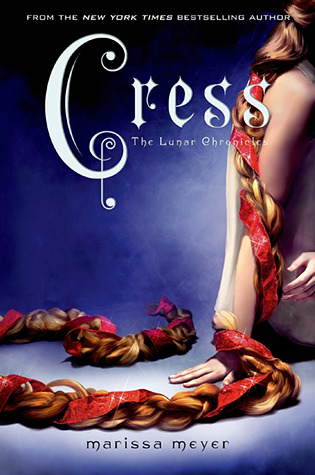
Review: Cress by Marissa Meyer

Cress--Marissa Meyer
February 2014 by Feiwel & Friends
560 pages--Goodreads

Rapunzel’s tower is a satellite. She can’t let down her hair—or her guard.

In this third book in the bestselling Lunar Chronicles series, Cinder and Captain Thorne are fugitives on the run, with Scarlet and Wolf in tow. Together, they’re plotting to overthrow Queen Levana and her army.

Their best hope lies with Cress, who has been trapped on a satellite since childhood with only her netscreens as company. All that screen time has made Cress an excellent hacker—unfortunately, she’s just received orders from Levana to track down Cinder and her handsome accomplice.

When a daring rescue goes awry, the group is separated. Cress finally has her freedom, but it comes at a high price. Meanwhile, Queen Levana will let nothing stop her marriage to Emperor Kai. Cress, Scarlet, and Cinder may not have signed up to save the world, but they may be the only ones who can.


After almost a year's wait since reading Scarlet, Cress is finally out.  Huzzah!  It's a long one, but it's never slow.  There's always some rescue to pull off or some danger to avoid or some scheme to execute.

However, Meyer stretches herself too thin with all these characters.  I do enjoy seeing from each character's point of view, and POV switches are sometimes necessary to tell the story from its multiple locations.  But switching between  ten different characters is just too much.  At the same time, the characters are the best part, and I wouldn't have her cut any of them out.  I just wish we could see more of Cinder.

I really like where Meyer is taking Levana's character.  Rather than being evil for the sake of being evil, we get just a hint that her motivation is loneliness.  If her people will not love her on their own terms, she will make them love her; and she will conquer Earth so that more people will love her.  I hope Meyer expands this angle of Levana's character in the next book.  It makes her much more compelling than the generic evil queen.

I love how vulnerable Cinder is in this book.  Not to say she can't hold her own in a fight (she can) or that she's an emotional wreck (she's not).  She's just freaked out about the pressure of having to save the entire world (and moon).  She's scared and worried that she won't be able to do it.  She feels guilty for the deaths she's caused.  It's so nice to have a character who reacts normally to the saving the world situation rather than being completely confident or even just mildly worried.

My only major criticism, aside from the multiple perspectives, is that there isn't much chemistry between Thorne and Cress.  Wolf and Scarlet's relationship (while too sudden and cheesy) at least had chemistry.  I can see them going somewhere in the next book, but I don't root for them as I read like I am Cinder and Kai.

Cress is not a perfect novel, but it is a fun, fast-paced one.  Now I just have to sit here and wait for a year until Winter comes out.  

Sunday, January 12, 2014

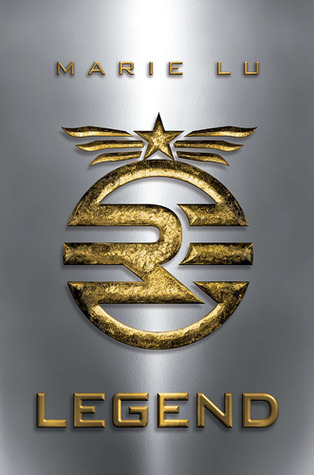
Review: Legend by Marie Lu

Legend--Marie Lu
November 2011 by Putnam Juvenile
320 pages--Goodreads

What was once the western United States is now home to the Republic, a nation perpetually at war with its neighbors. Born into an elite family in one of the Republic's wealthiest districts, fifteen-year-old June is a prodigy being groomed for success in the Republic's highest military circles. Born into the slums, fifteen-year-old Day is the country's most wanted criminal. But his motives may not be as malicious as they seem.

From very different worlds, June and Day have no reason to cross paths - until the day June's brother, Metias, is murdered and Day becomes the prime suspect. Caught in the ultimate game of cat and mouse, Day is in a race for his family's survival, while June seeks to avenge Metias's death. But in a shocking turn of events, the two uncover the truth of what has really brought them together, and the sinister lengths their country will go to keep its secrets.

Full of nonstop action, suspense, and romance, this novel is sure to move readers as much as it thrills. 


A bunch of my students love this series, so I figured I'd check Legend out.  Sadly, it was not as good as I had hoped it would be.  

I think I've finally figured out why most of the dystopian novels published in the last few years disappoint me:  they tend to use dystopia as a setting rather than as a social critique.  When I read a dystopia, I want the novel to hold up a mirror to our own world, to show the dangerous potential of where we could go, or to exaggerate our society's flaws so we can more easily see how they are problematic.  Books like Legend just use dystopia as a cool setting where the young heroes can be pitted against impossible odds.  That's just not as compelling to me.  

Additionally, the world building is too sparse.  Even ignoring the lack of social commentary, the setting is vague.  We never see how or why the Republic is a dystopia; we just have to take the synopsis's word that it is.  I need to see how the government is repressive.  What do they do that is so awful?  Since no one knows about the plague cause, that isn't enough.  What started the war between the Republic and the Colonies?  What happened to the United States to cause it to break  into factions?  Why would people start revolting at Day's arrest?  He's not a Robin Hood or a Mockingjay figure, and there's almost no evidence of repression, so the riot seems to exist solely to prick June's conscience.  More detail about the world will probably be revealed later in the series, that's too late.  You can surprise me later, but you must sell me on the world in the first book. 

INSTALOVE.  Seriously?  A military girl working undercover and a rebel criminal living on the streets should both be much much much slower to trust and should not start making out with each other a day after they meet each other.  I can accept descriptions of Day's gorgeous eyes and June's stunning beauty.  I'll just roll my eyes and move on.  But their relationship is way to serious given the time frame. 

June and Day's personalities and voices are not distinct.  Aside from their differing circumstances, either character could be narrating at any given time.  If you are going to use two first-person narrators, their voices need to be clearly different from each other.  As similar as the two characters are, they should not be identical. 

Lu gets points for allowing Day to be vulnerable enough to cry, but those points are cancelled out by Day telling June, "Sorry.  I couldn't help it," to explain why he kissed her.  You'd better help it, Bucko.  Even if you are not in control of your feelings, you are certainly in control of your actions.  Words on even the hazy end of the victim-blaming spectrum are not romantic.

Despite all it's flaws, Legend is a decently enjoyable read.  The mysteries, despite the bland world, are intriguing.  The writing is fast-paced.  The plot is exciting, and the book draws you in from the first line.  Legend gets a low 3.

Saturday, November 2, 2013

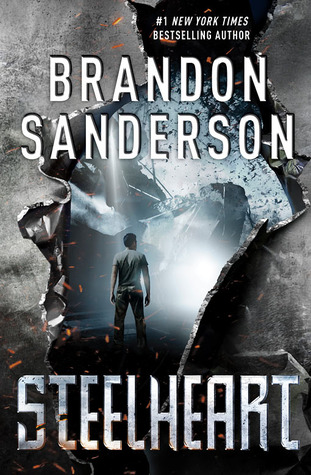
Review: Steelheart by Brandon Sanderson


Steelheart--Brandon Sanderson
September 2013 by Delecorte
384 pages--Goodreads

There are no heroes.

Ten years ago, Calamity came. It was a burst in the sky that gave ordinary men and women extraordinary powers. The awed public started calling them Epics.

But Epics are no friend of man. With incredible gifts came the desire to rule. And to rule man you must crush his wills.

Nobody fights the Epics... nobody but the Reckoners. A shadowy group of ordinary humans, they spend their lives studying Epics, finding their weaknesses, and then assassinating them.

And David wants in. He wants Steelheart—the Epic who is said to be invincible. The Epic who killed David's father. For years, like the Reckoners, David's been studying, and planning—and he has something they need. Not an object, but an experience.

He's seen Steelheart bleed. And he wants revenge.


Steelheart is another book to add to Sanderson's already long list of great novels. I never thought I'd enjoy a superhero comic book in novel form so much.  Some of the twists are predictable, but over all the story is still very good.  Dan and I spent a long while after finishing the novel discussing how everything might work out in the next books.  Steelheart is a very visual story, almost begging to be a movie.  You can totally tell when during the action sequences we're supposed to switch to slow motion.  And that was part of the fun of it.

The premise is intriguing:  a world of super villains and a renegade bunch of humans trying to fight back.  But these villains aren't as complex as Sanderson's usually are.  It's too simplistic for all Epics to be inherently and completely evil from using their powers.  There has to be at least one good Epic.  But I trust he will develop the magic system later in the series.  And hopefully he'll explain the physics-defying powers, like never ending bullets, somewhere along the way.

Character development is usually where Sanderson shines, but he had a couple of misses in this book.  Cody is hilarious, David's horrible metaphors and similes are funny, and I really want to know more of Prof's back story.  However, Megan is not very fleshed out.  She's mostly a love interest.  She has potential hidden in her history and the end plot twist, which Sanderson could explore in later books.  But so far, she's kind of flat, just the hot fighter chick that the hero/audience to ogles at but who has no real personality.  Hopefully, that will change.

Steelheart is an great beginning to a new series.  My biggest complaint, beyond Megan, is the long wait until the sequel.  And Nightweilder is SUCH a good name for a bad guy.

Wednesday, October 16, 2013

Review: The Prisoner of Cell 25 by Richard Paul Evans

The Prisoner of Cell 25--Richard Paul Evans
August 2011 by Simon Pulse
326 pages--Goodreads

My name is Michael Vey, and the story I’m about to tell you is strange. Very strange. It’s my story.

To everyone at Meridian High School, Michael Vey is an ordinary fourteen-year-old. In fact, the only thing that seems to set him apart is the fact that he has Tourette’s syndrome. But Michael is anything but ordinary. Michael has special powers. Electric powers.

Michael thinks he's unique until he discovers that a cheerleader named Taylor also has special powers. With the help of Michael’s friend, Ostin, the three of them set out to discover how Michael and Taylor ended up this way, but their investigation brings them to the attention of a powerful group who wants to control the electric children – and through them the world. Michael will have to rely on his wits, powers, and friends if he’s to survive.


The Michael Vey books are super popular at my school, especially with students who don't normally read, so I figured that as a responsible teacher, I should check them out.  I can see why they're popular with all my students, but they're not the books for me.

The Prisoner of Cell 25 seems to have been written specifically for some of my short attention span reluctant readers.  It is quite fast paced.  Boom.  I have powers.  Boom.  I can't tell anyone.  Boom.  I told Taylor.  Boom.  She has powers too.  Boom.  Now people are chasing us.  Boom.  Boom.  Boom.  Boom.  Boom.  There wasn't any set up or space to breath between events.  The book is made of short chapters and very, very short sentences.  Come on, vary your sentence length at least a little.  Don't write down to teens, Evans; they're capable of more than people give them credit for.  

The villain is a bit too mustache-twirly, crazy, and evil-for-the-sake-of-being-evil for me.  Yet, he can't come up with anything more evil than blackmailing airline companies?  He makes stupid mistakes like running a metal pipe from Cell 25 and the cell where Taylor and the other electric powered kids are being held when he knows that electric powers can be conducted through metal.  And the reason Hatch and company are scary and unbeatable is because "They have private jets and hidden compounds" (pg 156)?  I had to giggle a bit at that line.

The kids are way overpowered.  I'm fine with them having electric powers, even strong powers.  But no police department anywhere is going to let a 14 year old interview a violent suspect because, you know, he might just get more information out of the guy that we have, despite the fact that we've been specially trained and do this as our livelihood.  The final fight seemed a bit unrealistic too, though I can't speak about it in detail since I got bored and skimmed through it.  Beyond being overpowered, the characters are rather unoriginal.  We've got the cute, popular cheerleader; the overweight, genius friend; and the bullied kid with secret powers.  They don't grow throughout the novel.  And Zeus's 180 at the end is just unrealistic.

And Meridian?  If you've ever driven through the West, you know for a fact that there are more obscure, tiny, out of the way places to hide out than Meridian, Idaho.  And how big of a coincidence is it that two electric kids just happened to go to the same school?

The Prisoner of Cell 25 is basically brain candy.  It reminds me a lot of The Maze Runner and all the reasons I didn't like that book much either.  I know some of my students think Michael Vey is the best series ever, but I just don't know if I can in good conscience recommend it except to my reluctant reader when I know there are better written books out there with complex characters and logical plots.

Monday, September 30, 2013

Review: William Shakespeare's Star Wars by Ian Doescher

William Shakespeare's Star Wars by Ian Doescher
July 2013 by Quirk Books
176 pages--Goodreads

Inspired by one of the greatest creative minds in the English language-and William Shakespeare-here is an officially licensed retelling of George Lucas's epic Star Wars in the style of the immortal Bard of Avon. The saga of a wise (Jedi) knight and an evil (Sith) lord, of a beautiful princess held captive and a young hero coming of age, Star Wars abounds with all the valor and villainy of Shakespeare’s greatest plays. ’Tis a tale told by fretful droids, full of faithful Wookiees and fearstome Stormtroopers, signifying...pretty much everything.

Reimagined in glorious iambic pentameter—and complete with twenty gorgeous Elizabethan illustrations--William Shakespeare’s Star Wars will astound and edify Rebels and Imperials alike. Zounds! This is the book you’re looking for.


To like this book, you need to be both a Shakespeare nerd and a Star Wars geek.  Being a fan of both, William Shakespeare's Star Wars was hilarious.  Doescher does an excellent job of re-scripting the story in Elizabethan English in a humorous rather than stuffy way.  The asides and soliloquies are great and the iambic pentameter never feels forced.  Doescher also weaves in quotes from Shakespeare here and there, my favorite being when Luke starts reciting the Saint Crispin's Day speech to inspire the rebels.

The action sequences are a bit boring to read since the Chorus just gives us a play by play, but there's no other way to make that work in the context of a play.  Shakespeare didn't give stage directions, so we need a character of the Chorus to say what happens.

William Shakespeare's Star Wars is a goofy sounding combination that hits the mark.  It's a loving parody of both source materials.  I'm looking forward to The Empire Striketh Back.

Thursday, July 25, 2013

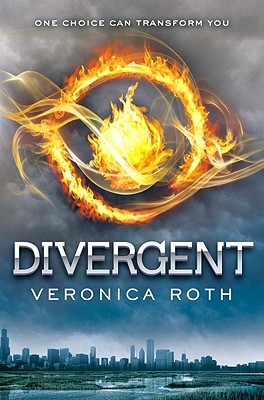
Review: Divergent by Veronica Roth

Divergent--Veronica Roth
April 2011 by Katherine Tegan Books
496 pages--Goodreads

In Beatrice Prior's dystopian Chicago, society is divided into five factions, each dedicated to the cultivation of a particular virtue—Candor (the honest), Abnegation (the selfless), Dauntless (the brave), Amity (the peaceful), and Erudite (the intelligent). On an appointed day of every year, all sixteen-year-olds must select the faction to which they will devote the rest of their lives. For Beatrice, the decision is between staying with her family and being who she really is—she can't have both. So she makes a choice that surprises everyone, including herself.

During the highly competitive initiation that follows, Beatrice renames herself Tris and struggles to determine who her friends really are—and where, exactly, a romance with a sometimes fascinating, sometimes infuriating boy fits into the life she's chosen. But Tris also has a secret, one she's kept hidden from everyone because she's been warned it can mean death. And as she discovers a growing conflict that threatens to unravel her seemingly perfect society, she also learns that her secret might help her save those she loves . . . or it might destroy her.


Divergent is one of those books that is action-packed and dramatic for the purpose of being action packed and dramatic.  It all felt very empty.  And SO IRRATIONAL.  Garg!  The world building is weak.  The characters are flat and do irrational, unexplained things.  They miss glaringly obvious plot "twists".  And yet this book has wormed its way into so many people's 5-star list.

First, the world building:  so many holes.  I get that Roth has this really cool premise that she wants to try out, but the cardinal rule of dystopias is that they are supposed to be extensions of current society.  They're supposed to explore the problems in our society.  That means your dystopian world has to be at least semi-plausible; we have to believe that we could get there from here.  But we get almost no explanation on how this post-civilization Chicago works.  What made human society fall apart?  War?  Internal conflict?  Tumblr?  I seriously don't see the entire country breaking up because of personality traits.  And what happened to the rest of the world?  For that matter, what even happened to the rest of the country?  What about people who lived in rural areas?  What exists outside Chicago's boundaries?  And while we're at it, how is everyone surviving in this city?  Where is the food coming from? Where are the farmers?  Where are the cows supplying hamburger meat?

Even the little world building we get doesn't make sense.  Everything about Dauntless is messed up.  They're supposed to be protecting the city, but no one patrols or guards or protects.  The Dauntless just jump off buildings, shoot muffins off people's heads, and perform other acts of recklessness chalked up as bravery.  And what the crap is up with Peter?  I get that Roth is going for the whole "corruption within the factions" thing, but, just what?  Stabbing your competition in the eye or tossing them over a cliff is a supreme act of cowardice, and he should have been banished.  You can't trust someone who will eye stab you.  It takes much more courage to admit to weaknesses than to pretend you don't have any, but the Dauntless are too focused on visible "bravery" and physical domination.

And why did all the transfers pick Dauntless in the first place.  We get Tris's reasoning and a bit of Al's, but why on earth did Will and Christina transfer?  This is never explained.  They're just there because Tris needs a group to train with.  Overall, the characters in this novel are not explored or fleshed out; they're just flat.  Tris, in particular makes no sense.  She's illogical.  Or stupid.  Allow me to demonstrate.  Warning:  spoilers.

  • Hmm, Erudite wants to start a rebellion, but they need a way to control the Dauntless.  They also have simulation serums that alter what the brain perceives.   Oh, look.  A new serum from Erudite.  Don't worry; it's just a tracking serum that we're injecting ALL the Dauntless with.  It couldn't possibly be a very convenient mind control serum.
  • I need to destroy the computer controlling the dauntless-wide simulation.  I could shoot the computer that's controlling the simulation.  No, I'll instead hand the gun to the person who's trying to kill me.  Don't worry, the power of love will save me.
  • One of my brainwashed friends is trying to kill me.  I could disable him by shooting him in the arm or leg.  Nah, I think I'll shoot him in the head.

There is a lot, a lot of violence.  If you don't like action flicks with guns and punching, Divergent is not your book.  It certainly wasn't mine.  But action lovers who don't care much about character development or plot progression will probably like it.  It's kind of like The Maze Runner and summer blockbusters in that way.

I could not take the romance seriously.  And that's all I have to say about that, so I'll rant about other things instead.  Let's just conflate depression and cowardice, why don't we?  As if we don't have enough problems in this country with how we handle mental illness.  And while we're at it, let's just promote the idea that the best thing to do after being sexually assaulted is to not report it.  Because reporting=cowardice apparently.  Garg. 

By the end of the book I got at least a bit invested in what would happen to some of the characters (Uriah, Will Christiana,  all deserved larger parts).  I was slightly curious about the plot, but it had ceased to make sense so I didn't care much.  Divergent wasn't awful, but I'm not invested in the rest of the series.  

Saturday, July 13, 2013

Review: For Darkness Shows the Stars by Diana Peterfreund

For Darkness Shows the Stars--Diana Peterfreund
June 2012 Balzer + Bray
402 pages--Goodreads

It's been several generations since a genetic experiment gone wrong caused the Reduction, decimating humanity and giving rise to a Luddite nobility who outlawed most technology.

Elliot North has always known her place in this world. Four years ago Elliot refused to run away with her childhood sweetheart, the servant Kai, choosing duty to her family's estate over love. Since then the world has changed: a new class of Post-Reductionists is jumpstarting the wheel of progress, and Elliot's estate is foundering, forcing her to rent land to the mysterious Cloud Fleet, a group of shipbuilders that includes renowned explorer Captain Malakai Wentforth--an almost unrecognizable Kai. And while Elliot wonders if this could be their second chance, Kai seems determined to show Elliot exactly what she gave up when she let him go.

But Elliot soon discovers her old friend carries a secret--one that could change their society . . . or bring it to its knees. And again, she's faced with a choice: cling to what she's been raised to believe, or cast her lot with the only boy she's ever loved, even if she's lost him forever.


Inspired by Jane Austen's Persuasion, For Darkness Shows the Stars is a breathtaking romance about opening your mind to the future and your heart to the one person you know can break it.


For Darkness Shows the Stars does a good job of both drawing on Persuasion while also standing as its own story.  The problem was I wouldn't let it be it's own story.  I could not stop comparing For Darkness to Persuasion and finding all the places it fell short.  I just couldn't let things go, and that kept me from enjoying the book as much as I could have.


The romance was neither tense nor tragic.  Seriously, Elliot.  Kai left when you were 14.  I had four concurrent crushes when I was 14 and none of those ever came close to panning out.  Move on.  I do like that Peterfreund built up their relationship as close childhood friends.  Then as adults Elliot and Kai talk to each other all the time, killing all the tension that is supposed to be there.  Anne and Wentworth never know what the other is thinking.  That's what makes the letter so satisfying: they finally, FINALLY express what we've been hoping they felt this whole time.  That tension just isn't there in For Darkness, even with Elliot and Kai's melodramatic fights.  

The letter itself was a disappointment   Nothing will ever be as swoon-worthy as Austen's original, and since Peterfreund hadn't been using Austenesque language, it would have been out of place to cut and paste it in.  But the rewritten letter is just so bland in comparison.  It honestly felt like a Sparknotes version of the original, and it was so much less than what I knew it could be.

I am impressed with how well Peterfreund translated Regency England's social structure to her post-apocalyptic world.  The classes are broken out just as rigidly and unsurmountably.  The Posts (rising middle class) are the new unknown middle ground threat.  The Reduced are just how the aristocracy and gentry would have viewed the peasant class, people who need to be watched over because they're not capable of caring for themselves.  Peterfreund also does an excellent job of making it clear why Elliot had to stay.  We can get a bit over-romantic while reading Persuasion and become convinced that Anne and Wentworth could have been happy as we overlook the fact that a war had just begun and he had no prospects and could have very easily died and left Anne a penniless widow cut off forever from her family.  It was the right choice for her to stay.  With Elliot we realize it would have been selfish of her to leave.  Had she left, the estate would have fallen apart from ill management and hundreds of people would have suffered.  

Peterfreund took a huge risk in reworking such beloved source material as Austen's Persuasion, and that risk didn't quite pan out for me, which is partly my own fault.  By the end of the novel I had finally allowed For Darkness to be its own novel and started to enjoy it more.  For Darkness Shows the Stars is not Persuasion by any measure, but it is good.  

Side note:  There was far too little of the Crofts/Innovations.  The Crofts are my absolute favorite Austen couple ever.  We see less of them in the movies, but in the books they are adorable.  The Innovations hardly spend two scenes together.  We see a lot of Felicia, and that's good, but I missed the Sophie going along with the Admiral's crazy driving and always sailing with him and the Admiral talking about how much he loved his wife, how he is used to having a woman (his wife) on his arm, and asking why all women can't be named Sophie. 

Sigh.  I should just go and reread Persuasion.

Monday, April 1, 2013

Review: Scarlet by Marissa Meyer

Scarlet--Marissa Meyer
February 2013 by Feiwel and Friends
452 pages--Goodreads

The fates of Cinder and Scarlet collide as a Lunar threat spreads across the Earth...

Cinder, the cyborg mechanic, returns in the second thrilling installment of the bestselling Lunar Chronicles. She's trying to break out of prison—even though if she succeeds, she'll be the Commonwealth's most wanted fugitive.

Halfway around the world, Scarlet Benoit's grandmother is missing. It turns out there are many things Scarlet doesn't know about her grandmother or the grave danger she has lived in her whole life. When Scarlet encounters Wolf, a street fighter who may have information as to her grandmother's whereabouts, she is loath to trust this stranger, but is inexplicably drawn to him, and he to her. As Scarlet and Wolf unravel one mystery, they encounter another when they meet Cinder. Now, all of them must stay one step ahead of the vicious Lunar Queen Levana, who will do anything for the handsome Prince Kai to become her husband, her king, her prisoner.


Last year, I saw so many 5-star, rave reviews about Cinder, that when I finally did read it, it was killed by the Hype Monster.  It couldn't live up to the reputation i had built up of it in my mind.  I went into Scarlet with more normal expectations, and this time around I quite enjoyed the read. Now freed from the hype, I can appreciate all of Cinder's awesomeness.  Scarlet is cool too, but Cinder is great.   I love all of her cyborg gadgets.  And as her lunar gift emerges, she has to deal with the ethical implications of her ability to manipulate people with her mind.  

While Cinder and Scarlet take center stage, the side characters are great too.  Iko is back, just bubbly enough to be both slightly annoying and very endearing.  And Thorne is hilarious   He takes a bit of getting used to, but once you do, he's great.  He's got that sort of Flynn Ryder "I'm devilishly handsome and I know it" vibe.

And the plot?  Scarlet has several twists that I did not see coming, especially the "Grandma, what big eyes you have" scene.  I didn't realize we were in that scene until it was almost over and then my mind was blown.  It was an unexpected way to work that scene, and the surprise was very satisfying.

One of my annoyances with Cinder was the lack of information we got about Luna.  I mean, how did these moon colonists develop crazy mind powers?  But we learn much more about Lunars in Scarlet, and given the way the book ends, Cress should give us even more.  I am a bit worried that we'll start spreading ourselves too thin between all the characters.  We already spend time in Cinder, Kai, Levana, Scarlet, and Wolf's heads.  The next book will throw in Cress at the very least.  If we go too broad, we won't be able to go deep.  But Meyer juggles the multiple viewpoints well.  You always know where you are and which character you're dealing with, which cannot be said of every multiple-POV novel.

The Scarlet-Wolf romance is a bit rushed, which is annoying.  They know each other for a day and then BOOM!  Kissing.  Scarlet has no reason to trust him, but she falls for him.  Also, the ending is a bit sappy.  And you just can't use the word nuzzle if one of your character's name is Wolf.  It's too close to muzzle.  Horses nuzzle.  I also have some issues with Wolf's behavior during the climax (spoilers for the rest of this paragraph).  Yes, he's being mind-controlled and driven to follow animal instincts, but his defense of Scarlet is just too possessive.  I mean, "She's mine!"?  Seriously?  Protectiveness is good, but not possessiveness.  I can see why Meyer wrote it in, but it just rubbed me the wrong way.  

Despite these couple of flaws, I really enjoyed Scarlet.  I could not put it down.  And I can't wait for Cress to come out next year.

Friday, March 1, 2013

Review: Matched by Ally Condie

Matched--Ally Condie
November 2010 by Dutton Juvenile
369 pages--Goodreads

Cassia has always trusted the Society to make the right choices for her: what to read, what to watch, what to believe. So when Xander's face appears on-screen at her Matching ceremony, Cassia knows with complete certainty that he is her ideal mate... until she sees Ky Markham's face flash for an instant before the screen fades to black.

The Society tells her it's a glitch, a rare malfunction, and that she should focus on the happy life she's destined to lead with Xander. But Cassia can't stop thinking about Ky, and as they slowly fall in love, Cassia begins to doubt the Society's infallibility and is faced with an impossible choice: between Xander and Ky, between the only life she's known and a path that no one else has dared to follow.


Wow, that was good.  I had kind of low expectations going in, but it was a hard book to put dow
n.  The synopsis above makes the book sound shallow, but I liked it, and I saw the the love triangle stuff as the impetus for Cassia to question the perfection of the Society.  I am a bit annoyed, though, that a love triangle is the basis of the plot.  Thankfully, it isn't as big of a trip up as I expected it to be.  I don't like love triangles, especially when the girl waffles between two boys and she just can't decide who she likes better.  Cassia spends the whole time being drawn to Ky and feeling guilty about hurting Xander, but she doesn't really waffle.  So points there.  By the way, no I will not pick a team.  Teams are not the point; the Society and its absolute control is.  I will not allow romance to get in the way of my dystopia.  And since we all know how this is going to end, there is no point in bickering.  Xander is the representation of the status quo; Ky represents choice.  She can never choose Xander because that would prove that the Society is right, and we can't have that.

Condie does a good job of the building and describing a credible dystopia.  We start out seeing the micromanaging control as strange but justified.  Everything is safe this way.  But then Condie leads us through a gradual reveal of the darker side of the Society.  There's not much in the way of action, so don't expect a thrilling Hunger Games read-alike.  But it is engaging through the interpersonal relationships and government induced issues.  

I love Cassia's parents.  So many YAs kill off the parents to get them out of the way.  It is so nice to see good parents who love and support each other and care about their kids.  I also like how their choices are flip sides of the same coin.  Mother keeps the rules to protect the ones she loves; Father bends the rules to protect the ones he loves.  They are an interesting and unexpected pair.  I wish we could have seen more of Grandpa, but it is kind of important to get rid of him early on as his death is part of what spurs the change in Cassia.

I like the role "Do Not Go Gentle" and other poems play in Cassia's emerging rebellion.  Yes, literature can change the world!  I know it would be terribly boring to include in the book, but I'd be interested to see a list of the 100 songs, poems, history lessons, ect.  Maybe as bonus material online or at the end of the book?  I'm curious.

I will definitely read the next book.  I hope Crossed includes more about the outer provinces and the countries the Society is fighting against as well as more turmoil within the Society.  I also hope we learn why and how the Society came to be.  The scary part of dystopias is not that such a world could exist; it's seeing our own society's potential to go down the same path.  

Is it formulaic?  A bit.  There's definitely a lot of carry over from The Giver, but I don't think that kills the novel.  Condie makes her world original enough to satisfy me.  Besides, what's wrong with a deeper exploration of that type of world?

P.S.  Google Chrome thinks "dystopia" should be "topiary".

Monday, February 11, 2013

Review: Unwind by Neal Shusterman

Unwind--Neal Shusterman
November 2007 by Simon & Schuster
335 pages--Goodreads

Connor, Risa, and Lev are running for their lives.

The Second Civil War was fought over reproductive rights. The chilling resolution: Life is inviolable from the moment of conception until age thirteen. Between the ages of thirteen and eighteen, however, parents can have their child "unwound," whereby all of the child's organs are transplanted into different donors, so life doesn't technically end. Connor is too difficult for his parents to control. Risa, a ward of the state is not enough to be kept alive. And Lev is a tithe, a child conceived and raised to be unwound. Together, they may have a chance to escape and to survive.


I have heard a ridiculous number of good things about Neal Shusterman and this series in particular.  A friend was awesome enough to let me borrow it, so I finally got to read it.  I may have built the book up too much in my mind, but I still liked it.  


Unwind is written in first-person in present tense.  I think this is the first book I've ever read in present tense.  It was a little weird at first and took a while to get used to, but it gave an immediacy to the plot: we're right there with the characters instead of watching from the sidelines looking back like we usually do.  And the unusual tense makes Shusterman's book stand apart.

The book is split between the point of view of three main characters.  With as short as the book is, we don't have enough time to explore any of them as deeply as I would have liked since our attention is so split.  Lev's story in particular needs more time and more development so we can understand why he changed; it's there, I just want more time to let it soak in.  However, the multiple perspectives give us a wider view of the situation as a whole.  We focus on the stories of individuals rather than the all of society, but we still get the big picture.  I especially like that Shusterman doesn't turn any of his characters into monsters or saints.  Each is complex, and even if we don't agree with their choices, we see where they're coming from.  

I loved the Humphrey Dunfee urban legend that came up again and again throughout the novel.  It tied things together in an unexpected but satisfying way.  I'm still a bit annoyed at myself for not making the connection to Humpty Dumpty until now.  How did I miss that?

The premise is not terribly plausible, but Shusterman makes it work, and by the end, we can see why society may have chosen to go down such a callous road.  This book deals with some hard issues that can springboard into great discussions.  What is the soul?  Are you still alive if all your physical parts are?  What does the sanctity of human life really mean?  How much choice should an individual have over their own life?  What should society do with with the people it doesn't want?  Shusterman doesn't preach, doesn't tell you what to think.  He just presents the story and lets us think it out for ourselves.  There are no clear answers, but it is the thinking that matters.  We cannot, as the novel's society does, just evade the responsibility of an unexpected baby or a troublesome teenager.

The book does contain some content that will be disturbing to some readers.  It's not graphic, but Shusterman writes in such a way that your imagination fills in the blanks in a heebee jeebees kind of way.  Aside from that, and perhaps because of it, it is a very compelling novel and a satisfying read.

P.S. Register to be an organ donor if you haven't done so already.  You won't need your liver if you're dead, and someone else does.

Friday, January 25, 2013

Review: The Adoration of Jenna Fox by Mary E. Pearson

The Adoration of Jenna Fox--Mary E. Pearson
April 2008 by Henry Holt and Co.
266 pages--Goodreads

Who is Jenna Fox? Seventeen-year-old Jenna has been told that is her name. She has just awoken from a coma, they tell her, and she is still recovering from a terrible accident in which she was involved a year ago. But what happened before that? Jenna doesn't remember her life. Or does she? And are the memories really hers?

This fascinating novel represents a stunning new direction for acclaimed author Mary Pearson. Set in a near future America, it takes readers on an unforgettable journey through questions of bio-medical ethics and the nature of humanity. Mary Pearson's vividly drawn characters and masterful writing soar to a new level of sophistication.


I really enjoyed this book.  From the intriguing beginning all through the book it was well paced.  I was engrossed by Jenna's story and could not put the book down.  It was compelling in the same way as the episode of Stark Trek: Next Generation in which there is a trial to determine whether or not Data is alive.  Some plot elements were easy to guess, but I was reasonably able to put aside my guesses and just go with the flow of Jenna's slow re-discovery of her life and her world.  The book is in first person and Jenna's voice is distinct, but not something every reader will like.  She spends a lot of time musing semi-poetically about things. I think that quality is appropriate for this book, but it will bug some readers and it took me a while to get used to.


Adoration is set in the near future.  The science is foreign enough to be futuristic, but plausible enough to be believable for a story set 50ish years from now.  While the book has some science fiction elements, it doesn't rely too heavily on them, making it great for readers who don't normally go for hard sci-fi (like me).

There is so much room for discussion with this book.  I would love to use it in a classroom of 9th or 10th graders.  What does it mean to be human?  What does it mean to be alive?  What is thought or consciousness?  How far will parents go to save their child?  How far should science be allowed to go?  Should it be limited at all?  Can you ethically save someone when there is hardly enough to be considered human?  Can you ethically not save them if you have the power to do so?  These questions don't have clear right or wrong answers, but they are important to consider.  Pearson writes in such a way that she brings these topics up for discussion without trying to force the "right" answer down on your throat.

Jenna's character is erratic at times.  She is perfectly fine one minute and the next she is angry and yelling at people with no transition in between.  It feels at times as if she has two separate personalities.  This may be Pearson's attempt to show Jenna straining against the restraints of her parents, but it feels unnatural.  Also, Jenna's relationship with Ethan is too rushed.  Total and complete trust comes into play after they have known each other for just a couple of weeks.

There is a sequel, for those who are interested, but for me the story is complete as a stand-alone.  Even the epilogue doesn't need to be there; it throws off the flavor of the rest of the book.  Adoration is definitely a slower, more ponderous book, but it makes you confront difficult issues in a satisfying way.  

There is some strongish language in a few places.

Friday, October 26, 2012

Review: Rip Tide by Kat Falls

Rip Tide--Kat Falls
May 2011 by Simon & Schuster Children's Books
320 pages--Goodreads

Ty has always known that the ocean is a dangerous place. Every time he swims beyond the borders of his family's subsea farm, he's prepared to face all manner of aquatic predators-sharks, squid, killer whales . . .

What Ty isn't prepared to find in the deep is an entire township chained to a sunken submarine, its inhabitants condemned to an icy underwater grave. It's only the first clue to a mystery that has claimed hundreds of lives and stands to claim two more -- lives very precious to Ty and his Topsider ally, Gemma.

Now in a desperate race against the clock, Ty and Gemma find themselves in conflict with outlaws, Seaguard officers, and the savage, trident-wielding surfs -- plus a menagerie of the most deadly creatures the ocean has to offer.

Kat Falls brings to life the mysteries, marvels, and monsters of the deep in this fast-paced and inventive action-adventure.


Rip Tide is the sequel to Dark Life, which I really enjoyed reading this summer.  I was disappointed through the first third or so of Rip Tide because it wasn't living up to the standard Dark Life had set, but fear not--the book gets better as it goes on.

Rip Tide is just as action-packed as its predecessor.  Dark Life begins with a shark attack in paragraph two.  Rip Tide shows a bit of restraint and waits all the way until page four or five before setting a squid on us.  While the first book sometimes feels like no more than one escape after the other, Rip Tide has a more developed, intricate, mystery-driven plot.  Ty is more proactive and the plot ends up being better for that.

I love the setting of these books.  With the rise of the oceans and flooding of the land, most of the world's population lives in stacked, UV-scorched cities; but Falls puts her characters in the deep sea as pioneers with a bit of sci-fi technology.  We still get the Firefly vibe in this book, though not as strongly--no Reavers this time around.  [Side note.  If you haven't checked out Firefly yet, do.  Space cowboys!]  Falls' books just have that rough-and-tough, independent, tame-the-land feeling, complete with the good-hearted settler, the vigilante sheriff, the crooked smuggler, the town mayor, etc.  It's a western, but underwater.  I realize it sounds kind of weird, but it's good.

The main characters/good guys aren't developed much (typical teenage boy protagonist, determined, good at heart, a bit naive), but Falls does a great job with her villains.  We never really know where Shade is.  Fife is the sleazy showman that you can't underestimate.   Radder is the dumb,brute strength with a twist.  However, Captain Reavus' character felt a bit contrived.

Even though these books are part of a series, the plots of each book stand alone rather than forming one huge story arc.  Little in this book depends on you having already read Dark Life. I appreciate series like this.  We aren't left with a stupid cliffhanger designed to make us buy the next book.  It's just a satisfying story.

I like the reader for this audio book.  Keith Nobbs fits Ty's voice well. He occasionally struggles with dialogue a bit, especially with differentiating Ty's voice from Gemma's, so it's sometimes hard to tell who's talking.  But aside from that, it was a good listening experience.

One other teeny tiny complaint.  I don't want Ty to die, but a salt water crocodile will ALWAYS win in a fight against a human.

All in all, Rip Tide is a great book, especially if you're looking for something a bit different in the flood of post-apocalypse novels.

Thursday, September 20, 2012

Review: Leviathan by Scott Westerfeld

Leviathan -- Scott Westerfeld
October 2009 by Simon Pulse
434 pages Goodreads

Prince Aleksander, would-be heir to the Austro-Hungarian throne, is on the run. His own people have turned on him. His title is worthless. All he has is a battletorn war machine and a loyal crew of men.

Deryn Sharp is a commoner, disguised as a boy in the British Air Service. She's a brilliant airman. But her secret is in constant danger of being discovered.

With World War I brewing, Alek and Deryn's paths cross in the most unexpected way…taking them on a fantastical, around-the-world adventure that will change both their lives forever.


Over the summer I read a lot of books for my adolescent lit course, and Leviathan was by far my favorite.  The world building was intricate, the characters were real and funny, the plot line was fast-paced and exciting, the illustrations were amazing.  Since reading it I have recommended it to most everyone I've come in contact with.  This is one of the few books I finished and then immediately had to get my hands on the sequels. 

Leviathan was my first real experience with steam punk and it gave me a great impression of the genre.  The illustrations added so much to the story and gave me a feel for the characters as well as the world.  The pictures guided, without limiting, my mental picture of Deryn, the Leviathan, mech suits, and all the other creation in Westerfeld's world.  I was skeptical about the Darwinists at first.  A flying whale airship?  I could accept that in Dr. Who, but in WWI Europe?  However, Westerfeld pulls it off convincingly with the ecosystem of fabricated creatures, a sentient air ship, and the cleverest ferret-things that you sadly don't meet until book two.

Westerfeld does a wonderful job with the characters.  Everyone we meet is fresh and interesting. I loved Deryn.  She was a no nonsense woman of action, who occasionally dreams of love without making the romance take center stage (one of my serious pet peeves about most YA lit).  She keeps a cool head in the face of danger and wields a hot tongue all the time.  I wish my imagination had a better Scottish voice because Deryn has some feisty speeches.  Alek starts out as a static plot device used to move the story along by getting everyone into a series of scrapes, but he gets better as the series continues.  He becomes more decisive, a better leader, and just more fun.  Deryn and Alek felt younger than their stated ages, but I think that caters to the intended audience.  

Going into the book I wondered how Westerfeld would handle his alternate history.  You can't just have your characters stop WWI from happening; that's much too big a change.  Westerfeld manages to keep the characters a small part of the worldwide conflict without making them insignificant.  Alek and Deryn do become more involved in world politics as the series progresses, but by book three Westerfeld has built up the world enough that the changes he makes are believable.

For my summer reading I was supposed to read 20-30 books from all sorts of genres, so I didn't really have time to spend on Behemoth and Goliath, but I couldn't resist--I had to know what happened next.  So I ignored the books I was supposed to be reading and indulged in the world of Leviathan.  It's been a while since a series drew me in so completely.  However, Leviathan's story is complete in itself; it could be a stand alone novel.  It doesn't have one of those cliffhanger must know what happens next endings.  You finish the book dying to know what happens next because you love the world and the characters and the story, not because you're left hanging.  Leviathan is a fantastic read and the entire series now lives on my bookshelves.

LinkWithin

Related Posts Plugin for WordPress, Blogger...