Showing posts with label medieval. Show all posts

Sunday, June 12, 2016

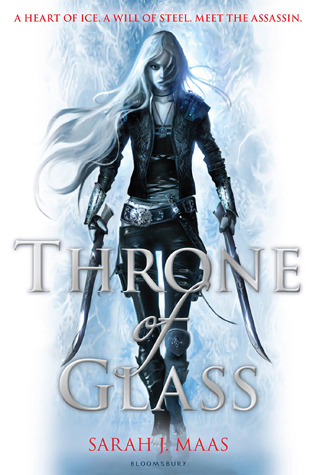
Review: Throne of Glass by Sarah J. Maas

Throne of Glass--Sarah J. Maas
August 2012 by Bloomsbury
406 pages--Goodreads

Meet Celaena Sardothien.
Beautiful. Deadly.
Destined for greatness.

In the dark, filthy salt mines of Endovier, an eighteen-year-old girl is serving a life sentence. She is a trained assassin, the best of her kind, but she made a fatal mistake: she got caught.

Young Captain Westfall offers her a deal: her freedom in return for one huge sacrifice. Celaena must represent the prince in a to-the-death tournament—fighting the most gifted thieves and assassins in the land. Live or die, Celaena will be free. Win or lose, she is about to discover her true destiny. 


I would call Throne of Glass a solid meh, except that I care too much about it for it to just be a blah book.  I wanted to like it.  I still want to like it.  So many people say the series is amazing and the covers are cool, and are assassins and political intrigue and arhgablargastarg!  

I have a lot to say.  I may get a bit ranty.

First, I see this book compared to The Girl of Fire and Thorns a lot.  Stop comparing them.  Right now.  They are not the same in tone or plot or character or setting or style or anything.  Just because two fantasy romance YAs with female protagonists came out at roughly the same time does not mean the two books are similar.  Besides, Girl of Fire and Thrones is a much stronger and more enjoyable novel.

Second, the shifting POVs are a bit shaky, especially at the beginning of the novel.  I think this is what rubbed me the wrong way initially, and it made me more critical as the book progressed.  We spend nearly all our time in 3rd person limited, dipping into Celeana's thoughts.  At some chapter breaks we change to 3rd person limited Chaol or Dorian.  Fine.  Not terribly clear at first, but fine.  But randomly, in the middle of some chapters, without indication, and especially near the beginning of the novel, we switch POVs for a couple sentences or paragraphs.  No reason is given for why we're hopping into Chaol's brain for a second.  We don't know why it should matter that we're now getting Dorian's thoughts but only for these two sentences.  Or we're following some super temporary omniscient narrator and seeing into multiple heads at a time.  It's just clumsy and confusing and annoying.

Probably my biggest problem with the novel:  I am so sick of love triangles.  I can enjoy a good romantic subplot.  I can even enjoy a good romantic foreplot.  But these stupid, angsty triangles-are-cool-right-now, weak excuses for plots are driving me insane.  If Celaena just had feelings for Chaol, that would be fine, though it would still be a pretty weak romance.  But the Prince was just terrible.  Spoiled, arrogant, entitled, and uninteresting.  As a side character he would be annoying, but as a romantic interest I couldn't stand him.  All the time spent mooning over the prince could have been spent on Nehemia, easily the most interesting character in the book .  Rebel spy; witty, fighting princess from conquered lands?  Why isn't more of the book about her?  Granted, there are actually some good plot reasons for this, and it looks like she might get more screen time in later books.  But I just wanted to leave the boys behind and have Celeana and Nehemia to go off monster-slaying and empire-overthrowing with occasional side trips for Celeana to pull a heist with Nox.

The villains, meanwhile, are too obvious to be very interesting.  Spoiler paragraph.  It is pretty clear from pretty early on that Pennington and Kaltain are up to no good.  Maas isn't trying to be sneaky there.  But the question who's butchering the champions is supposed to be the driving mystery of the whole book.  I'm supposed to wonder.  I'm supposed to be surprised.  I'm supposed to have several wrong guesses before the true villain is finally revealed.  Instead we get the obviously distasteful brute named after the most famous murderer in all of Western literature who's being manipulated by Pennington, who we already know is a bad guy.  With what we get in the final chapter, I could see Pennington and the king becoming more interesting, but overall I wanted better antagonists.

And Celeana herself is unrealistic.  Not that she's too skilled; I can buy that.  Nor is she too vain; her need for others to recognize and applaud her skill fits her character.  But she's an assassin--trained to live in the shadows, to be alert, to trust no one.  And she was betrayed.  AND she's spent the last year in the salt mine death trap.  Yet she keeps falling asleep, in seconds, no problem, around people she doesn't fully trust, or continues to sleep soundly when they sneak into her room.  I don't need full on just-off-the-streets Vin paranoia, but a little more caution and attentiveness from the supposed best assassin in the land would be nice.  Yes, this sound nit-picky, but come on.  She specifically makes her door hinge squeaky so people can't sneak into her room, then two scenes later the Prince sneaks in to watch her sleep (which was creepy by the way) without the door making noise or Celeana waking up, then two scenes after that the door is squeaky again and she wakes up when Chaol comes in to report another murder.  I expect better from my assassins.

But in spite of all this, I do think I will try the first 50 pages or so of book 2.  I have heard from multiple people that the series gets better, that book one is the weakest, that if I just stick it out I'll be satisfied.  There is potential.  The mystery of the Wyrdmarks, the fae realm, Celeana's past, more Nehemia, more assassination.  Book two could be good.  Or it could get bogged down by the stupid love triangle.  I guess I'll see.

Friday, June 13, 2014

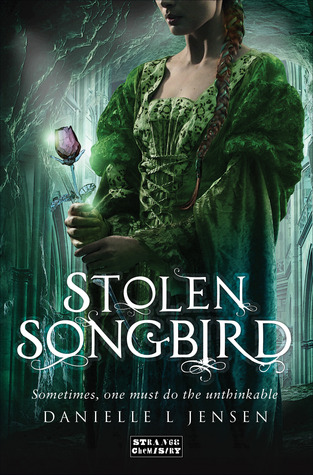
Review: Stolen Songbird

Stolen Songbird by Danielle L. Jensen
April 2014 by Strange Chemistry
469 pages--Goodreads

For five centuries, a witch’s curse has bound the trolls to their city beneath the ruins of Forsaken Mountain. Time enough for their dark and nefarious magic to fade from human memory and into myth. But a prophesy has been spoken of a union with the power to set the trolls free, and when Cécile de Troyes is kidnapped and taken beneath the mountain, she learns there is far more to the myth of the trolls than she could have imagined.

Cécile has only one thing on her mind after she is brought to Trollus: escape. Only the trolls are clever, fast, and inhumanly strong. She will have to bide her time, wait for the perfect opportunity.

But something unexpected happens while she’s waiting – she begins to fall for the enigmatic troll prince to whom she has been bonded and married. She begins to make friends. And she begins to see that she may be the only hope for the half-bloods – part troll, part human creatures who are slaves to the full-blooded trolls. There is a rebellion brewing. And her prince, Tristan, the future king, is its secret leader.

As Cécile becomes involved in the intricate political games of Trollus, she becomes more than a farmer’s daughter. She becomes a princess, the hope of a people, and a witch with magic powerful enough to change Trollus forever.


I will start off by saying that ending was so much not okay.  I need book two right now.  What do you mean book two wont be out for a year and then I have to wait a whole nother year for book three?!  GAHAHGadfjaoeiwnodainvpaofiahs.

Now that I've gotten that out, I will say that I loved Stolen Songbird.  It was not a perfect book and it is not a book for everyone, but I could not put it down.  With the exception of the 30 or 40 pages I read before going to bed, I read the whole 400+ pages in one day.  Had I started later in the day or had the book been longer, I would have needed to stay awake all night to finish it to find out what happened.

This is one of the very few times a romance has taken center stage in a plot without me objecting as I read.  With many, many romances I roll my eyes at how shallow the characters are and how uninteresting their story is, but I cared about this one a lot.  And the romance didn't detract from the other important things going on.  I really wanted Tristan and Cecile to get together, and at the same time I really wanted to figure out Tristan's political machinations.  And I wanted to find out whether the rebellion would work or fail miserably.  And I loved seeing how Cecile integrated herself into Troll society 

I also loved the minor characters.  Marc, Tips, even Anais, but especially the twins.  I loved Victoria and Vincent and their good natured competitions and Cecile's friendship with them.  Along with engaging characters, Jensen presents us with a rich world with complex political and social structures without infodumping.  We are given answers just a little bit at a time as Cecile learns things or figures them out.

Stolen Songbird reminded me a lot of The Hollow Kingdom but with more adventure and romance.  And endearing characters.  And pages.  Basically take everything I liked about The Hollow Kingdom and add more of it and you get Stolen Songbird.  I did not expect to love it so much.  It is not the right book for everyone, but it was the right book for me right now.  It's full of mystery and intrigue, and I need answers.  Do you hear me, Jensen.  I need book two now!

Wednesday, January 1, 2014

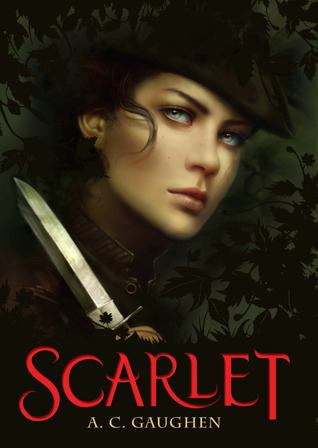
Review: Scarlet by A. C. Gaughen

Scarlet--A. C. Gaughen
February 2012 by Walker Children's
292 pages--Goodreads

Posing as one of Robin Hood’s thieves to avoid the wrath of the evil Thief Taker Lord Gisbourne, Scarlet has kept her identity secret from all of Nottinghamshire. Only the Hood and his band know the truth: the agile thief posing as a whip of a boy is actually a fearless young woman with a secret past. Helping the people of Nottingham outwit the corrupt Sheriff of Nottingham could cost Scarlet her life as Gisbourne closes in.

It’s only her fierce loyalty to Robin—whose quick smiles and sharp temper have the rare power to unsettle her—that keeps Scarlet going and makes this fight worth dying for.


Aaarg!!  This book was such a disappointment.  I wanted Scarlet to be an awesome adventure about the girl hiding in plain sight among the Merry Men.  I wanted to know where she came from and why she was hiding from Gisbourne and how she got so good at knife throwing and why she dressed up like a man and why she joined Robin's group and how she hid her identity from the world.  Basically I wanted an Alanna-esque character inserted into the Robin Hood mythology.

Of all the stories that didn't need a stupid, stupid love triangle!  This could have been such a good book with knife throwing and daring escapes and hangings.  But instead, we spent the whole book listening to Robin, John, and Scarlet angst about who would get together with whom, completely ignoring the more important and deadly things going on.  Yes, Alanna had a love triangle too, but the adventure and the fate of the kingdom always came first.  The external plot or internal non-romantic conflict in a novel will always be more interesting to me than romantic angst.

And the best part of the awful unnecessary romance:  Robin, who never said a word to John about sleeping around, calls Scarlet a "whore" for accepting a little comfort in a moment when she is scared and injured and in shock.  And his reason for doing this?  "Hurting you is the best way I know to punish myself."  What kind of messed up crap is that?!  That statement is so close to justification for domestic abuse, I can't believe it made the final cut into the novel.  We'll just log it away with Carosel's If-he loves-you-it-doesn't-hurt-when-he-hits-you message.

The slightly less annoying or unsettling problems in the novel include:

  • The trust timeline was unrealistic.  Scarlet had been working with Robin and company for almost two years before the book gets started, and she didn't trust them at all.  Then, once we finish the first few chapters, she suddenly trusts them.  Because reasons.
  • Robin needs to be an adult.  Otherwise, the myth loses a lot of its significance.  Robin has to be a man when he returns from the crusades to find his lands seized and his people starving.  You can't blame a mere boy for letting his people down, but Robin the man has to accept that responsibility.  If you're going to make Robin a teenager, you better have a very good reason for doing it, and angst is not a good enough reason.

Scarlet was so disappointing, and yet frustratingly addictive.  I couldn't stop reading, even though I didn't like it.  This book sullies the good name of Scarlet.  Go read a good Scarlet instead where Marissa Meyer proves that a romantic sub plot can enhance rather than completely derail the main plot.

Monday, December 30, 2013

Review: The Princess Curse by Merrie Haskell

The Princess Curse--Merrie Haskell
September 2011 by Harper Collins
328 pages--Goodreads

In the fifteenth-century kingdom of Sylvania, the prince offers a fabulous reward to anyone who cures the curse that forces the princesses to spend each night dancing to the point of exhaustion. Everyone who tries disappears or falls into an enchanted sleep.

Thirteen-year-old Reveka, a smart, courageous herbalist’s apprentice, decides to attempt to break the curse despite the danger. Unravelling the mystery behind the curse leads Reveka to the Underworld, and to save the princesses, Reveka will have to risk her soul.


The Princess Curse mashes-up  "The 12 Dancing Princesses," "Beauty and the Beast," and "Hades and Persephone" while also telling its own story.  Reveka is an awesome protagonist (even though I'm not entirely sure how to pronounce her name).  Her snarky disrespect is rather funny.  She's likable without being perfect and flawed without being infuriating.  She's practical and capable and just fun to read about.

Some readers have an issue with Reveka's goal of entering a convent, but during the middle ages, convents were on of the few places people could dedicate their lives to something other than just working really hard to stay alive.  A convent would be the only place she could become a master herbalist.  Also, I love how Reveka uses herbology (**SPOILER** and awesome underworld powers) to save the day.   

I wish we could have seen more of the underworld.  And dragons.  The fact that dragons were in this book needed to be more heavily advertised. 

The Princess Curse is a quick, enjoyable, curl up on the couch with cocoa read.  It left me longing for more (sequel? hopefully? write it please!).  This makes the second Christmas in a row I've read a fairy tale retelling.  TRADITION!!!!!!!!

Tuesday, December 24, 2013

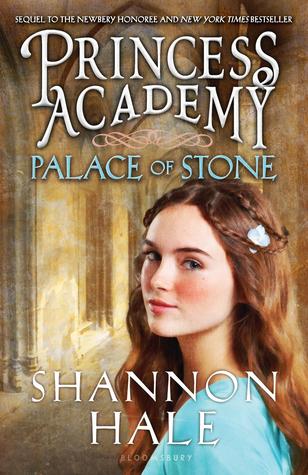
Review: Palace of Stone by Shannon Hale

Palace of Stone--Shannon Hale
August 2012 by Bloomsbury USA
323 pages--Goodreads

Coming down from the mountain to a new life in the city is a thrill to Miri. She and her princess academy friends have been brought to Asland to help the future princess Britta prepare for her wedding.There, Miri also has a chance to attend school-at the Queen's Castle. But as Miri befriends students who seem sophisticated and exciting she also learns that they have some frightening plans. Torn between loyalty to the princess and her new friends' ideas, between an old love and a new crush, and between her small mountain home and the bustling city, Miri looks to find her own way in this new place.


When I heard that Shannon Hale was publishing Palace of Stone, my first thought was "No; Princess Academy's story is complete.  It does not need a sequel.  A sequel would diminish the story that already exists."  I still hold that position, but Palace of Stone isn't a sequel, weird as that sounds.  Yes, it takes place in the same world with the same characters, but it's not a sequel.  Rather than stretching the Mount Eskel story beyond what it has material for, Palace of Stone is its own story.  Hale explores new situations and new locations while holding onto the characters and spirit we love from the first book.

The political situation is excellently crafted.  Hale poses complicated situations that I think her younger readers will miss the nuances of, but I love them.  We Americans tend to be a overly gung-ho in support of revolutions, but Hale asks the hard questions.  Is it better to support the stability of a bad ruler while some people starve, or to incite rebellion which may improve things or may lead to complete anarchy and widespread starvation and violence?  This part of the plot is wrapped up a bit too easily and neatly, but Miri faces the issue's complexity enough that I'll take it.

Hale even makes a love triangle work!  This is no "Team Edward/Team Jacob" clone thrown in to garner sales from angsty teenage girls or to cover up lack of substance elsewhere in the plot. The triangle is used more as an external representation of Miri's torn allegiance between the familiarity of home and the excitement of new experiences in Asland, which is a much more interesting tension than a romantic one.

I love the characters; I love the world; I love the plot;  I love Hale's writing style.  Palace of Stone was exactly what I needed after a massive disappointment from a different book.

Sunday, December 1, 2013

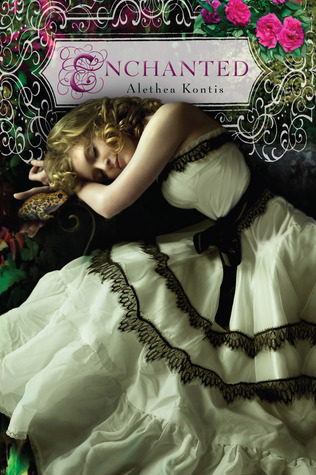
Review: Enchanted by Alethea Kontis


Enchanted--Alethea Kontis
May 2012 by Harcourt's Children's Books
308 pages--Goodreads

It isn't easy being the rather overlooked and unhappy youngest sibling to sisters named for the other six days of the week. Sunday’s only comfort is writing stories, although what she writes has a terrible tendency to come true.

When Sunday meets an enchanted frog who asks about her stories, the two become friends. Soon that friendship deepens into something magical. One night Sunday kisses her frog goodbye and leaves, not realizing that her love has transformed him back into Rumbold, the crown prince of Arilland—and a man Sunday’s family despises.

The prince returns to his castle, intent on making Sunday fall in love with him as the man he is, not the frog he was. But Sunday is not so easy to woo. How can she feel such a strange, strong attraction for this prince she barely knows? And what twisted secrets lie hidden in his past - and hers?


I loved all the references to well known and less known fairy tales, but Enchanted  wasn't as strong a retelling as I had hoped.  

First, there was the instalove.  It just didn't work, even for a fairy tale.  Retellings are a way to explore things that are skimmed over in the original tale, particularly the romance.  For me, retellings have to expand on the romance and have the characters more realistically fall in love over a longer span of time, at least a little bit.  Instead, Sunday kept love-at-first-sighting.  And she just wasn't smart in some scenes.  Really, Sunday.  You wake up in a dress that is not yours in a place you've never been before in the arms of a man who was not there when you passed out, and you're not at all worried?  Not even a little bit?  Not even when you first wake up before you get your bearings and realize it's the prince?  Really?  Come on!  You should freak out at least a little bit.  And Rumbold, you took too many liberties in that scene.

That wasn't the only aspect of the story that wasn't fully developed.  The climax was rushed.  So many fairy tales were pushed into that one scene that I wasn't sure exactly what was going on.  And why was the family suddenly okay with Wednesday and Sunday involving themselves with the royal family?  Weren't they supposed to hate them?  

I did like the scene where Sunday and her father swapped stories.  Honestly, Papa needed to be a bigger part of the story.  Familial relationships are sadly neglected in these types of stories.  I would have loved to see more of the father-daughter relationship.  And there should have been more Saturday.

In the end, I think Enchanted's biggest problem was trying to tell to much story in not enough time.  It wasn't the retelling for me.

Monday, October 14, 2013

Review: A Tale Dark & Grimm by Adam Gidwitz

A Tale Dark & Grim--Adam Gidwitz
October 2010 by Dutton Juvinile
252 pages--Goodreads

In this mischievous and utterly original debut, Hansel and Gretel walk out of their own story and into eight other classic Grimm-inspired tales. As readers follow the siblings through a forest brimming with menacing foes, they learn the true story behind (and beyond) the bread crumbs, edible houses, and outwitted witches.

Fairy tales have never been more irreverent or subversive as Hansel and Gretel learn to take charge of their destinies and become the clever architects of their own happily ever after.


A Tale Dark and Grimm was a very quick read; I finished in two days.  It was fun to hop through some lesser-known fairytales, and Gidwitz does not Disney-ify them.  They stay creepy and gruesome and Grimm.  This book might be a bit much for young, young readers, but most 10 year olds would like it.

I loved the narrator.  He pops in frequently to urge you to make sure the children can't hear the next part because it's just too scary for them.  He also points out some of the huge logical fails that fairytale characters make, such as why would Gretel have to cut off her finger for it to work as a key.  This book is a tribute to the Grimm tales, but it is a tongue in cheek tribute.

I wish Gidwitz had done more to flesh out Hansel and Gretel.  Their characters were never really developed.  They started as caricatures and never moved far beyond that.  I get that Gidwitz wrote the book to explore the stories rather than to explore the characters, but I still would have appreciated a bit more depth.  I never felt like I knew Hansel and Gretel as people.

A Tale Dark and Grimm is a fun, quick read with a beautiful cover (I'm a sucker for silhouettes).  It's definitely worth a try for any fairytale lovers.

Sunday, October 6, 2013

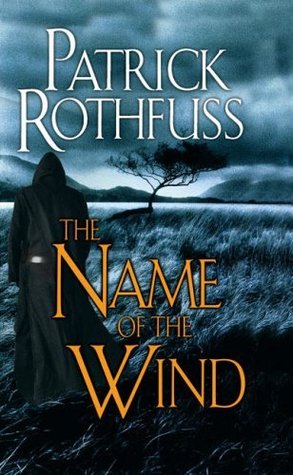
Review: The Name of the Wind by Patrick Rothfuss

The Name of the Wind--Patrick Rothfuss
March 2007 by DAW Hardcover
662 pages--Goodreads

Told in Kvothe's own voice, this is the tale of the magically gifted young man who grows to be the most notorious wizard his world has ever seen. The intimate narrative of his childhood in a troupe of traveling players, his years spent as a near-feral orphan in a crime-ridden city, his daringly brazen yet successful bid to enter a legendary school of magic, and his life as a fugitive after the murder of a king form a gripping coming-of-age story unrivaled in recent literature. A high-action story written with a poet's hand, The Name of the Wind is a masterpiece that will transport readers into the body and mind of a wizard.


The Name of the Wind was fine, but not amazing.  It has a nontraditional premise, and I congratulate Rothfuss for pulling it off.  I mean, how many authors could write a trilogy where the main character sits in an in and tells the story of his life for three days straight.  And that's it.  And the publishers buy it and readers give it some of the highest ratings I've ever seen on Goodreads.  

One of my biggest problems with the novel is Kvothe's obsession with Denna.  She's just dull.  If she wasn't such a big part of the book I could ignore her, but Kvothe keeps mooning over her and it gets very boring.  Seriously, Kvothe; stop moping about your crush and go learn magic.  Denna did show some more depth near the end of the novel, so maybe there's hope for book two.  I don't need her to be a great or even a good person, but I need her to be a real person with goals and motivations.  For now she's just a pretty face.  

It's a very slow burning novel.  Not boring, but not terribly exciting either.  I liked Kvothe's time in the forest and the city.  And I want to see more of the female loanshark.  She's a much more interesting character than Denna.  Why can't we spend more time with her?

So, it's good, but not the best book I've ever read.  I will get around to reading book two eventually, but I don't feel a driving need to finish the series now.  Especially since book three isn't out.

Monday, September 30, 2013

Review: William Shakespeare's Star Wars by Ian Doescher

William Shakespeare's Star Wars by Ian Doescher
July 2013 by Quirk Books
176 pages--Goodreads

Inspired by one of the greatest creative minds in the English language-and William Shakespeare-here is an officially licensed retelling of George Lucas's epic Star Wars in the style of the immortal Bard of Avon. The saga of a wise (Jedi) knight and an evil (Sith) lord, of a beautiful princess held captive and a young hero coming of age, Star Wars abounds with all the valor and villainy of Shakespeare’s greatest plays. ’Tis a tale told by fretful droids, full of faithful Wookiees and fearstome Stormtroopers, signifying...pretty much everything.

Reimagined in glorious iambic pentameter—and complete with twenty gorgeous Elizabethan illustrations--William Shakespeare’s Star Wars will astound and edify Rebels and Imperials alike. Zounds! This is the book you’re looking for.


To like this book, you need to be both a Shakespeare nerd and a Star Wars geek.  Being a fan of both, William Shakespeare's Star Wars was hilarious.  Doescher does an excellent job of re-scripting the story in Elizabethan English in a humorous rather than stuffy way.  The asides and soliloquies are great and the iambic pentameter never feels forced.  Doescher also weaves in quotes from Shakespeare here and there, my favorite being when Luke starts reciting the Saint Crispin's Day speech to inspire the rebels.

The action sequences are a bit boring to read since the Chorus just gives us a play by play, but there's no other way to make that work in the context of a play.  Shakespeare didn't give stage directions, so we need a character of the Chorus to say what happens.

William Shakespeare's Star Wars is a goofy sounding combination that hits the mark.  It's a loving parody of both source materials.  I'm looking forward to The Empire Striketh Back.

Tuesday, August 6, 2013

Mini Review: The Hero's Guide to Storming the Castle by Christopher Healy

The Hero's Guide to Storming the Castle--Christopher Healy
April 2013 by Walden Pond Press
477 pages--Goodreads

Prince Liam. Prince Frederic. Prince Duncan. Prince Gustav. You remember them, don't you? They're the Princes Charming who finally got some credit after they stepped out of the shadows of their princesses - Cinderella, Rapunzel, Snow White, and Briar Rose - to defeat an evil witch bent on destroying all their kingdoms.

But alas, such fame and recognition only last so long. And when the princes discover that an object of great power might fall into any number of wrong hands, they are going to have to once again band together to stop it from happening - even if no one will ever know it was they who did it.


I won a copy of The Hero's Guide to Storming the Castle in a giveaway from Walden Pond Press.  Thank you, thank you thank you.  This book is a lot of fun.


The characters reverte back to where they were at the beginning of the first book.  Frederick goes back to being a scardy-cat.  Liam loses his confidence.  Etc.  They do grow again, but I don't want them to start over at the beginning of each new book.  They could have kept their distinct personalities without losing all the progress they made in the first book.

I like the growth from Briar Rose.  In the first book, she was just a spoiled brat.  Now, she's starting to show that all she really wants is friendship; she just doesn't realize it yet.  I see a lot of potential for her in future books.  Lila is still the best.  I want a side book just about her adventures with Ruffian during her bounty hunter training.  Troll is even funnier this time around.  I love Gustav's nicknames for everyone, particularly Tassels for Frederick.

This series is just a whole lot of fun.  Clever in some places, like the henchman Redshirt who is thrown out a window a couple paragraphs after we meet him.  I can't wait for the next installment.  And we'll finish off the review with a couple more quotes, just for fun.

"The element of surprise can offer a hero great advantage in battle. The element of oxygen - also important."

"Some people say Rundark was born out of a mad alchemist's attempt to distill the essence of pure evil. others clam he emerged fully grown from an erupting volcano. although it's also possible that he was the son of a used cart salesman from Nebbish Villiage--they didn't keep very good records in Dar."

Monday, July 29, 2013

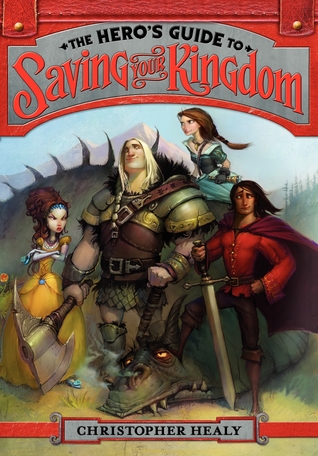
Mini Review: The Hero's Guide to Saving Your Kingdom by Christopher Healy

The Hero's Guide to Saving Your Kingdom--Christopher Healy
May 2012 by Walden Pond Press
419 pages--Goodreads

Prince Liam. Prince Frederic. Prince Duncan. Prince Gustav. You’ve never heard of them, have you? These are the princes who saved Sleeping Beauty, Cinderella, Snow White, and Rapunzel, respectively, and yet, thanks to those lousy bards who wrote the tales, you likely know them only as Prince Charming. But all of this is about to change.

Rejected by their princesses and cast out of their castles, the princes stumble upon an evil plot that could endanger each of their kingdoms. Now it’s up to them to triumph over their various shortcomings, take on trolls, bandits, dragons, witches, and other assorted terrors, and become the heroes no one ever thought they could be.


The Hero's Guide to Saving Your Kingdom is just a fun book.  It's a bit cheesy, but it's funny and cute.  It's a zany sort of slapstick adventure with some word play thrown in.  Saving Your Kingdom is 
long for a middle grade novel, but it clips along at a quick pace.  The characters are just great.  They're a bit one dimensional, but there's enough characters that you get a lot of variety.  Ella the adventurous, Frederick the timid, Lila the awesome.  Troll is a lot of fun, and I love Gustav's direct bullheadedness.

I don't have much else to say, so I'll just finish with some of my favorite quotes.

"Neville and Horace stopped and eyed them smugly through the bars.  Eyeing smugly was something the pair excelled in.  They'd actually shared the title of Best Smug Eyers in their graduating class at bandit school."

"The rooftop level of the Bandit King's castle had been constructed as a convenient spot from which the robbers could spill boiling oil down onto anyone who tried to break into their headquarters, but it also served as a nice place to have duels, and occasionally, to sunbathe." 

"This was not Liam's finest hour.  The frustrations of the past several days had been slowly eating away at him and muddying his mind.  On a normal day, had Liam been confronted by a fire-breathing dragon, he would have come up with a brilliant tactic for defeating the beast.  He would have lured the dragon into a tight spot to trap it, or maybe found some clever way to make the huge chandelier overhead fall down onto the monster.  But this day?  This day he decided to kick the beast in the tail and yell, 'Take that, dumb dragon!'
"The dragon, as you might suspect, was not impressed." 

"On still another road, a green-haired man wobbled by on peppermint-stick stilts, a fiery-plumed bird of paradise perched on his shoulder.  But he's not in this story, so don't pay any attention to him." 

Tuesday, May 21, 2013

Review: The False Prince by Jennifer A. Nielsen

The False Prince--Jennifer A. Nielsen
April 2012 by Scholastic
342 pages--Goodreads

THE FALSE PRINCE is the thrilling first book in a brand-new trilogy filled with danger and deceit and hidden identities that will have readers rushing breathlessly to the end.

In a discontent kingdom, civil war is brewing. To unify the divided people, Conner, a nobleman of the court, devises a cunning plan to find an impersonator of the king's long-lost son and install him as a puppet prince. Four orphans are recruited to compete for the role, including a defiant boy named Sage. Sage knows that Conner's motives are more than questionable, yet his life balances on a sword's point -- he must be chosen to play the prince or he will certainly be killed. But Sage's rivals have their own agendas as well.

As Sage moves from a rundown orphanage to Conner's sumptuous palace, layer upon layer of treachery and deceit unfold, until finally, a truth is revealed that, in the end, may very well prove more dangerous than all of the lies taken together.


The False Prince takes some time to get into.  It's not really a slow burning plot, it just takes some time to get used to Sage, our lovely narrator.  I like a snarky narrator.  Sage is not a snarky narrator.  He's just obnoxious.  He's stubborn and arrogant and, at times, kind of snotty.  He gets more likeable as the book goes on, but for the first few chapters, he's just irritating.  Once Sage tones down, we get to settle into an interesting plot with some good political machinations and scheming.  And secret passage ways.  And dagger wounds.

The plot twist is good, but I saw it coming.  Neilsen may have dropped too many hints or I may have read enough books that I know what to expect out of stories like this.  Either way, the twist left me feeling a bit betrayed.  This is a first person narrative; we're supposed to know everything that our main character knows.  That Sage pulls out all this secret information at the end of the book is cheating, even if it does make the climax more exciting.

I would have liked to see more development out of Conner.  We've got a guy who develops a complicated political scheme that requires delicacy and precision.  Neilsen could do so many cool things with a silver-tongued manipulator or misguided patriot.  Instead, Conner just ends up as the bad guy who is bad because the plot requires a villain in a stock character sort of way.  

Even as the beginning of a series, The False Prince can stand well as an independent novel.  And not that it matters much to the plot, but why would you name one of your villains Cregan when you could name him Kregan?  Come on!  The letter K is so much more aggressive looking.

LinkWithin

Related Posts Plugin for WordPress, Blogger...